San Juan del Sur: Vanderbilt's Shortcut to California
The name is a puzzle. San Juan del Sur means "southern San Juan," yet it lies further north than its sister town San Juan del Norte - "northern San Juan" - on the Caribbean coast. The explanation requires thinking like a 16th-century Spanish explorer: del Sur refers not to latitude but to the Mar del Sur, the "South Sea," which is what they called the Pacific Ocean. To deepen the confusion, the Nicaraguan town of San Juan de Oriente - "eastern San Juan" - sits further west than both of them. Geography and language have been cheerfully disagreeing here for five hundred years, and the town on its crescent bay seems perfectly content with the contradiction.
Cornelius Vanderbilt's Pacific Doorstep
In the 1840s, this fishing village entered world history for the most American of reasons: gold. When the California Gold Rush sent thousands scrambling west, the overland route across the continent was brutal and slow. Cornelius Vanderbilt saw a faster way. His Ruta del Transito began with an ocean liner from New York City to San Juan del Norte on the Caribbean coast. From there, passengers took a river cruise up the Rio San Juan and across Lake Nicaragua to the port of San Jorge. Then came a thirty-kilometer horse-carriage ride to San Juan del Sur, where another ocean liner waited to carry them to San Francisco. The entire route cut weeks off the alternative. For a brief, improbable period, this small Pacific harbor was one of the most important transit points in the Western Hemisphere - a place where East Coast fortune-seekers stepped off carriages and onto ships, leaving the jungles and volcanoes of Nicaragua behind for the goldfields of California.
The Bay and the Cross
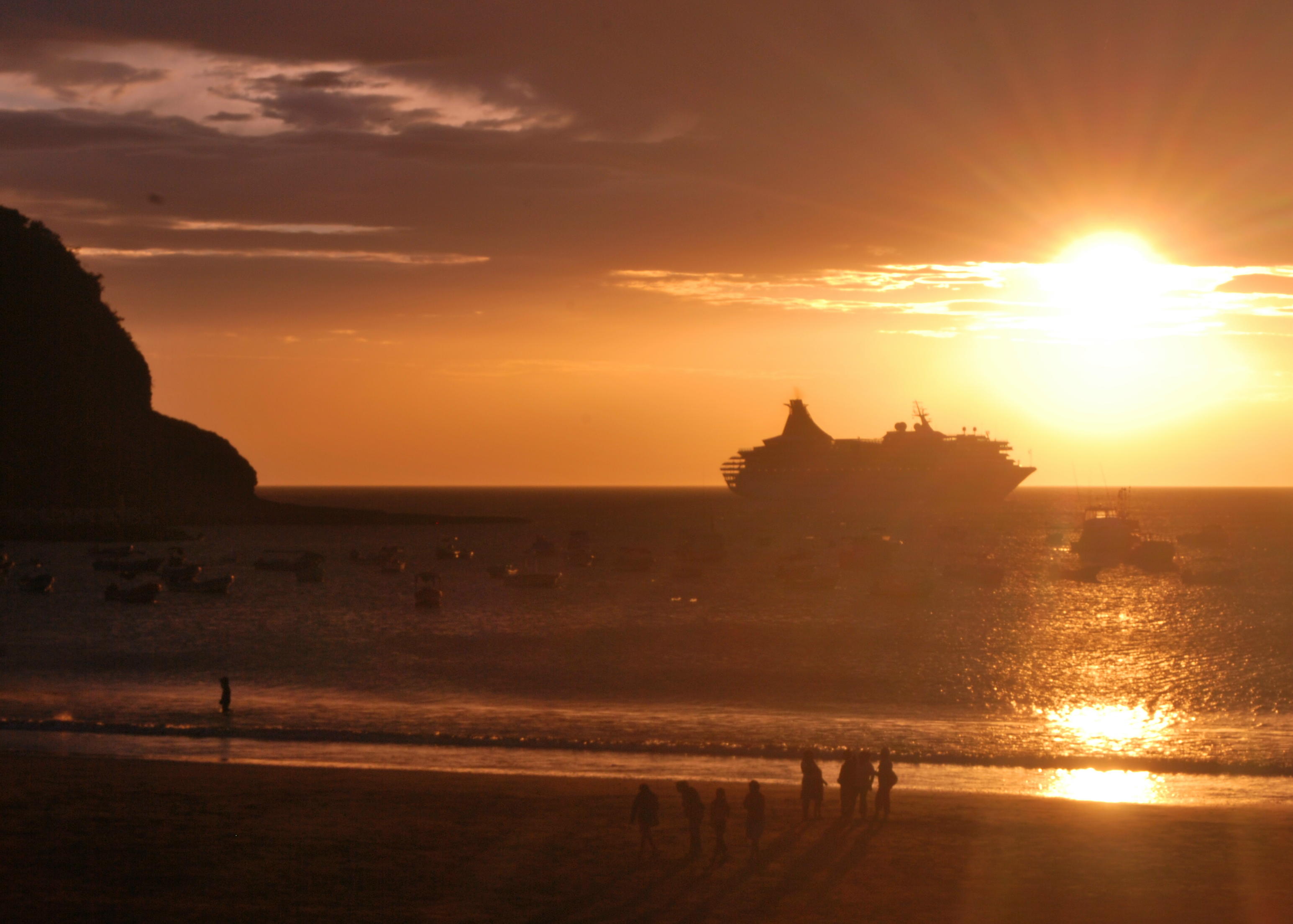
San Juan del Sur wraps around a crescent-shaped bay where small boats bob at anchor and pelicans swoop to perch on their bows. The town is compact enough that no matter where you stand, the beach is at most 500 meters away. The walk up to the cross overlooking the harbor takes a punishing twenty minutes of steep climbing, but the panoramic view from the top - the bay spreading below, the Pacific stretching to the horizon, fishing boats tracing slow arcs across the water - makes the effort worthwhile. Brightly painted houses cascade down the hillsides, landing on every tourist's camera. Beyond the town proper, dozens of remote beaches stretch north and south along the coast, where pounding surf meets dramatic rock formations. Some are accessible only by water taxi, lending them a seclusion that the main bay, with its waterfront restaurants and cruise ship visits, no longer has.
Surf, Rum, and Spider Monkeys
The culture of San Juan del Sur runs on a few simple fuels: waves, warmth, and Flor de Cana rum. The surrounding beaches offer excellent surfing, with breaks suited to different skill levels scattered along the coast. Playa Madera to the north is a half-hour water taxi ride or a bumpy cab journey where the driver may ask passengers to walk up the steeper hills. Beaches to the south, including Playa del Coco, are harder to reach but reward the effort with relative solitude. Between the surf sessions, the town encourages a certain productive laziness. Open-air restaurants along the waterfront serve fresh seafood. Zip-line canopy tours lift visitors into a forest canopy where spider monkeys swing through the branches. The pace is deliberately unhurried - the kind of place where the local advice for what to do can be honestly summarized as: hang out, talk, drink, eat.
Nicaragua's Only Pacific Port of Call
San Juan del Sur is one of only two cruise ports in all of Nicaragua, the other being Corinto further north along the Pacific coast. This distinction brings periodic waves of visitors who disembark for a few hours to sample the beach and the town's growing collection of shops and cafes. Rates for accommodations triple during Semana Santa - Easter week - and rooms book out fast. The rest of the year, you can reasonably expect to find a place to stay after two or three tries. Getting here requires either a three-hour drive from Managua's international airport or a two-and-a-half-hour drive from Liberia in Costa Rica, crossing the border at Penas Blancas. From the nearby city of Rivas, colectivo taxis run to San Juan del Sur for 35 cordobas per person, regardless of how many passengers the driver manages to squeeze in. The honest taxi drivers will tell you whether it is a colectivo before you climb aboard. The town serves as a base for exploring further afield: Isla de Ometepe, with its twin volcanoes rising from Lake Nicaragua, lies within reach, as do the colonial cities of Granada and Leon.
From the Air
Located at 11.254N, 85.872W on the Pacific coast of southwestern Nicaragua, in a crescent-shaped bay clearly visible from altitude. The town sits at the end of a road from Rivas, approximately 30 km from the Pan-American Highway. The bay's horseshoe shape with surrounding hills makes it highly recognizable from the air. Nearest major airport: Augusto C. Sandino International Airport (MNMG) in Managua, about 140 km north. Daniel Oduber Quiros International Airport (MRLB) in Liberia, Costa Rica is roughly 130 km south. Best viewed at 3,000-5,000 feet; the coastline features numerous bays and beaches both north and south. Lake Nicaragua and the twin cones of Ometepe are visible to the northeast as major landmarks.