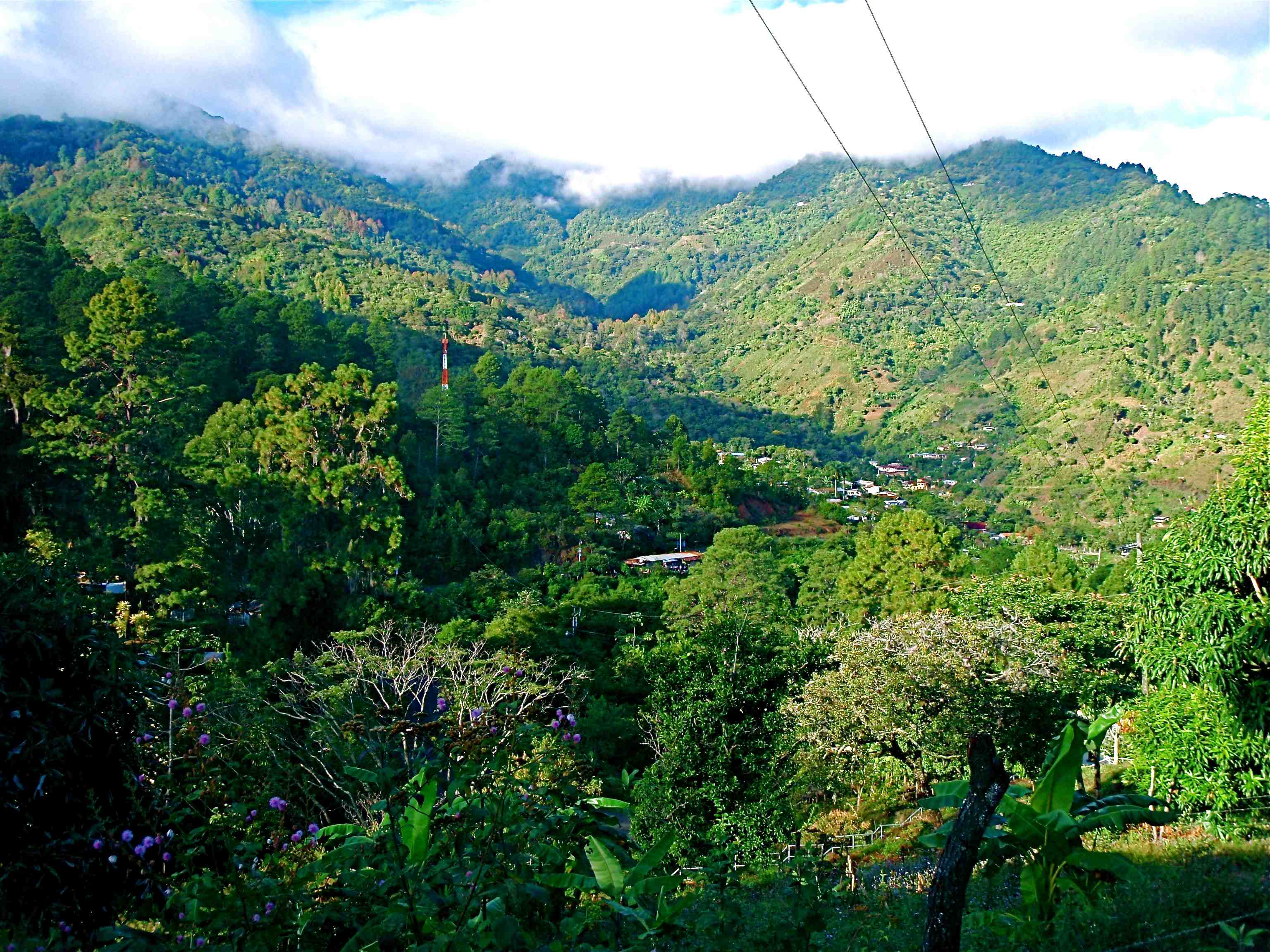
San Juancito, Honduras
The first light bulb in Honduras flickered on here. So did the first cinema in Central and South America, the first telegraph in the country, and the first Pepsi bottling plant in Central America. All of it happened not in Tegucigalpa, not in San Pedro Sula, but in San Juancito -- a mining town perched at over 1,200 meters in the mountains of Francisco Morazan, 40 kilometers northeast of the capital. By the early twentieth century, San Juancito's population had swelled to 44,000, roughly matching Tegucigalpa itself. Today, about 1,400 people live here. Its central neighborhood still appears on the back of the 500-lempira bill, a reminder of the wealth that once flowed through these mountains.
Silver Veins and a President's Gamble
Long before the Spaniards arrived, the Tolupan people mined these mountains on a small scale. The Spanish tried their hand in the sixteenth century, but disease and brutal working conditions devastated the indigenous labor force, and the colonizers moved on to other sites. The mountains kept their riches for three more centuries. In 1880, President Marco Aurelio Soto advertised San Juancito's mineral wealth to attract foreign capital. Julius Valentine of New York City took the bait, founding the New York and Honduras Rosario Mining Company and exchanging half the company's stock for mining rights to the El Rosario deposits -- rights that Soto himself owned. The arrangement may have helped motivate the relocation of Honduras's capital from Comayagua to Tegucigalpa that same year, driven less by social scandal than by the president's business interests and the development of southern Honduras.
A Company Town Above the Clouds
Between 1880 and 1954, the Rosario Mining Company extracted gold and silver destined overwhelmingly for the United States. By 1888, the mines were the most powerful economic interest in Honduras. The company imported heavy machinery, won timber and water rights across the countryside, and used those water rights to build the country's first hydroelectric plant. Technology arrived in San Juancito before it reached anywhere else in the nation. Life in the town was sharply segregated: foreign staff lived in an established camp near the mining headquarters, while the Honduran majority lived below in San Juancito proper. Schools, dance halls, sporting clubs, even graveyards -- everything was divided. An American Consulate operated at over 1,600 meters above sea level. Honduran miners were well paid by local standards and had access to company-built schools and a hospital, but the benefits existed within a rigid hierarchy that left little ambiguity about who held power.
The Exodus and the Storm
In 1954, the minerals ran out. A national labor movement was gaining force, and the company had already begun developing new operations at El Mochito in Santa Barbara. When the Rosario Mining Company left, most of San Juancito's population left with it -- the mines had been the sole major employer in the region. The town shrank from tens of thousands to a fraction. In 1980, Honduras declared La Tigra as the nation's first national park, and San Juancito found itself within the buffer zone at one of the park's two entrances. Mine tunnels and old railworks now sit inside the park's core zone, surrounded by regenerating forest. Then came October 30, 1998, and Hurricane Mitch -- the deadliest natural disaster in Honduras's modern history. Cascading floodwaters from the town's two rivers destroyed roughly 60 buildings. NGOs arrived to rebuild, and many residents relocated to El Plan, a small mesa safely above the river. The skeletal remains of some hurricane-damaged structures are still visible today.
Cloud Forest and Quetzals
San Juancito sits in a verdant amphitheater backed by the three highest peaks in the department: Cerro La Estrella at 2,245 meters, Cerro El Volcan at 2,270 meters, and Cerro La Pena de Andino at 2,290 meters. Subtropical moist forest transitions into cloud forest as you enter La Tigra National Park, whose boundary lies just 2.5 kilometers from the town center at the hamlet of Nuevo Rosario. The park shelters over 200 bird species, including the resplendent quetzal. Pumas, ocelots, and reclusive monkeys inhabit the deeper forest. Ferns, bromeliads, and hundreds of epiphytic species cling to every surface where clouds infiltrate the canopy. Since the mines closed, reforestation has reclaimed previously barren mountainsides, turning the scars of extraction into dense green slopes.
Coffee, Art, and Quiet Persistence
Today's San Juancito runs on coffee. The altitude and climate produce high-quality beans, and COMISAJUL, a cooperative of several hundred small farmers, operates from town. Small plots of potatoes, bananas, guava, and corn fill the surrounding hillsides. In the renovated Pepsi bottling plant building -- itself a relic of the mining era -- the San Juancito Foundation runs an art workshop staffed mostly by women, producing paper, metal, and glass artwork sold at a gallery in Tegucigalpa. The foundation, created by Honduran artist Regina Aguilar, also runs La Escuela Magica, a free art education center for local children. San Juancito sees very few tourists, being the more remote of La Tigra's two entrances, but a paved road has connected it to Tegucigalpa since 2003. The town that once lit up before any other place in Honduras now keeps a quieter kind of flame.
From the Air
Located at 14.22N, 87.07W at approximately 1,239 meters (4,027 feet) elevation in the mountains northeast of Tegucigalpa. The town sits within the buffer zone of La Tigra National Park, visible as a small settlement in a mountain amphitheater backed by peaks exceeding 2,200 meters. Nearest major airport is Toncontin International (MHTG) in Tegucigalpa, roughly 40 km to the southwest. Approach from the south for best views of the cloud-forest-covered ridgeline.