San Marcos, California
The story of how San Marcos got its name involves a cattle theft. In the late 18th century, a small band of Native Americans reportedly stole livestock from the Mission San Luis Rey flocks and fled into the hills. Spanish soldiers pursuing them in 1797 came upon a fertile valley on April 25 — the feast day of Saint Mark. They named it Los Vallecitos de San Marcos: the Little Valleys of Saint Mark. The name simplified over the following century into San Marcos, and the city that grew from those valleys now has a population of 94,833 people, two major institutions of higher education, and a light rail line connecting it to the rest of North County San Diego.
From Rancho to Railroad Town
Governor Juan B. Alvarado granted Rancho Vallecitos de San Marcos to his relative, José María Alvarado, in 1840. Alvarado was killed at the Pauma Massacre in 1846, and the land passed to his widow, who sold it. Eventually Cave Johnson Couts, the Tennessee-born West Point graduate who was acquiring substantial properties across North County, acquired part of it.
The first permanent settlement arrived when Major Gustavus French Merriam from Topeka, Kansas, homesteaded 160 acres in the Twin Oaks Valley and began wine and honey production. German and Dutch immigrants followed in the early 1880s. In 1883, a few miles south, John H. Barham — for whom Barham Drive is named — founded the first formal town, complete with a post office, blacksmith, feed store, and weekly newspaper. The Santa Fe Railroad's arrival in 1887 reorganized everything: the tracks were laid a mile from both Barham and the original San Marcos townsite, forcing two successive relocations. By 1903, the people of San Marcos literally moved their homes east along the rail line to the intersection of Mission Road and Pico Avenue.
Water and Growth
San Marcos's modern expansion has a precise starting point: 1956, when the first water from the Colorado River arrived. Before that delivery, the valley's agricultural water supply limited how many people could practically live there. After it, the city grew rapidly — to 2,500 in the late 1950s, to 17,479 by 1980, past 30,000 in 1990, and approaching 100,000 by 2020. The city incorporated on January 28, 1963, during a period when San Diego County's coastal valleys were filling with people drawn by the post-war California promise of space, sunshine, and affordable housing.
San Marcos has a total area of 24.4 square miles. Its climate is typical of inland North County: Mediterranean, moderated by Pacific marine influence, with cool overcast in May and June giving way to dry summer heat, the occasional Santa Ana wind, and rainfall concentrated between November and March.
Two Colleges and a P on the Hill
San Marcos is, above all, a college town — or rather a city with two colleges that shape its character in different ways. Palomar College occupies a main campus of 200 acres in northern San Marcos, enrolling about 30,000 full- and part-time students in more than 250 associate degree and certificate programs. The giant letter P on the hillside above campus is one of the city's most recognized landmarks, visible from miles in every direction. California State University San Marcos, founded in 1989 on a 304-acre hillside in the southeastern part of the city, enrolls about 14,000 students and offers 44 undergraduate programs, 10 graduate programs, and a doctorate in education.
The presence of these two institutions gives San Marcos a demographic and economic character different from its North County neighbors. SPRINTER light rail stops at both campuses, connecting them to Escondido and Oceanside. High Tech High, a nationally recognized charter school network, operates in San Marcos as well, at a campus across from San Marcos High School.
Landmarks and Identity
San Marcos has the kind of local landmarks that accumulate in communities where people have lived for generations. An illuminated cross on a hill above Lake San Marcos is visible at night from many parts of the city. The Williams Barn, a community center and reception hall built in 1952 to look like a big red barn, sits in Walnut Grove Park in Twin Oaks alongside a collection of historic houses maintained by the San Marcos Historical Society.
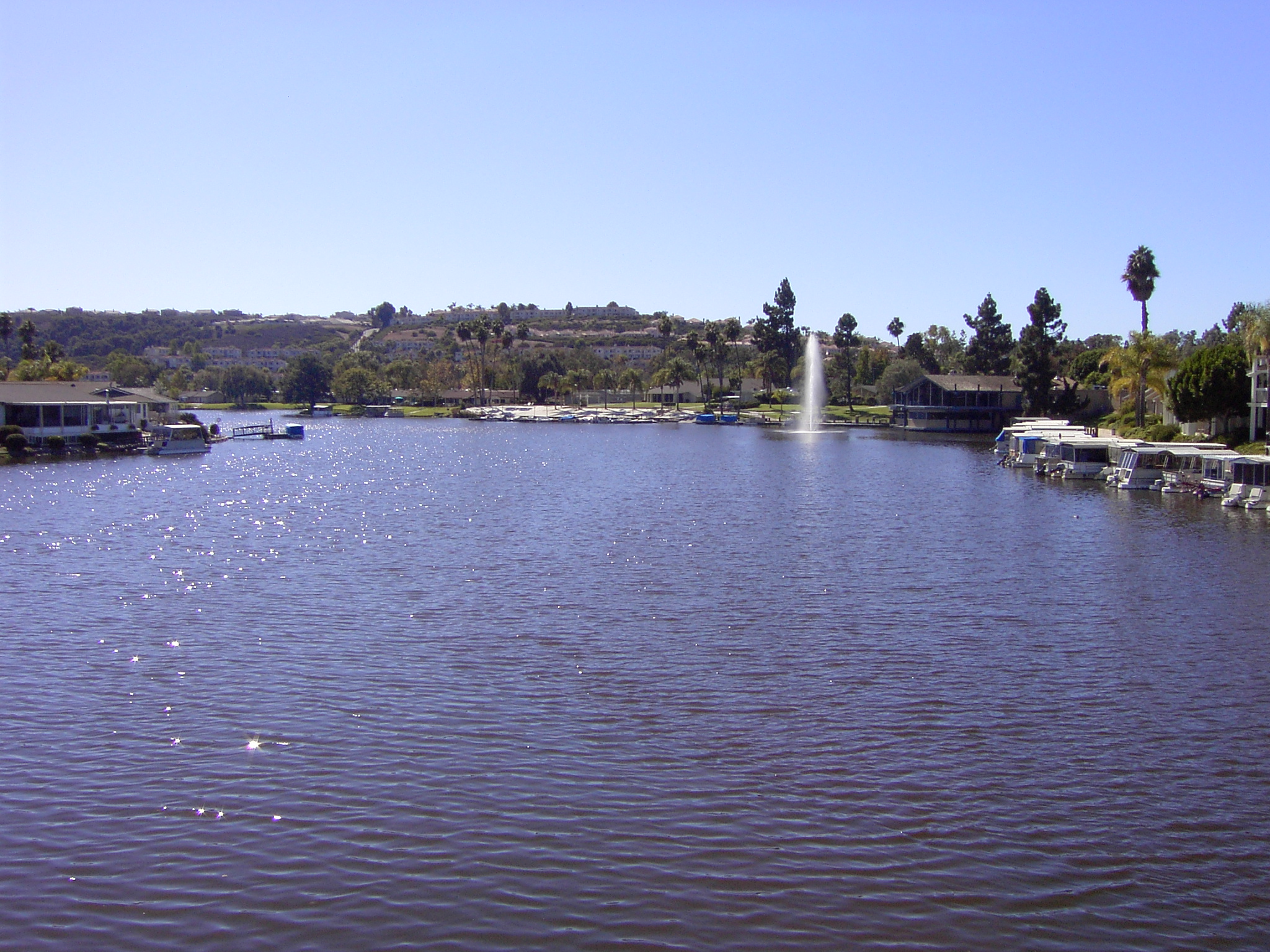
Lake San Marcos is a county island — an unincorporated enclave within the city's boundaries — a geographic quirk that reflects the complicated way municipal boundaries were drawn in mid-20th-century California. Stone Brewing, one of the most influential craft breweries in the country, was founded in San Marcos in 1996 before expanding its footprint to multiple locations. The city that Spanish soldiers named for a saint on a cattle-chasing mission has become something rather different: a dense, diverse, transit-connected community that sits at the educational and economic heart of North County.
From the Air
San Marcos, California sits at approximately 33.14°N, 117.17°W in the North County interior, east of Carlsbad and west of Escondido. From altitude, the city is visible as a dense suburban development in the coastal foothills, with the CSUSM campus identifiable on a hillside in the southeast. The large 'P' on the hillside above Palomar College is a landmark. McClellan-Palomar Airport (CLD) is approximately 5 miles to the northwest. Best viewed at 4,000-6,000 feet AGL.