San Marcos de Apalache Historic State Park
Five flags have flown over this muddy spit of land where the Wakulla and St. Marks rivers merge and empty toward Apalachee Bay. In 1679, Spanish Governor Pablo de Hita y Salazar ordered a fort built at this strategic confluence, and the men who raised it coated their logs with lime so the walls would gleam white and look like stone from a distance. It was a bluff in every sense. Within two years, pirates burned the fort and looted what remained. Yet the Spanish came back, and so did the British, the Creek Indians, Andrew Jackson's soldiers, the Confederacy, and finally the Union. San Marcos de Apalache changed hands more times than nearly any fort in North America, and each new flag planted here rewrote the story of Florida itself.
Three Forts, Three Centuries
The first wooden stockade lasted barely two years before pirates reduced it to ash in 1681. In 1719, Spanish Captain Jose Primo de Ribera arrived to try again, raising a second wooden fort on the same ground. Twenty years later, in 1739, the Spanish finally began building in stone, determined that this fort would endure. They never finished it. The Seven Years' War ended Spanish control of Florida in 1763, and Britain took possession of a half-completed fortress. Spain returned in 1787 and held it for another thirteen years, but by then the fort had become less a stronghold than a revolving door. The remains of that stone construction are still visible today, low walls and foundations standing among the live oaks where three centuries of soldiers once kept watch over the river.
The Adventurer Who Seized an Empire
In 1800, a former British officer named William Augustus Bowles led roughly 400 Creek Indians in a surprise attack and captured the fort. Bowles had a flair for the dramatic: he had already declared himself Director General of the State of Muskogee, a short-lived Creek and Seminole nation he conjured into existence as a buffer against both Spain and the United States. From San Marcos, he controlled the river trade and defied Spanish authority. It lasted five weeks. A Spanish flotilla sailed up the coast, recaptured the fort, and eventually Bowles was arrested and sent to a prison in Havana, where he died in 1805. His stolen empire dissolved, but the episode proved what everyone already knew: whoever held this river junction held the key to northwest Florida.
Jackson, Yellow Fever, and the Hospital on the Ruins
General Andrew Jackson seized the fort in 1818 during the First Seminole War, part of a campaign that would eventually force Spain to cede all of Florida to the United States in 1821. For the next two decades, American troops garrisoned the site. Then, in 1857, the federal government built a marine hospital directly on top of the old Spanish fortifications, recycling the fort's stone blocks into the new structure's walls. The hospital treated sailors and soldiers suffering from yellow fever, the disease that ravaged Gulf Coast ports every summer. Today, the park's museum and visitor center stand on the hospital's original foundations. A reconstructed stone well and retaining wall nearby, rebuilt from archaeological evidence, are the only hints of the layered history buried underfoot.
The Last Flag
When Florida seceded in 1861, Confederate troops occupied the site and renamed it Fort Ward. A Union naval squadron blockaded the mouth of the St. Marks River for the duration of the war, sealing off this once-vital corridor. In 1865, U.S. forces regained control, and the fort's long military career finally ended. The site slipped into private ownership for a full century. It was not until the 1960s that the State of Florida purchased the land and established the park. In 1966, the fort area was designated a National Historic Landmark, and it was added to the National Register of Historic Places and recognized as a National Engineering Landmark. The park also appears on the Florida Native American Heritage Trail, acknowledging the Apalachee people whose name the fort carried across three centuries of colonial conflict.
Where the Rivers Converge
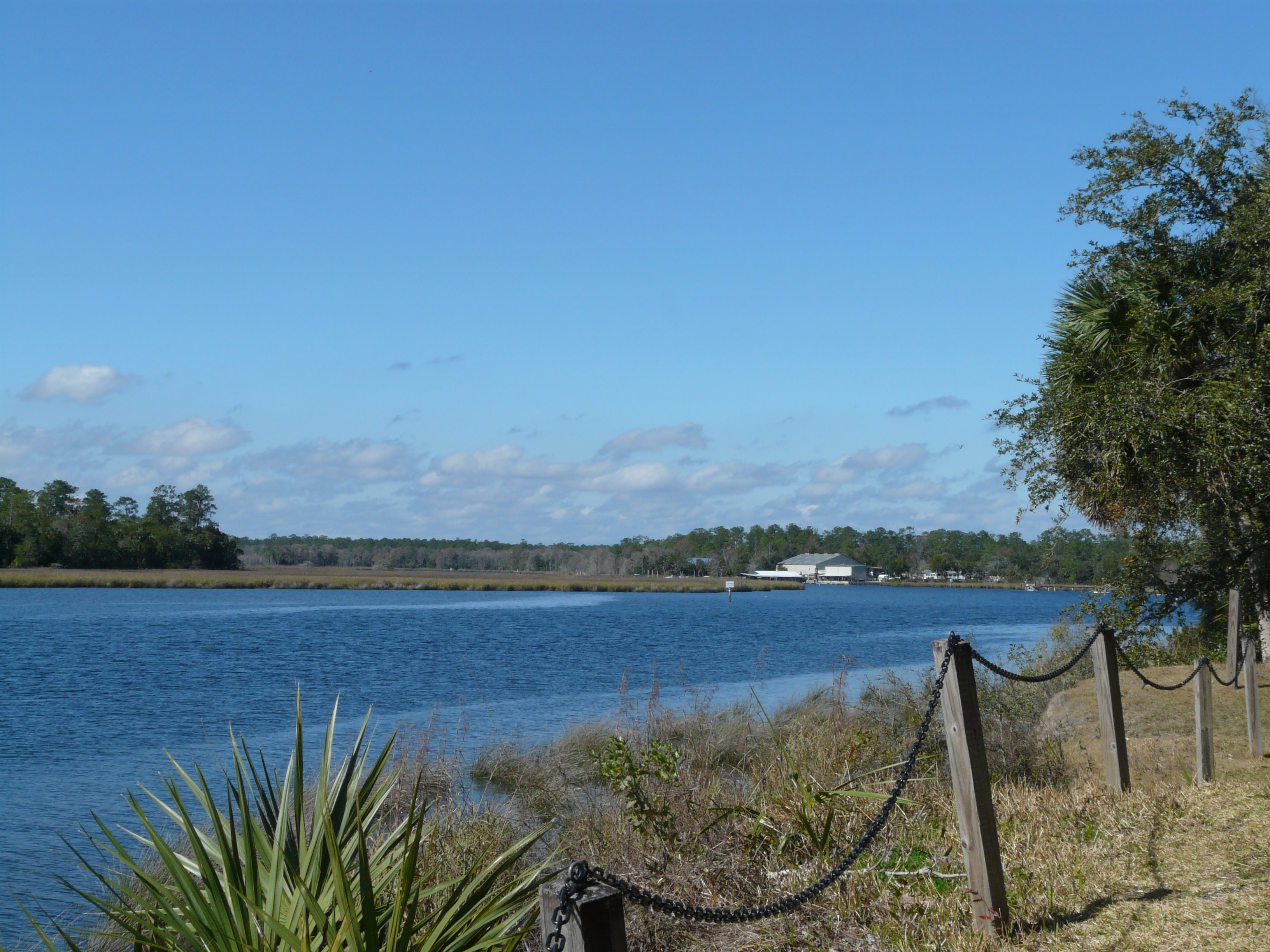
Stand at the point where the Wakulla and St. Marks rivers meet, and the view opens south toward the Gulf. Ospreys circle overhead. Mullet break the surface. The water is dark with tannins, stained by the cypress swamps upstream. It is easy to see why every colonial power wanted this spot. The rivers provided both a highway into the interior and a natural moat for defense. The park's trails wind through the surrounding woods and along the riverbanks, passing the old military cemetery where markers date to 1818 and 1819. The gravestones are modest, the names mostly forgotten, but they represent the human cost of a place that spent three hundred years as a prize fought over by empires that have themselves become history.
From the Air
San Marcos de Apalache Historic State Park is located at 30.155N, 84.211W in Wakulla County, Florida, at the confluence of the Wakulla and St. Marks rivers near the town of St. Marks. From the air, look for the distinctive Y-shaped river junction where two dark-water rivers merge before flowing south toward Apalachee Bay. The park and fort ruins sit on the point between the two rivers. Nearest airport: Tallahassee International (KTLH), approximately 20nm north. Best viewed at 1,500-2,500 feet AGL to appreciate the river confluence and surrounding marshlands.