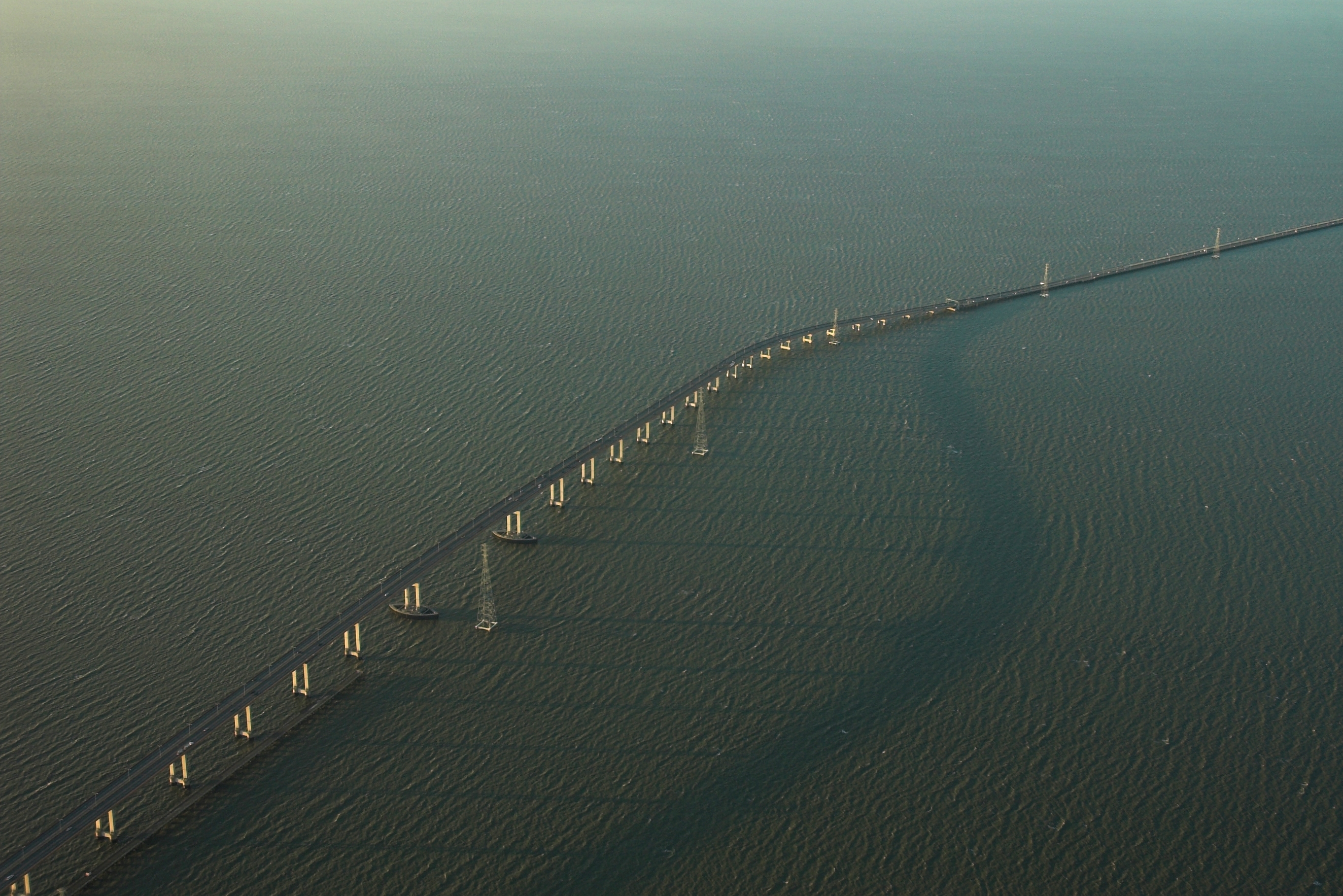
San Mateo-Hayward Bridge
In April 1930, Stanford students stole the Stanford Axe back from Cal. The getaway car was presumed to be heading across the San Mateo Bridge, the shortest route back to Palo Alto. Pursuing Cal students gave chase. But the drawbridge operator on duty happened to be a Stanford graduate student. When he learned that Cal students were causing the traffic surge, he raised the draw and stopped all traffic. The Stanford students, meanwhile, were driving home via San Jose. The bridge had served as a decoy without even trying.
The Longest Bridge in the World
The original San Mateo-Hayward Bridge opened on March 2, 1929, after about a year of construction. It was a privately owned venture and was, at the time, the longest bridge in the world. The San Francisco Bay Toll-Bridge Company had issued 4.5 million dollars in bonds to help fund the estimated 7.5 million dollar budget. The bridge incorporated a vertical lift span over the main shipping channel. Despite favorable initial press, daily traffic never exceeded 2,000 cars per day until 1947. The bridge lost money in its first year of operation, a reminder that visionary infrastructure does not always align with immediate demand.
Engineering Firsts
The modern bridge, which replaced the original starting in the 1960s, was a showcase of engineering innovation. It was the first large-scale use of an orthotropic deck, a design that reduces weight and seismic loading. Its main span, at 750 feet, was the longest girder span in the United States at the time of construction. The bridge also pioneered the use of epoxy asphalt concrete as a wearing surface. Murphy Pacific Marine built a custom floating barge-crane called the Marine Boss in 1966 to perform heavy lifts of prefabricated box girders and deck sections from a Richmond fabrication yard. That crane, later renamed the Weeks 533, went on to perform some of the most famous heavy lifts in American history, including moving the Concorde and the Space Shuttle Enterprise onto the Intrepid Sea, Air and Space Museum and recovering the downed hull of US Airways Flight 1549 from the Hudson River.
Seven Miles Across the Bay
The completed bridge stretches seven miles, divided between a 1.9-mile western highrise section and a 5.1-mile eastern trestle. It carries State Route 92 across San Francisco Bay, linking Foster City on the San Francisco Peninsula with Hayward in the East Bay. High-voltage power lines built by PG&E in the 1950s parallel the bridge across the entire Bay, providing power to the Peninsula and San Francisco. The bridge underwent extensive seismic retrofitting from 1997 through 2000 after being temporarily closed following the 1989 Loma Prieta earthquake. A second trestle for westbound traffic, completed in 2002, finally relieved what had been considered the worst evening commute in the Bay Area.
The Ten-Dollar Pier
When the new bridge was built, the old one was demolished, but San Mateo County purchased the western approach of the original 1929 bridge for the nominal sum of ten dollars. The remnant, known as Werder Pier, served for decades as a fishing pier extending into the Bay. By 2015, after years of structural degradation from marine exposure, the pier was closed and the site was dedicated as Bridgeview Park. The transformation from bridge remnant to parkland completed yet another chapter in the structure's century-long story of reinvention.
From the Air
The San Mateo-Hayward Bridge is located at 37.59°N, 122.24°W, crossing San Francisco Bay between Foster City and Hayward. At 7 miles long, it is one of the most prominent visual features of the Bay from altitude. San Carlos Airport (KSQL) is approximately 3 miles southwest of the western terminus. Hayward Executive Airport (KHWD) is approximately 5 miles east of the eastern terminus. The bridge runs roughly parallel between the Bay Bridge and the Dumbarton Bridge.