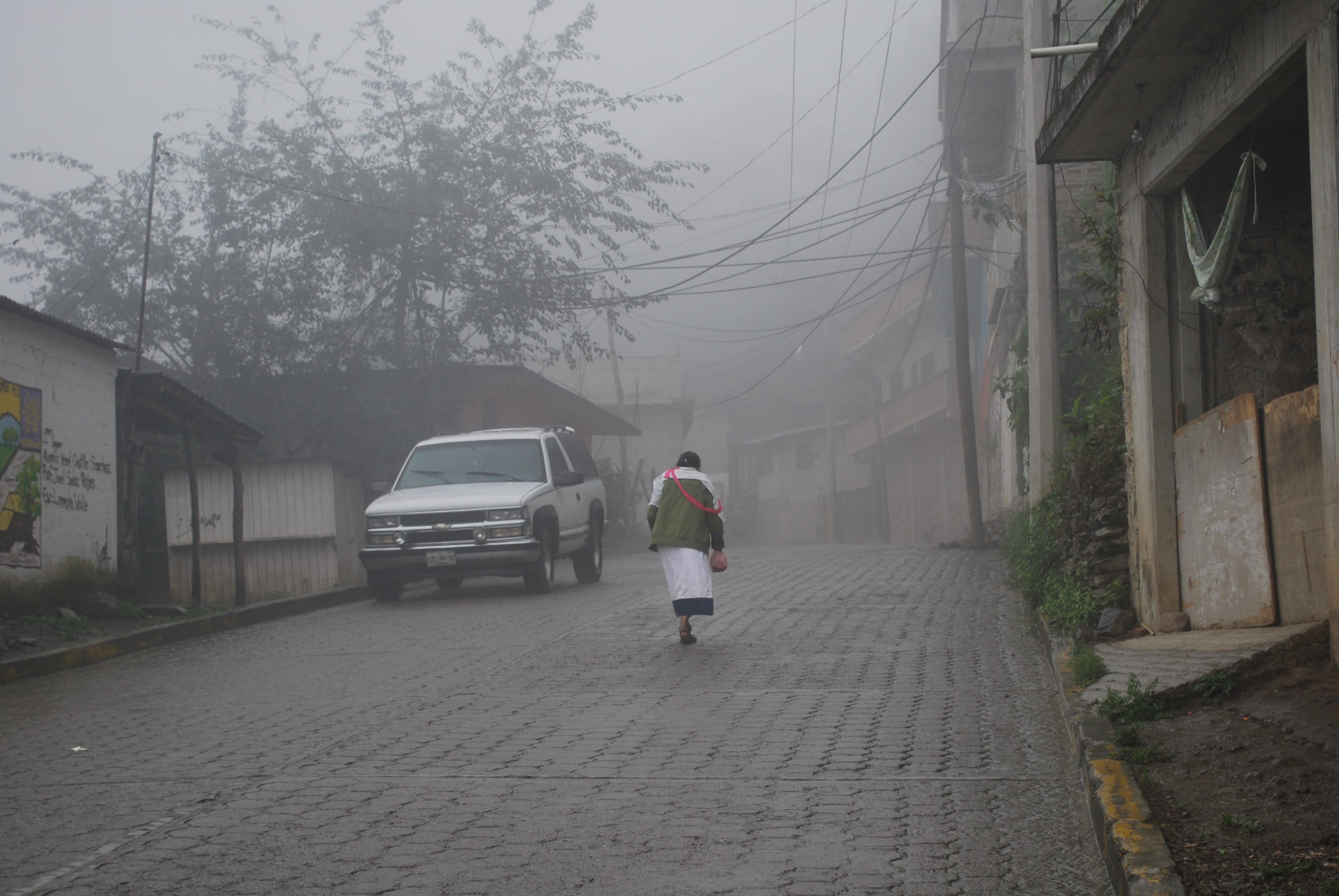
San Pablito, Puebla
Before 1978, there was no road to San Pablito. The only way to reach this Otomi village on the flanks of Guajalote Mountain in the Sierra Norte de Puebla was a steep path by foot or horse. That isolation preserved something extraordinary: a papermaking tradition stretching back centuries before the Spanish arrived. The bark paper is called amate, and for generations only shamans were permitted to make it for ritual use. Today, roughly 6,000 Otomi people in and around San Pablito produce amate commercially -- soaking bark, pounding fibers into sheets, and laying them in the sun to dry. The craft has transformed a village that outsiders once could not find into a small town that trades with the world.
Witches' Paper
Amate paper was sacred before it was commercial. Shamans made it for ceremonies tied to agriculture, healing, and spiritual protection, and its manufacture was restricted to these ritual specialists. For this reason, locals still call it papel de brujos -- witches' paper. Figures cut from amate carry meaning in their details: those representing evil wear shoes, as Europeans and mestizos do, while those representing good go barefoot, like indigenous peoples. Even today, shamans in San Pablito and neighboring Otomi communities control the ritual use of the paper, though its commercial production has long since passed to the broader community. Shamans from other villages once preferred paper made in San Pablito because it was considered more powerful. The traditional medicine that accompanies these rituals divides sickness into two types: illnesses that respond to herbs or modern medicine, and spiritual afflictions that require shamanic intervention to restore harmony between a person and the universe.
The Mountains That Protected a Culture
The Otomi people of this region originally allied with the Spanish against the Aztecs, then quickly turned against their new rulers. The rugged terrain of the Sierra Norte made Spanish enforcement difficult. The valley held no significant mineral wealth, so colonists saw little reason to settle there. Parish churches came late, and evangelization met fierce resistance. The result, centuries later, is a community that blends Catholic and indigenous beliefs in ways that remain distinctly Otomi. Paper ceremonies persist alongside church services. Traditional dress endures: women wear embroidered blouses under a poncho-like garment called a quezquemetl, white with wide purple or red trim, folded onto the head when the sun is strong. Men wear plain cotton with macrame-fringed belts and ixtle fiber bags. The road that finally connected San Pablito to the outside world was paved only in the mid-1990s. Even now, the town carefully guards the details of how its paper is made -- from outsiders and from other inhabitants of the Sierra Norte alike.
From Shaman's Craft to Global Market
The commercialization of amate traces back at least to the 1960s, but the craft gained national recognition when Nahua painters from the state of Guerrero adopted bark paper as a canvas, transferring designs from their ceramics to the new medium. Nearly all of San Pablito's early production went to these Nahua artists, establishing a standard sheet size of 40 by 60 centimeters. The Mexican government intervened through FONART, first promoting the paper internationally at the 1968 Olympic Games in Mexico City, then becoming a major buyer to keep the Nahua painters supplied. Production has since diversified far beyond the standard sheet. Artisans now make envelopes, bookmarks, cutout figures, and sheets up to 1.2 by 2.4 meters, some decorated with dried flowers and leaves. Industries purchase amate for lampshades, furniture covers, wallpaper, and parquet flooring. One recent innovation is large poster-sized cutouts richly decorated with suns, flowers, and birds framed by friezes, sometimes combining different bark types in a single piece.
A Town of Women and Paper
Since the 1980s, most working-age men have migrated from San Pablito, largely to North Carolina. What remains is a town run primarily by women and children, who produce the paper that sustains the local economy. Work follows the weather: May through July, the driest months, are peak production season, while December through February slows output. On good days, work runs from sunrise to sunset. Religious festivals like Holy Week and Day of the Dead drive demand spikes. About seventy percent of makers sell to local wholesalers, and this dependence has created economic stratification -- the middlemen earn more than the producers. Despite this, the sale of amate has given San Pablito outsized political and economic clout within the municipality of Pahuatlan. It is the only community besides the municipal seat with a high school, computers, and private telephone service. In 2001, an Otomi leader from San Pablito won election as municipal president, the first indigenous person to hold that office in the Sierra Norte. But success carries costs: trees are being over-stripped for bark, and the use of caustic soda and industrial dyes has polluted the San Marcos River, whose waters flow into the Cazones.
From the Air
Located at 20.301N, 98.163W on the flank of Guajalote Mountain in the Sierra Norte de Puebla, at roughly 1,200 meters elevation. The terrain is extremely rugged mountain terrain with limited road access. Nearest airports include Poza Rica (MMPA) to the northeast and Puebla (MMPB) to the south. The village is difficult to spot from the air due to dense vegetation and mountain terrain; look for the San Marcos River valley as a reference.