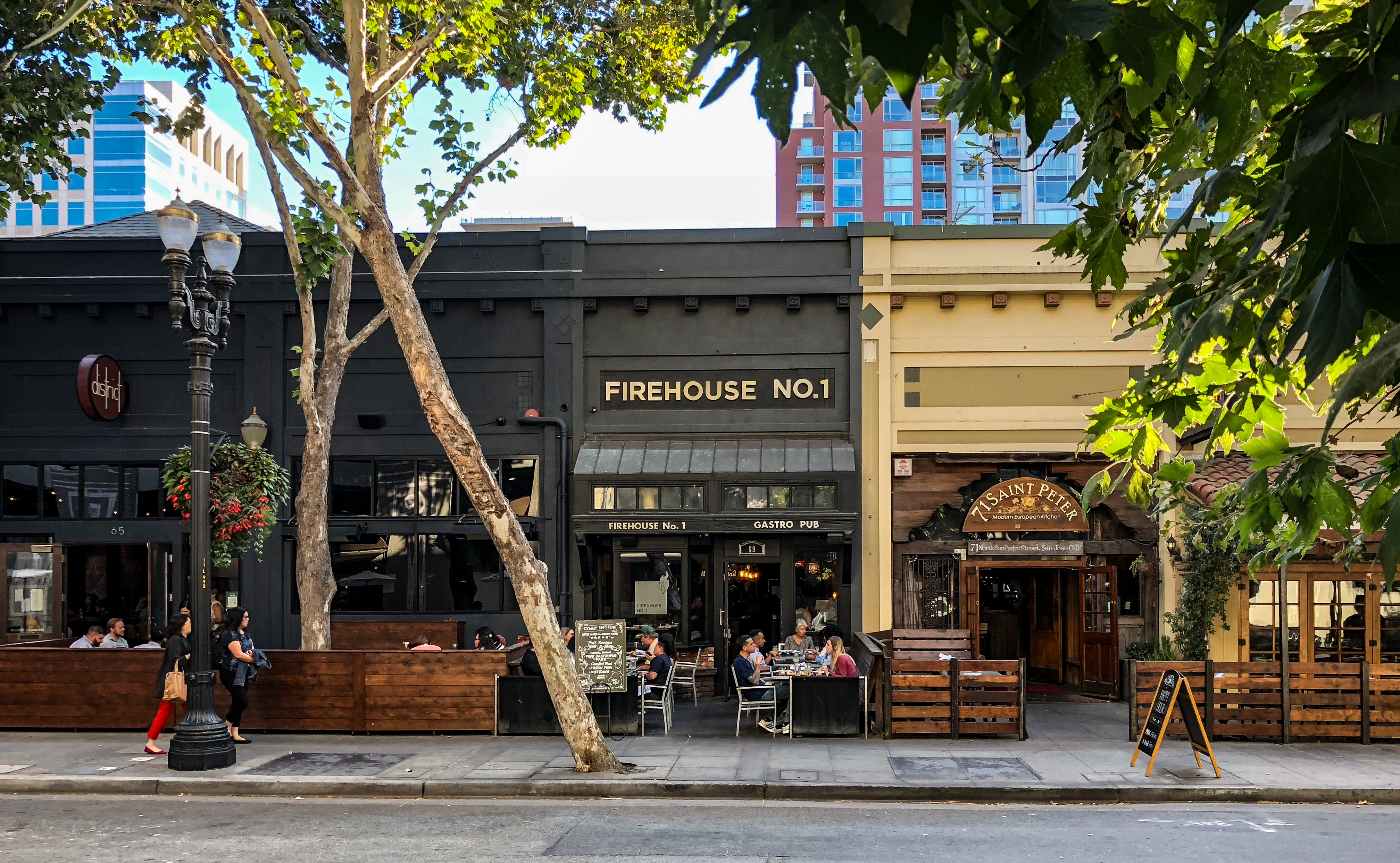
San Pedro Square
The oldest building in San Jose has dirt-brown walls two feet thick, built from sun-dried bricks of clay and straw in 1797. The Peralta Adobe sits in the middle of San Pedro Square, surrounded by restaurants that did not exist five years ago, on land that has been continuously inhabited since before California was a state, before it was part of Mexico, before it even had a name that Europeans could pronounce. Walk a hundred yards in any direction and you will find brewpubs, a food hall, and a theater. But the adobe persists, squat and unadorned, a reminder that this city's story did not begin with semiconductors.
Before the Valley Was Silicon
San Pedro Square occupies the oldest ground in San Jose. The Peralta Adobe, built in 1797, is a national historic landmark and the city's most tangible connection to its Spanish colonial period. The structure was part of the Pueblo de San Jose de Guadalupe, one of the first civilian settlements in California. Nearby stands the Fallon House, an Italianate mansion built in 1855 by Thomas Fallon, who served as mayor of San Jose from 1859 to 1860. Fallon was an Irish immigrant who had fought in the Mexican-American War and helped raise the American flag over San Jose in 1846. His house, with its ornate Victorian details, represents a different layer of the city's identity, one generation removed from the adobe and already looking toward American prosperity. Together, the two buildings sit side by side in the square, a compressed timeline of California's colonial and early statehood years.
The Market Floor
San Pedro Square Market opened as a modern food hall and has become the neighborhood's gravitational center. Under its open-air roof, vendors sell everything from ramen to wood-fired pizza, and on weekend evenings the communal tables fill with a cross-section of downtown San Jose that few other places in the city can match. Young engineers from nearby tech offices sit next to families from the surrounding neighborhoods. There is a theater venue for live performances and comedy shows. The market operates on the same principle that has made food halls work in cities around the world: give people good food in a shared space and they will find reasons to linger. For a downtown that spent decades struggling with the perception that it lacked a social center, San Pedro Square Market has provided something close to an answer.
A Neighborhood, Not Just a Destination
What distinguishes San Pedro Square from a simple entertainment district is that people actually live here. Apartment buildings and townhome communities have grown up around the restaurants and bars, creating a walkable neighborhood in a city that has historically been defined by its sprawl. St. James Street marks the boundary between San Pedro Square and the neighborhood of North San Pedro to the north, but the line between them is more cartographic than experiential. The residential density gives the area foot traffic at hours when most of downtown San Jose goes quiet. Dog walkers pass the Peralta Adobe in the morning. Office workers eat lunch in the square at midday. By evening, the restaurants and bars draw crowds from across the South Bay. It is the kind of layered, full-day urban life that city planners dream about and that usually takes decades to cultivate organically.
Old Bones, New Energy
San Pedro Square works because it does not try to choose between its past and its present. The Peralta Adobe and Fallon House are not roped off behind hedges or buried inside a museum. They sit in the middle of the action, open to visitors, their context provided by the living neighborhood around them rather than by explanatory plaques alone. A visitor who stumbles onto the adobe after dinner at the market encounters it the way historical buildings should be encountered: as part of a functioning city, not as a specimen preserved in amber. San Jose is often described as a city in search of its identity, overshadowed by San Francisco to the north and the tech campuses that sprawl south. San Pedro Square suggests the identity was always there, rooted in the oldest neighborhood in town, waiting for the city to build something lively enough around it.
From the Air
San Pedro Square is located at 37.34°N, 121.89°W in northern downtown San Jose, identifiable by the low-rise mixed-use buildings and pedestrian areas near the intersection of San Pedro and Santa Clara Streets. Norman Y. Mineta San Jose International Airport (KSJC) is approximately 2 miles to the northwest. The area sits between the distinctive Adobe towers to the south and the Guadalupe River corridor to the west. SAP Center, the large arena, is a nearby visual landmark to the northwest.