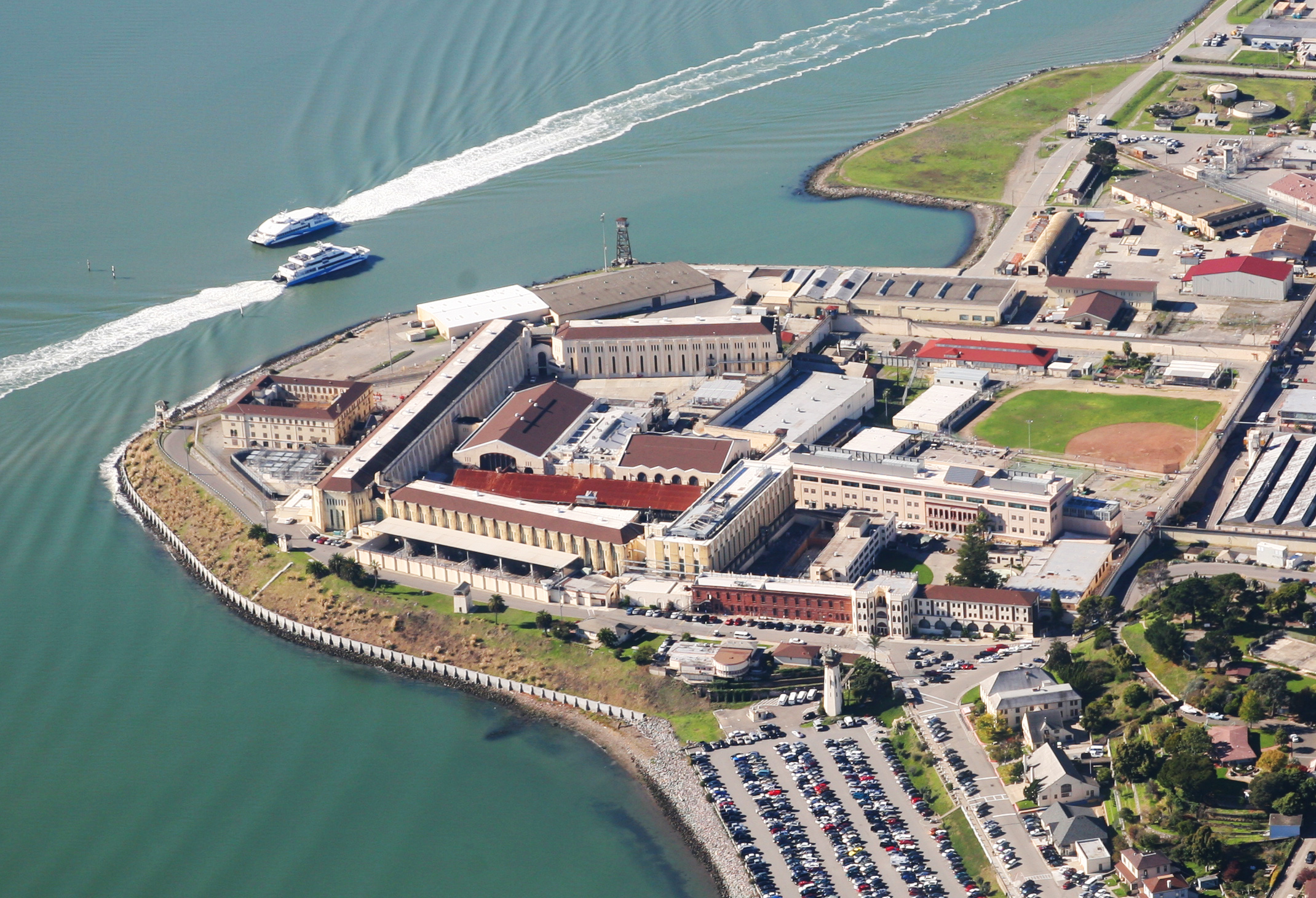
San Quentin Rehabilitation Center
The oldest prison in California sits on 432 acres of prime waterfront real estate on the Marin County shore of San Francisco Bay. San Quentin has been a place of incarceration since 1852, when the state's first prisoners were housed on a ship anchored offshore. For 170 years, it has been synonymous with punishment -- death row, maximum security, the weight of California's criminal justice system pressing down on one piece of coastal land. In 2023, Governor Gavin Newsom ordered its transformation into something entirely different: the San Quentin Rehabilitation Center.
From Prison Brig to Institution
San Quentin's history predates California's statehood by only two years. When the state needed a prison in 1852, it started with a ship -- the Waban -- anchored in the bay off Point San Quentin. Inmates were soon moved to shore, and over the following decades the prison expanded into a sprawling complex that became the state's primary execution facility. The prison housed California's death row for male inmates and its gas chamber, later converted to lethal injection. The facility's waterfront location, which would be worth billions as residential or commercial property, has been a recurring source of irony and political debate. Some of the most valuable real estate in the Bay Area has been devoted, for over a century and a half, to caging human beings.
A Cultural Institution of Sorts
San Quentin developed an unlikely cultural life within its walls. Johnny Cash performed his legendary 1969 concert here, following his equally famous Folsom Prison show. The prison has had arts programs, journalism programs, and educational initiatives that have produced published writers and college graduates from among its inmate population. The San Quentin News, an inmate-run newspaper, became one of the most respected prison publications in the country. These programs existed in tension with the facility's primary identity as a place of punishment, creating a paradox that mirrored California's own ambivalence about the purpose of incarceration.
The Rehabilitation Experiment
Governor Newsom's 2023 executive order to rebrand and restructure San Quentin as a rehabilitation center represents one of the most ambitious experiments in American criminal justice. The plan calls for transforming the facility into a campus focused on education, vocational training, and behavioral health treatment. Norway's Halden Prison, often cited as the world's most humane correctional facility, has been invoked as a model. The challenge is immense: converting a facility built for punishment into one designed for transformation, while managing the political sensitivities of a public that remains divided on criminal justice reform. Whether the San Quentin Rehabilitation Center achieves its ambitions or becomes another in a long line of well-intentioned corrections reforms that fade under political pressure, the attempt itself marks a turning point in how California thinks about what a prison is for.
From the Air
Located at approximately 37.94N, 122.49W on the Marin County shore of San Francisco Bay, between Richmond and Larkspur. The large institutional complex is visible from the air along the waterfront. Nearest airports: KSFO (18nm south), KOAK (12nm east). Best viewed at 2,000-4,000 ft AGL.