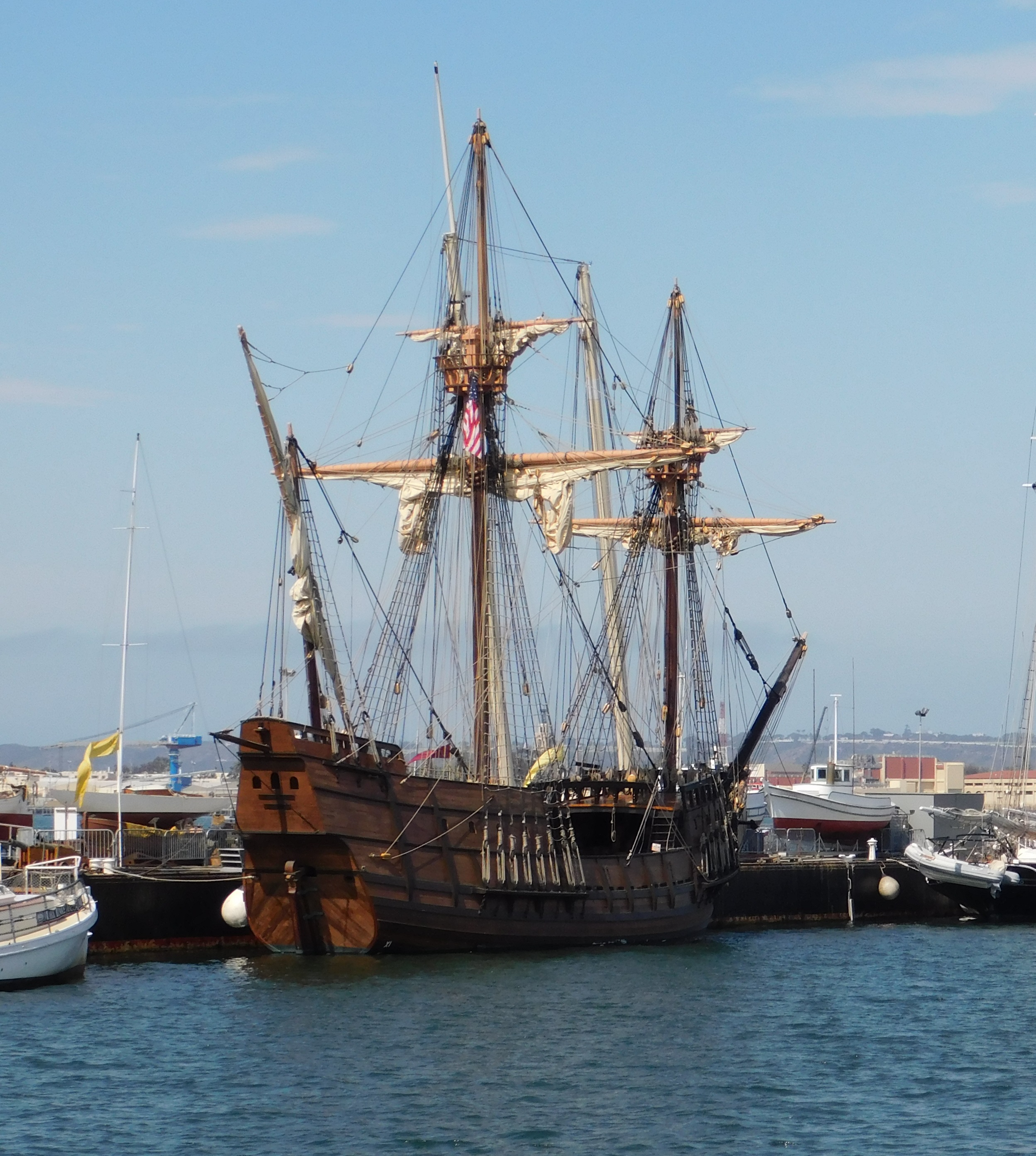
The Ship That Saw San Diego First
On September 28, 1542, a Spanish navigator named Juan Rodríguez Cabrillo sailed into a bay he called San Miguel and became the first European to set eyes on what is now San Diego. He was commanding a 100-ton galleon called the San Salvador. Four and a half centuries later, shipwrights in San Diego would spend four years building it again.
Cabrillo's Voyage
Juan Rodríguez Cabrillo's 1542 expedition was the first European reconnaissance of the Pacific coast of North America. He sailed north from the Spanish colonial port of Navidad in Mexico, charting coastline that no European had documented, encountering indigenous peoples who had no framework for understanding what they were seeing offshore.
The San Salvador was his flagship, a vessel built in Guatemala probably using indigenous labor and locally available materials. At roughly 100 tons and 92 feet in length, it was not a large ship by the standards of Iberian exploration — Columbus's Santa María was smaller, but the great Manila galleons that would later cross the Pacific were considerably larger. The San Salvador was a working vessel, designed for coastal exploration rather than ocean crossing.
The Bay He Named
Cabrillo named the bay he entered on September 28 San Miguel, after the saint's day. The name did not stick — the bay was later renamed San Diego, and Cabrillo's original nomenclature was applied to an island in the Santa Barbara Channel instead. But the event itself — the first European encounter with the harbor that would become one of the most important on the Pacific coast — is commemorated at Cabrillo National Monument at the tip of Point Loma, where the explorer's statue looks out over the water he first saw.
Cabrillo died in January 1543, from an injury sustained during a shore encounter in the Channel Islands. He had not reached the major Spanish settlement he was seeking — there was none north of Mexico in those years — and his voyage, while historically significant, produced no immediate exploitation of the California coast.
Building the Replica
The project to build a replica of the San Salvador began in 2011 at the Maritime Museum of San Diego. Working from historical research into sixteenth-century Iberian shipbuilding practices, a team of shipwrights spent four years reconstructing what Cabrillo's flagship might have looked like.
The completed vessel was launched on September 4, 2015 — close to the 473rd anniversary of Cabrillo's arrival in San Diego Bay. At 92 feet in length, it is full-scale, built using techniques as close to historical as modern safety requirements permit. The construction process was itself educational, requiring researchers to consult archives in Spain and Guatemala to understand how a mid-sixteenth-century galleon would have been assembled.
The Living Ship
The San Salvador replica is now part of the Maritime Museum of San Diego's fleet, a collection that also includes the Star of India — the oldest active sailing ship in the world — and the HMS Surprise, a replica of an eighteenth-century Royal Navy frigate. The museum's ships are not static exhibits; they sail, though the San Salvador's active schedule depends on crew availability and maintenance requirements.
Sailing the replica offers an experience that no amount of historical documentation can fully provide: the motion of a sixteenth-century hull in San Diego Bay, the creaking of timbers under sail, the limited horizon visible from a deck sitting low in the water. It makes viscerally clear what Cabrillo's crew experienced as they approached an unknown coastline — and how different the encounter with this particular bay must have looked from the water, before anything had been built on its shores.
From the Air
The Maritime Museum of San Diego, where the San Salvador replica is moored, sits along the downtown waterfront near the Embarcadero, its tall masts visible from the air.