San Ysidro McDonald's massacre
On July 18, 1984, James Oliver Huberty walked into a McDonald's restaurant in San Ysidro and opened fire, killing 22 people and wounding 19 others in a 77-minute rampage that shocked the nation.
The Afternoon That Changed San Ysidro
San Ysidro sits at the edge of everything — the last American neighborhood before the most-crossed international border in the world. On a hot July afternoon in 1984, it became the site of one of the deadliest mass shootings in United States history up to that point.
At 3:40 in the afternoon, 41-year-old James Oliver Huberty entered the McDonald's at 460 West San Ysidro Boulevard. He was armed with a 9mm Uzi semiautomatic rifle, a 9mm Browning pistol, and a Winchester 12-gauge pump-action shotgun. He told the people inside: 'I've hunted humans before and now I'm hunting humans again.' Then he began firing.
For 77 minutes, Huberty walked through the restaurant as patrons tried to hide under tables, crawl to exits, and shield one another. Customers, employees, and children who had been using the playground outside were all struck. The youngest victim was four months old. The oldest was 74.
Who Huberty Was
Huberty had been a troubled man for years. An Ohio native trained as a mortician and welder, he had struggled with mental illness, failed businesses, and a pattern of violence that frightened neighbors and family members alike. He had called a mental health crisis line the day before the shooting — the call was not returned in time.
In the months before July 18, he had relocated his family to San Ysidro, living in a small apartment near the restaurant. His wife later recalled that on the day of the shooting he said he was going 'hunting humans.' She did not believe him. No one had reason to believe he was capable of what came next.
At 5:17 p.m., a San Diego police SWAT sniper shot and killed Huberty from a rooftop across the street. The shooting had lasted 77 minutes. Twenty-two people were dead. Nineteen more were wounded.
The People Lost
The victims ranged across generations and backgrounds, reflecting the community Huberty had chosen to attack. San Ysidro is a heavily Latino neighborhood, a border town where families from both sides of the line gather at ordinary places for ordinary reasons. Many of the dead were children or young adults. Families in the restaurant for an afternoon meal. Workers on their shift. A man who had just stopped in.
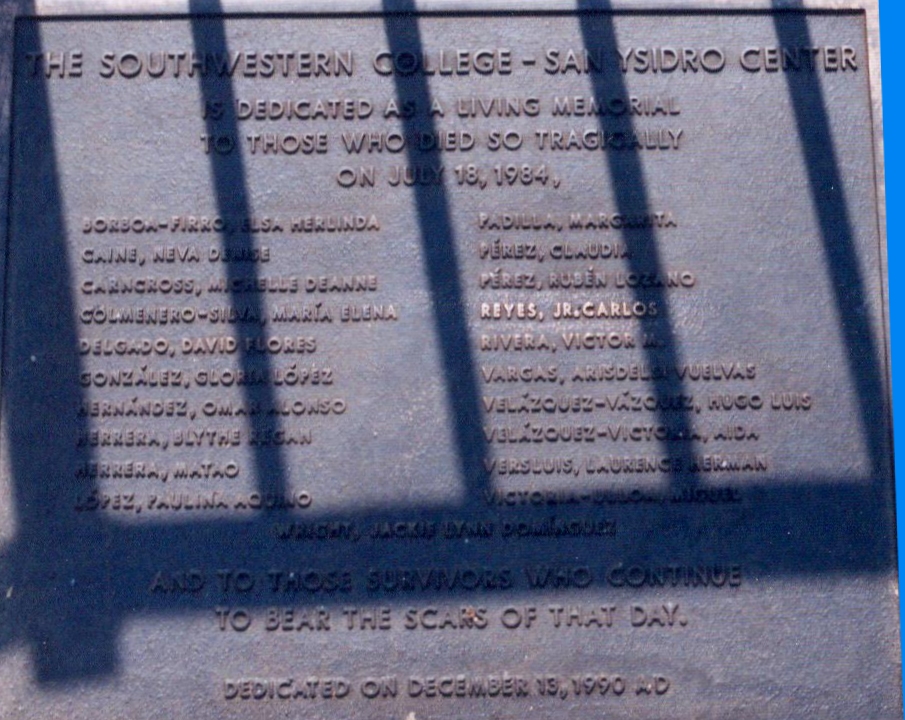
The community grief was immense. McDonald's permanently closed the location and donated the land to the city. A memorial now marks the site — a small survivor's wall and a plaque listing all 21 names of the victims (one victim, a child, died from injuries days later, bringing the confirmed total to 22). The McDonald's chain also established a scholarship fund for survivors and victims' families.
What Changed After
The San Ysidro massacre preceded a wave of legislation and policy conversations about access to military-style weapons. Criminologists and law enforcement officials cited the event for years when discussing mass shooting prevention. It preceded the 1986 Firearms Owners Protection Act, which banned civilian ownership of new machine guns, though the weapons Huberty used were already semiautomatic.
For San Ysidro itself, the massacre is remembered not through the gunman but through its survivors and those who were lost. The neighborhood — which continues to be a crossing point, a gateway, a place where families from two nations meet — absorbed the grief and rebuilt. The site where the restaurant once stood is now a community memorial, and the people of San Ysidro have ensured the victims are not forgotten.
From the Air
San Ysidro sits just north of the US-Mexico border crossing at Tijuana. The community is clearly visible below from the approach corridor to KSAN (San Diego International Airport), roughly 10 miles to the northwest. At lower altitudes heading south, you can see the border wall and the high-traffic crossing of San Ysidro — the busiest land border crossing in the Western Hemisphere.