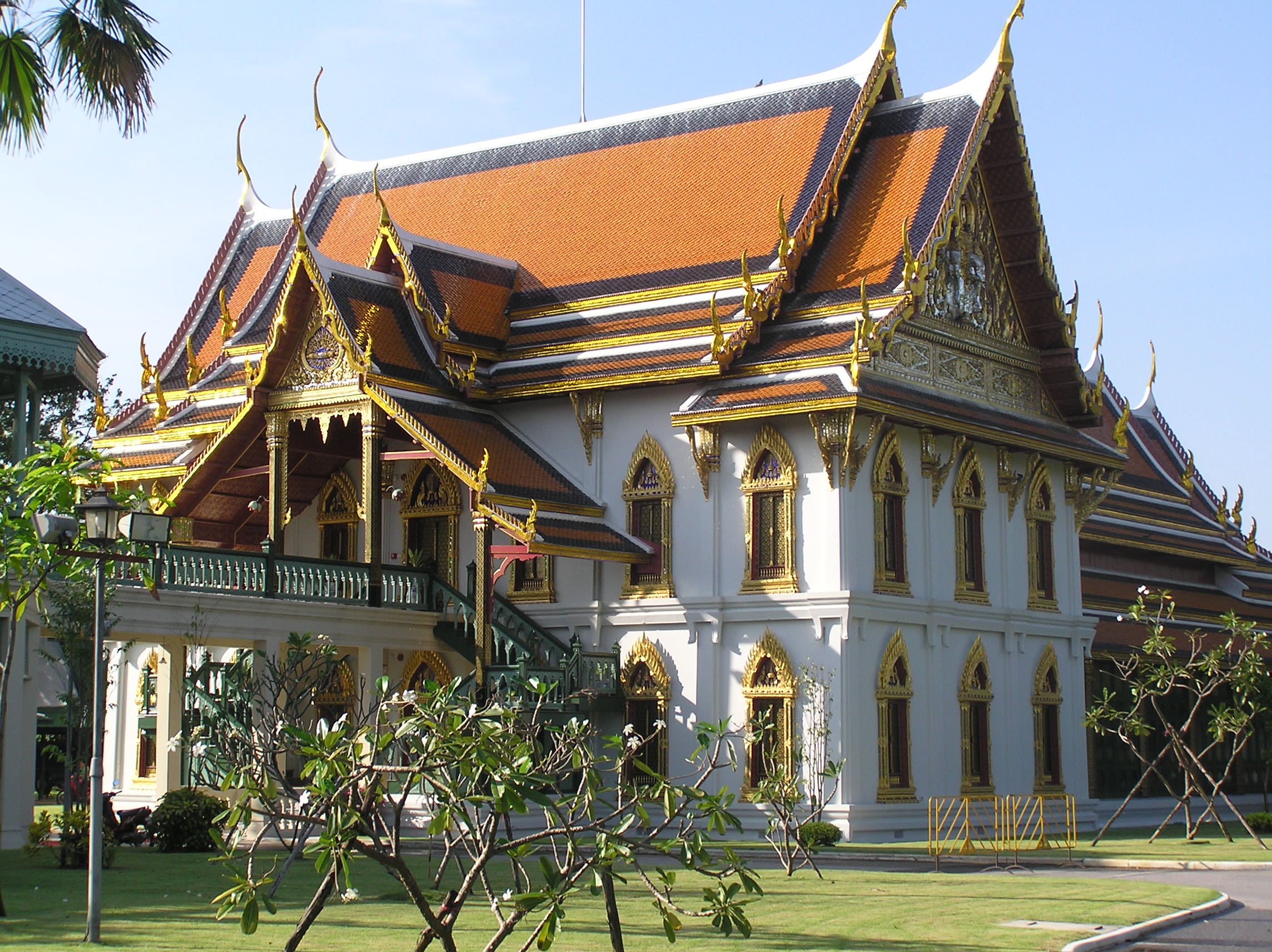
Sanam Chandra Palace
One of the most photographed structures in Nakhon Pathom looks nothing like a Thai palace. The Chaleemongkolasana Residence resembles a reddish-yellow European castle, complete with French Renaissance details and English half-timbered walls, rising incongruously from the flat central Thai plains. It was originally named Yah Leh Residence, after a dog. This collision of regal ambition, Western imitation, and deep personal sentiment defines Sanam Chandra Palace, a complex that reveals more about the personality of King Vajiravudh than any official biography could.
A Crown Prince's Retreat
Before he became Rama VI, Crown Prince Vajiravudh traveled to Nakhon Pathom to pay homage at the Phra Pathommachedi, the enormous golden stupa that dominates the province's skyline. He fell in love with the surrounding countryside and, in 1907, purchased roughly 335 acres of land around Noen Prasart Hill, a rise believed to sit atop the ruins of an ancient palace. Construction began during the final years of his father Chulalongkorn's reign and was completed in 1911. Vajiravudh named the complex after a natural pool nearby called Sa Nam Chand, meaning "Moon Pond." But this was never meant to be merely a place of rest. The king envisioned it as a strategic stronghold, a fallback position should Bangkok face a national crisis. He regularly drilled his Wild Tiger Corps, a paramilitary force, on these grounds.
European Fantasies in the Tropics
The palace's five buildings read like a catalog of Western architectural fascinations filtered through tropical necessity. The Bhimarn Prathom Residence, the first structure built, is a brick-and-cement Western-style building whose upper-floor railings reveal traditional Thai carving patterns, a concession to climate and craftsmanship that the European architects never anticipated. Upstairs, a prayer room holds a Buddha image in the First Sermon Attitude, its murals painted by Phraya Anusart Jitrakorn. The Chaleemongkolasana Residence blends French Renaissance and English half-timber styles, adapted for monsoon humidity with cross-ventilation that no Loire Valley castle ever needed. A bridge connects it to the Maleeratanabanlang Residence, built in Thai style, so that walking between them means crossing from one civilization's aesthetic into another in a matter of steps.
Yah Leh and Charlie
In front of the Chaleemongkolasana Residence stands a bronze statue that surprises most visitors: a dog. Yah Leh was King Vajiravudh's beloved companion, and the residence was originally named in the dog's honor. In 1915, the king rechristened it "Chaleemongkolasana," meaning "the auspicious residence of Charlie," though what specific auspiciousness Charlie brought remains a matter for the visitor's imagination. The statue of Yah Leh has become one of the palace's most recognizable landmarks, a reminder that even divine-right monarchs are, in the end, people who love their dogs. Nearby, a Ganesh shrine presides over the grounds. The elephant-headed god of art later became the seal of Silpakorn University, creating a neat symbolic continuity between the palace's royal past and its academic present.
From Palace to University
After Vajiravudh's death, the palace closed. His will directed the government to use the grounds for a military academy, but that plan never materialized. Instead, the buildings fell into administrative use and partial neglect. Some halls were dismantled entirely and shipped to the National Museum in Bangkok. Then, in 1965, Silpakorn University, Thailand's premier institution for art and archaeology, needed space to expand. The Thai cabinet approved the palace grounds as a new campus. The choice carried a certain logic: Vajiravudh had been an archaeologist and artist himself, and the Ganesh shrine already sat waiting as a symbol for the university's mission. Students now walk through grounds where paramilitary drills once echoed, studying sculpture and restoration in buildings a king designed as a last redoubt.
Restoration and Return
In 1981, the Department of Fine Arts registered Sanam Chandra Palace as a historical site. But the decisive moment came in 2003, when Princess Bejaratana Rajasuda, Vajiravudh's daughter, chaired a renovation committee that returned the palace and its satellite buildings to the Bureau of the Royal Household. It was a homecoming of sorts, bringing the complex back under royal stewardship after decades of bureaucratic custody. The bureau opened several residences to the public, including the prayer room in Bhimarn Prathom and the Ganesh Shrine. The palace celebrated its centennial in 2007 with ten days of commemorations. A renovation beginning in 2017 closed the grounds temporarily, a reminder that preserving a century-old collision of Thai and European architecture requires constant attention.
From the Air
Located at 13.82N, 100.05E in Nakhon Pathom province, roughly 56 kilometers west of Bangkok. The palace complex sits about one kilometer from the massive golden dome of Phra Pathommachedi, the tallest stupa in Thailand, which serves as an unmistakable visual landmark. Best viewed at 2,000-4,000 feet AGL. Nearest major airport: Don Mueang International (VTBD) approximately 50nm east. Suvarnabhumi (VTBS) approximately 60nm southeast.