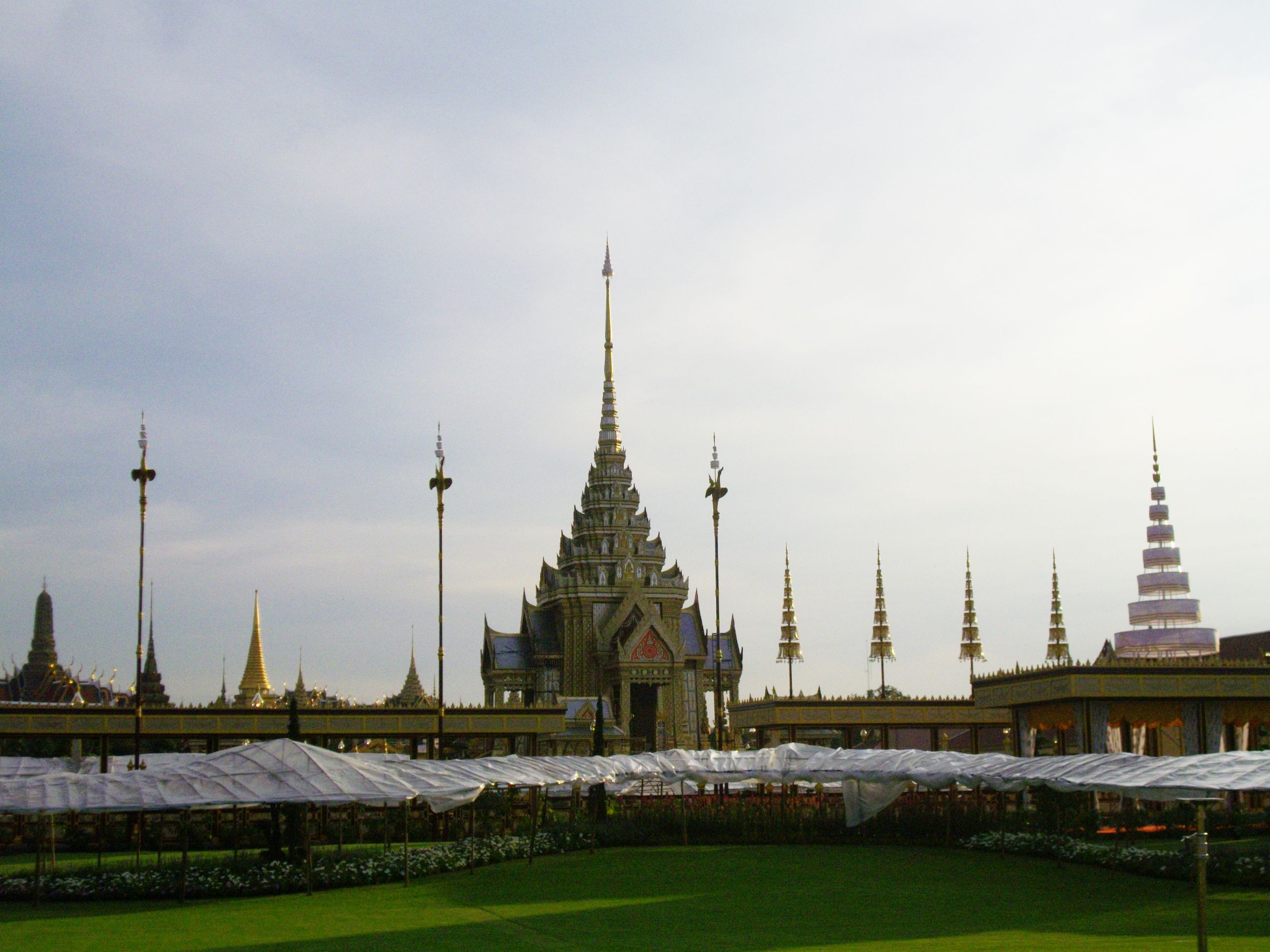
Sanam Luang
Its original name was Thung Phra Men -- the royal cremation ground. For centuries, this 74.5-rai field in front of the Grand Palace and Wat Phra Kaew served a purpose that its pleasant appearance belies: it was where Siam burned its monarchs. Kings, queens, and high-ranking princes have been cremated here since the reign of Rama I, the funeral pyres set at center field with royal pavilions flanking north and south, court music playing from opposite sides. In 1855, King Rama IV decided the name was too grim for a place he wanted to serve more varied purposes. He renamed it Thong Sanam Luang, a name the public shortened to Sanam Luang -- the royal field. The cremations continued anyway.
Rice, Kites, and Royal Theater
Before it became a ceremonial showpiece, Sanam Luang was farmland. During the reign of Rama III, when Siam was locked in a border conflict with Vietnam over Cambodia, the king ordered rice planted in front of the Grand Palace to demonstrate to foreign powers that his kingdom was so prosperous it could cultivate land even in the heart of the capital. When a royal funeral was needed, workers smoothed the field over. Rama IV formalized it further, establishing a site for the Royal Ploughing Ceremony -- low walls went up, a small hall held a Buddha image, and pavilions were built near the king's seat to watch sacred oxen trace furrows in the earth. Next to the royal pavilion stood a stage for theatrical performances to propitiate the gods. The field also hosted something less solemn. The Royal Chronicles record that at the beginning of trade wind season, the king flew a star-shaped chula kite in front of the Temple of the Emerald Buddha while his brother, the Prince of the Front Palace, flew a plain pakpao kite at Sanam Luang. Kite fighting remained a tradition here for generations.
Tamarind Trees and a Centennial
Rama V transformed the field's character. He enlarged Sanam Luang, demolished the ceremonial buildings of earlier reigns, and ended the practice of growing rice near the palace. The space was needed for a grand celebration in 1897, marking the king's return from a European tour and other royal events of that year. The celebration was grand enough to require the entire field. Afterward, inspired by the gardens he had seen at the Javanese sultan's court, Rama V ordered two rows of tamarind trees planted in a ring around Sanam Luang. Two more rows were added around 1967, bringing the total to 783 trees. Their canopy still defines the field's perimeter, creating a shaded oval boundary between the ceremonial ground and the city pressing in on all sides. Under Rama VI, the field continued its dual life -- sacred ceremonies alongside secular entertainments, including use as a racetrack and a golf course as Bangkok opened to foreign residents.
Grief, Violence, and Protest
On 6 October 1976, a massacre took place on these grounds and at the adjacent Thammasat University campus. Police, right-wing volunteers, and militia attacked student protesters, killing and brutalizing dozens in an act of political violence that remains one of the darkest chapters in modern Thai history. The field returned to ceremonial use in the decades that followed, hosting the bicentennial celebration of Bangkok in 1982, the golden jubilee of King Bhumibol's reign in 1996, and a succession of royal cremations -- King Ananda Mahidol in 1950, Queen Savang Vadhana in 1956, Queen Rambhai Barni in 1986, the Princess Mother Srinagarindra in 1996, Princess Galyani Vadhana in 2008, and Princess Bejaratana in 2012. When King Bhumibol Adulyadej died on 13 October 2016, massive crowds flooded Sanam Luang in grief. His cremation took place here on 26 October 2017.
A Plaque and Twenty-Four Hours
The field's role as a stage for political expression resurfaced during the 2020 Thai protests. On 19-20 September, demonstrators rallied at Sanam Luang and installed what they called the Second Khana Ratsadon Plaque -- a reference to the People's Party that ended absolute monarchy in 1932. The original plaque, set in a road near the old parliament, had been mysteriously removed in 2017. This new one lasted less than twenty-four hours before authorities took it away. Protest leaders were charged with damaging a historical site. The episode captured something essential about Sanam Luang: it is simultaneously a place the state controls and a place the public claims. Royal ceremonies and popular gatherings have competed for its meaning since the field was a rice paddy. That tension shows no sign of resolving. The Fine Arts Department lists Sanam Luang as a historical site, and the tamarind trees Rama V planted still ring the perimeter, indifferent to what happens beneath them.
From the Air
Located at 13.755N, 100.493E in Bangkok's Phra Nakhon district. Sanam Luang is a large oval open field immediately north of the Grand Palace and Wat Phra Kaew complex, ringed by tamarind trees. From the air it is one of the most recognizable landmarks in old Bangkok -- a green expanse surrounded by dense historic urban fabric. Best viewed at 1,500-3,000 feet. The Chao Phraya River runs just to the west. Nearest airports: Don Mueang (VTBD) approximately 15 nm north; Suvarnabhumi (VTBS) approximately 18 nm east-southeast.