Sanam, Sudan
Most ancient Egyptian and Nubian cemeteries give us the rich: kings, queens, high officials, the people rich enough to build for eternity. Sanam is different. When Francis Llewellyn Griffith dug here in 1912 and 1913, he found a burial ground of fifteen hundred graves belonging to ordinary inhabitants of the town - the weavers, the boat-pilots, the scribes who never became viceroys, the mothers and the children. The Kushite royal cemeteries at Nuri and Meroe have their crowns and sarcophagi. Sanam has something rarer and more honest: the everyday dead.
The Treasury That Burned
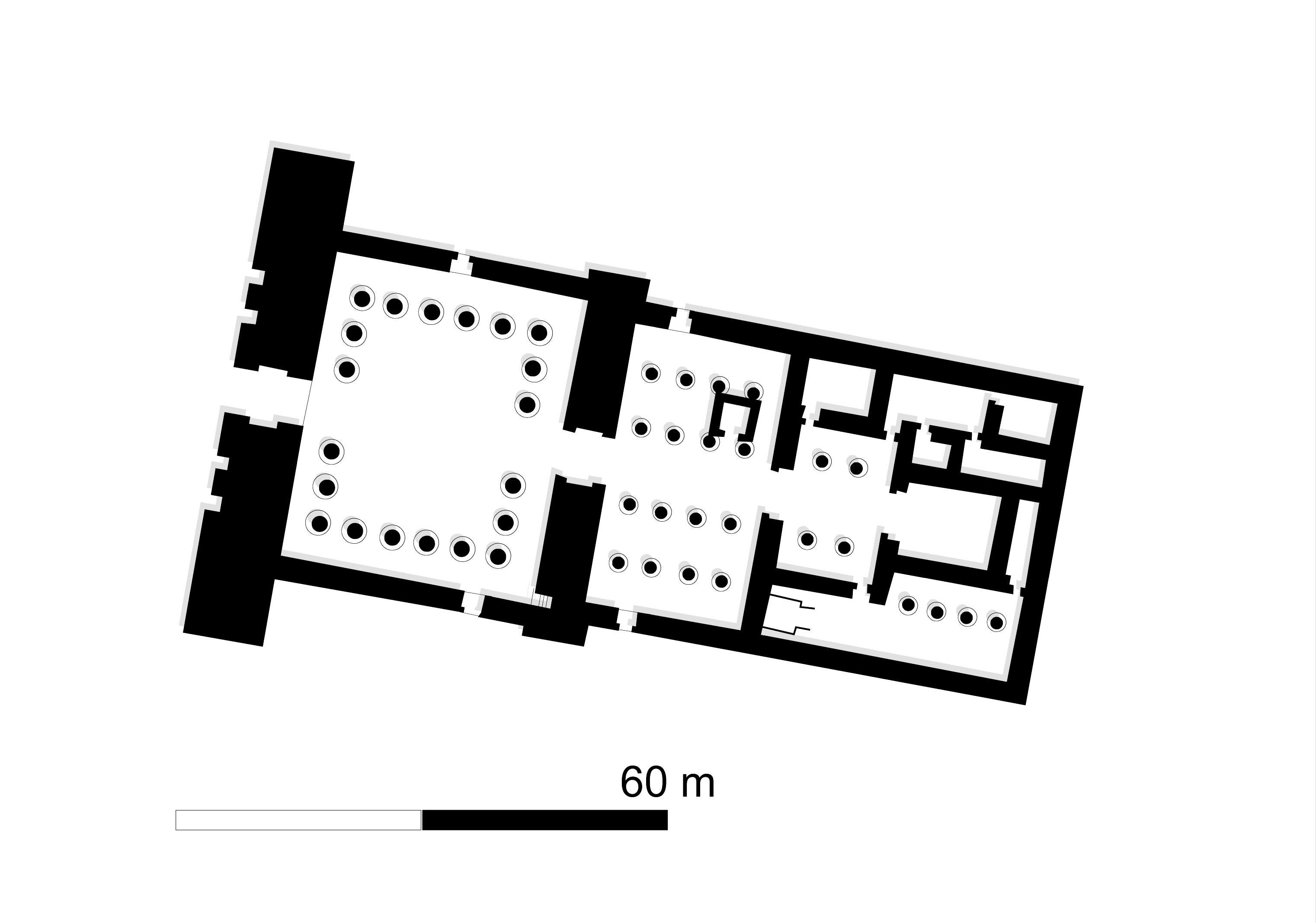
Sanam sits on the Nile's bank next to the modern town of Merowe, in the heart of the Napatan heartland. The ancient settlement here flourished during the Napatan period - roughly 800 to 300 BCE - and may have been part of Napata itself, the Kushite capital. Griffith's dig exposed a remarkable structure he called the Treasury: 267 meters long, courtyards with 35 surrounding rooms, the largest building in the city. It was mostly empty when he found it - most of its contents cleared before it burned - but it still held elephant tusks and traces of royal goods. The seals Griffith recovered pointed to a working life from roughly 747-716 BCE to 593-568 BCE, through the reigns of kings whose names are chiseled onto temples all along the Nile. The Treasury was not just storage. It was where royal goods were distributed - an early example of a state redistribution system, a palace economy running on ebony, ivory, and gold.
A Workshop for Royal Things
East of the Treasury, Griffith uncovered a smaller structure, now known to archaeologists as SA.K 300. This was a workshop - 39 by 35 meters, eleven rooms, nine of them opening onto a central courtyard. No one lived here. The excavators found pottery, ceramic debris, and storage spaces for materials. Royal seals on some of the finished goods marked them as products bound for the king. If you wanted a gilded object or a finely glazed bowl in Napatan Sudan around 700 BCE, the people who made it worked in rooms like these. Near the workshop stood a temple built by King Taharqa and later expanded by King Aspelta - dedicated to the god Amun, modeled on Egyptian temple architecture, and set among royal buildings. The whole complex read as a small, tightly integrated capital district.
The Common Dead
The cemetery Griffith excavated held 1,500 tombs, and its contents are what make Sanam special. No kings here. No queens. A separate, wealthier cemetery called Eltameer served higher-status inhabitants of the same town. The Sanam cemetery was for everyone else - the potters, the stonecutters, the granary workers, the mothers who buried their children and were buried beside them in turn. Few excavated Napatan-period cemeteries anywhere record ordinary lives like this. The social hierarchy of the Kushite kingdom comes through in the fact that two cemeteries were needed: one for the well-connected, one for the rest. But the existence of the rest - their care for their dead, their modest grave goods, their place in an ancient capital that we mostly remember through its pharaohs - is what Sanam recovers.
Reading Beneath the Sand
From 2016 to 2018, archaeologists Pearce Paul Creasman-era teams led by Tucker and Emberling came back to Sanam with instruments Griffith never had. Using magnetic gradiometry - a technique that maps magnetic variations in the soil to reveal buried walls and foundations without digging - they produced a detailed subsurface map of the settlement. The technique found seven substantial buildings between the Temple of Amun and the workshop complex. None were houses. The domestic quarters of Sanam are still hiding somewhere, waiting. The surveys confirmed that the site remained active from the Napatan into the Meroitic periods - a span of several centuries during which Kushite civilization moved its capital south to Meroe but kept working the holy ground near Jebel Barkal. Sanam never became famous. It did not need to. It just stayed itself.
From the Air
Located at 18.48N, 31.82E on the west bank of the Nile in Sudan's Northern State, adjacent to the modern town of Merowe and about 10 km south of Jebel Barkal. Recommended viewing altitude: 3,000-5,000 feet AGL to see the broad sweep of archaeological ground near the Nile bend. The ancient site is now partially beneath modern village and cultivated fields, so ground features are subtle from altitude. Nearest major airport is Dongola (HSSW), roughly 170 km downstream. Merowe has a small airstrip (HSMN) used by the nearby Merowe Dam operations. Clear desert air gives excellent visibility; look for the dark silhouette of Jebel Barkal 10 km to the north as a distinctive landmark.