Sanctuary of Vicoforte
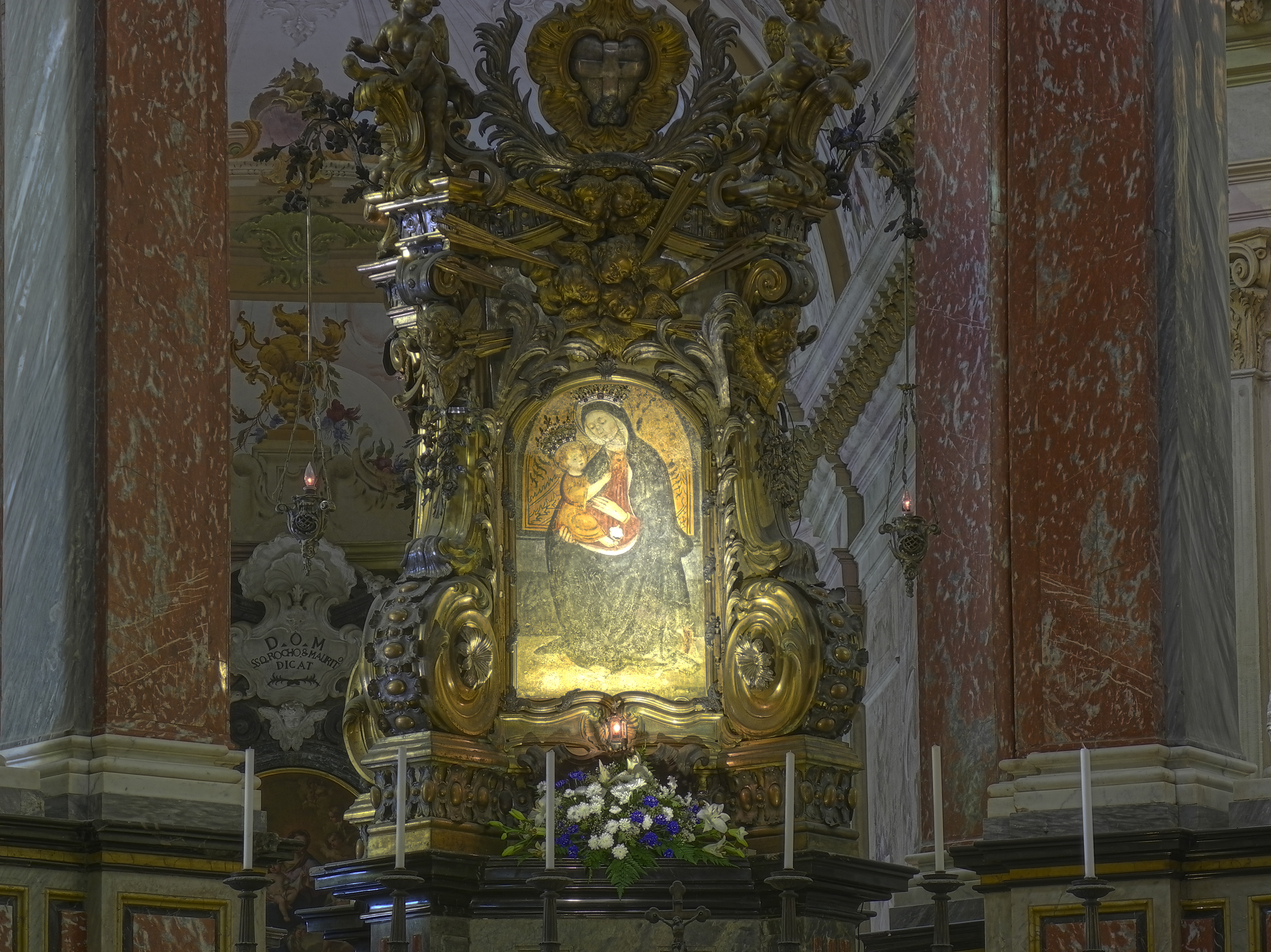
Around 1590, a huntsman's stray shot struck a roadside fresco of the Madonna and Child near the village of Vicoforte in Piedmont. According to legend, the image began to bleed. Whether the bleeding was miracle or metaphor, the penitent huntsman left his arquebus at the shrine and began collecting money to repair the damage and atone for his sin. That act of contrition set in motion a construction project that would take nearly three centuries to complete and produce the largest elliptical dome ever built.
A Duke's Ambition, an Architect's Death
The story of the Sanctuary of Vicoforte is a story of interrupted grandeur. The modest pilgrimage site attracted the attention of Charles Emmanuel I, Duke of Savoy, who visited and conceived a plan to build a monumental church worthy of the miracle -- and of his own burial. In 1596, he commissioned the court architect Ascanio Vitozzi to design the sanctuary. But both the duke and his architect died before the work could be finished, and construction stopped. The project lay dormant for more than a century, an unfinished shell marking both the duke's ambition and its frustration. Charles Emmanuel had wanted Vicoforte to be his final resting place. In the end, it took four hundred years for royalty to be buried here -- and it was not the duke.
The Dome That Shouldn't Stand
When construction resumed in the eighteenth century, architect Francesco Gallo took on the challenge of completing Vitozzi's vision. He designed the great elliptical dome that defines the sanctuary, with major and minor diameters of approximately 36 and 25 meters. The engineering was so audacious that contemporaries doubted the structure could support itself. According to tradition, Gallo was required to remove the scaffolding personally, because no one else believed the dome would stand without it. It did. The elliptical form, unprecedented at this scale, creates an interior space that feels simultaneously vast and intimate, the curved ceiling drawing the eye along unfamiliar geometries.
Six Thousand Square Meters of Heaven
The dome's vault encompasses 6,032 square meters of frescoed surface, completed in 1752 by painters Mattia Bortoloni and Felice Biella. The frescoes depict celestial scenes with the Virgin Mary surrounded by angels, saints, and musical figures. Looking up from the nave, the paintings cover every visible surface of the dome in a continuous sweep of color and movement, the elliptical shape adding a dynamism that a circular dome would not produce. The eye follows the curve and keeps moving, never settling into the static geometry of a circle. The sanctuary reached its current external form in 1884, when the campanili and three facades were finally completed -- nearly three centuries after Charles Emmanuel I laid down his commission.
A King Comes Home
On 15 December 2017, the remains of Queen Elena of Italy were quietly transferred from Montpellier, France, to the chapel of San Bernardo inside the sanctuary. Two days later, the remains of King Vittorio Emanuele III arrived from St. Catherine's Cathedral in Alexandria, Egypt, where he had died in exile in 1947. The transfers were conducted without prior public notice, reflecting the controversy that still surrounds Italy's last king. Vittorio Emanuele III had signed the racial laws of 1938 and had fled Rome in 1943 as German forces moved in. His interment at Vicoforte was not without critics. But the sanctuary that was built to house a duke's tomb and waited four centuries for royal remains finally received them -- not through triumph but through the quiet logistics of historical reckoning. The huntsman's arquebus is still preserved in a chapel near the original fresco that started it all.
From the Air
Located at 44.36N, 7.86E in the commune of Vicoforte, province of Cuneo, Piedmont. The sanctuary's large elliptical dome is a distinctive landmark from the air. Cuneo Levaldigi Airport (LIMZ) is 20 km southwest. Turin Caselle Airport (LIMF) is 80 km north. Best viewed at 3,000-5,000 ft, where the dome stands out prominently against the surrounding Piedmontese hills.