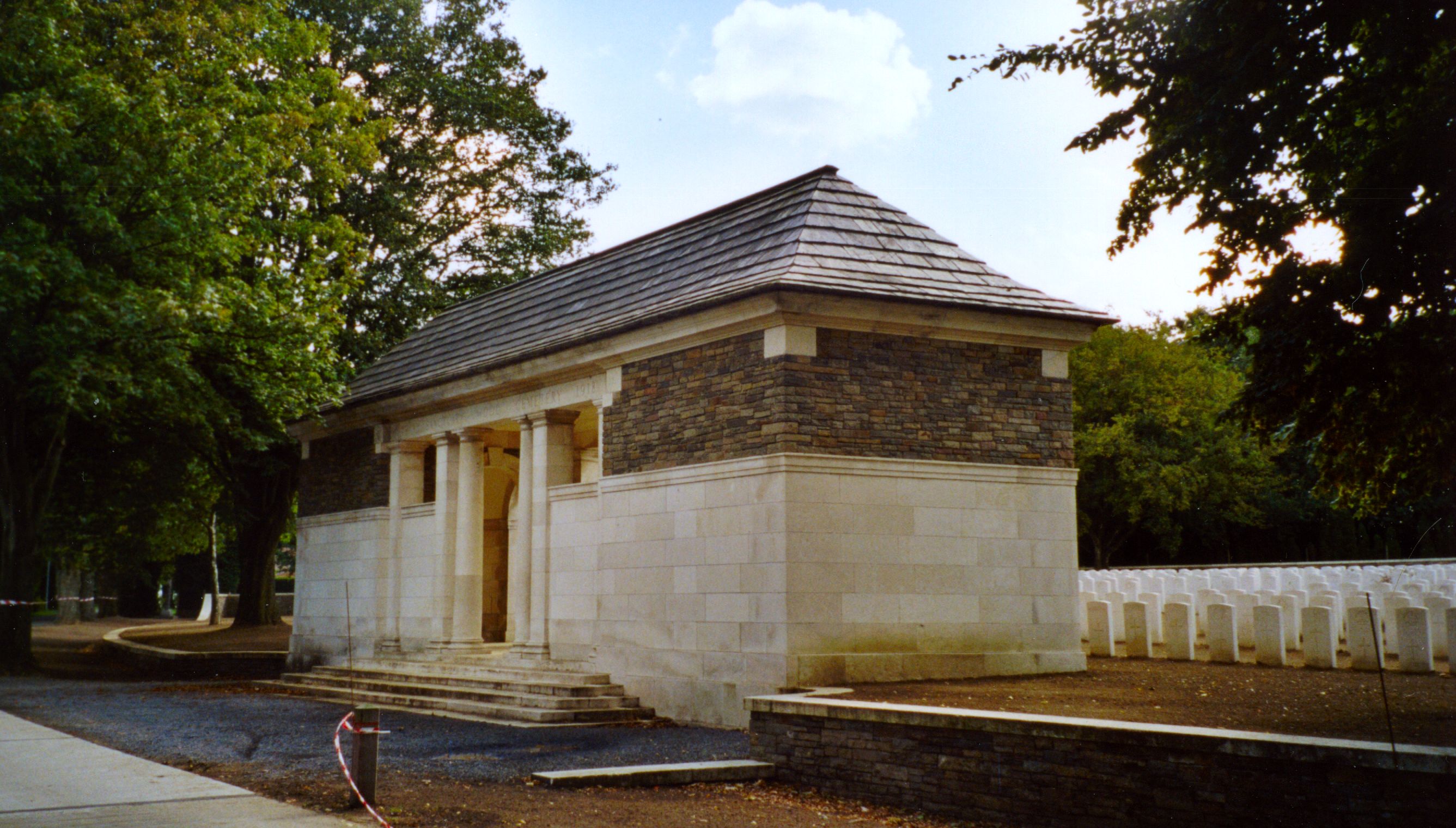
Sanctuary Wood Cemetery
Walk into the wood beside the cemetery and you can still get into the trenches. Real ones. The fire-steps where men stood up to shoot, the duckboards in the floor, the rusted wire pickets, the corrugated iron of dugout roofs - all still there, 108 years after the last shot was fired. The Schier family, who farmed this land, refused to fill in the trenches when the Belgian government compensated other landowners for restoring their fields after the war. They kept theirs as a museum. You can walk into them today and brush your shoulder against the same packed earth that British and Canadian soldiers slept in, fought from, and were buried beneath when the shells came in. Next door, in the cemetery, lie 1,989 men. Some of them died in those exact trenches.
Why the Wood Was Named
It was November 1914, and a unit of the British 4th Division had pulled back from the line, exhausted, to a small wood east of Ypres. The wood was the only cover for miles in the flat Flemish farmland. An officer wrote in his journal that they had found 'a sanctuary' there, away from the shelling. The name stuck. Sanctuary Wood. It was, of course, a brief sanctuary. By September 1915, fighting had reached the trees; by June 1916, during the Battle of Mount Sorrel, the wood was the centre of one of the most savage engagements of the Ypres Salient. The Canadian and German infantry fought through the splintered trunks, and three small Commonwealth burial grounds inside the wood were obliterated by shellfire. After the war, soldiers searching the ground recovered traces of one of them - 137 graves still identifiable. Those 137 became the core of the cemetery that bears the wood's name today.
Gilbert Talbot
Plot 1, Row G. Lieutenant Gilbert Walter Talbot, 7th Battalion, Rifle Brigade, killed near Hooge on 30 July 1915, aged 23. He had been the son of the Bishop of Winchester, a brilliant Oxford undergraduate, by all accounts gentle and serious. His older brother Neville was an army chaplain at the front. After Gilbert's death, Neville and another chaplain named Philip 'Tubby' Clayton founded a club in nearby Poperinghe, a place where soldiers of any rank could come for tea, music, a quiet room, a chapel. They named it Talbot House. The signpost said: 'All rank abandon, ye who enter here.' Officers had to leave their pips at the door. The house operated through the rest of the war as a small, vital refuge from the unrelenting violence of the Salient. The Toc H movement - 'Toc' being signaller's shorthand for the letter T - grew out of it after the war and now operates worldwide. It exists because of one young officer in Plot 1, Row G.
The Trenches That Were Never Filled In
After the Armistice the Belgian government paid landowners to fill in their trenches and craters so the fields could be farmed again. Most did. The Schier family, who owned a plot at the edge of Sanctuary Wood, refused the payment. They left the trenches where they were, propped up the dugouts, kept the corrugated iron in place. By 1923, they had begun charging admission. The Sanctuary Wood Museum Hill 62, as it became known, is now one of the very few places on the Western Front where original Great War trenches survive in something close to their wartime state. The duckboards have been replaced over the years and the woodwork patched, but the earthworks themselves - the parapets and traverses, the dugout shafts - are exactly where they were dug. A visitor can walk where a soldier walked, in the same trench, in the same shadow under the same Flanders sky.
Where the Bodies Lay
The cemetery was greatly expanded between 1927 and 1932, as concentration parties moved isolated graves from the surrounding battlefields into a single managed burial ground. Some came from as far away as Nieuwpoort, 30 kilometres up the coast. The majority of those buried here died in the 1914 battles around Ypres, or in the third battle of 1917 - the offensive that ground its way to Passchendaele through 100 days of rain and mud and machine guns. 1,989 are buried at Sanctuary Wood today. 637 are identified by name. The rest are 'Known Unto God' - the phrase Rudyard Kipling chose for the unidentified, his own son among them, lost at Loos. Walking the rows, the headstones repeat: 19, 20, 22, 25, 18. The mathematics of the dead does not change with rereading.
The Celtic Cross at the Gate
Just outside the cemetery gate stands a tall Celtic cross with a sword carved into its shaft. It commemorates Second Lieutenant Thomas Keith Hedley Rae, killed at Hooge on 20 July 1915 at the age of 22. His family had the memorial built privately, in 1921, on the spot where he fell. In the 1960s, as the farmland around it changed hands, the cross was moved to the cemetery gate where it now stands. It is the kind of thing that lasts on the Salient: a private grief made permanent in stone by people who could not bear the unmarked ground. There are dozens of such crosses scattered through Flanders. Each one a young man who did not come home. Each one a family that found a way to mark the place. Sanctuary Wood Cemetery sits in a landscape of such markers, and is itself one of them, scaled up.
From the Air
Located at 50.838 N, 2.944 E - 5 km east of Ypres, near Hooge in the municipality of Zillebeke. The cemetery is on Canadalaan (Canada Lane), 100 metres from the Hill 62 Memorial. Sanctuary Wood Museum lies adjacent, with the original WWI trenches still walkable. Nearest airport is Ostend-Bruges (EBOS), 60 km northwest; Lille (LFQQ) is 35 km southwest. Recommended viewing altitude 1,500-3,000 ft. From the air the wood is a small block of trees on a low ridge - utterly unremarkable in the patchwork of Flemish farms - which is exactly what makes the survival of its trenches astonishing.