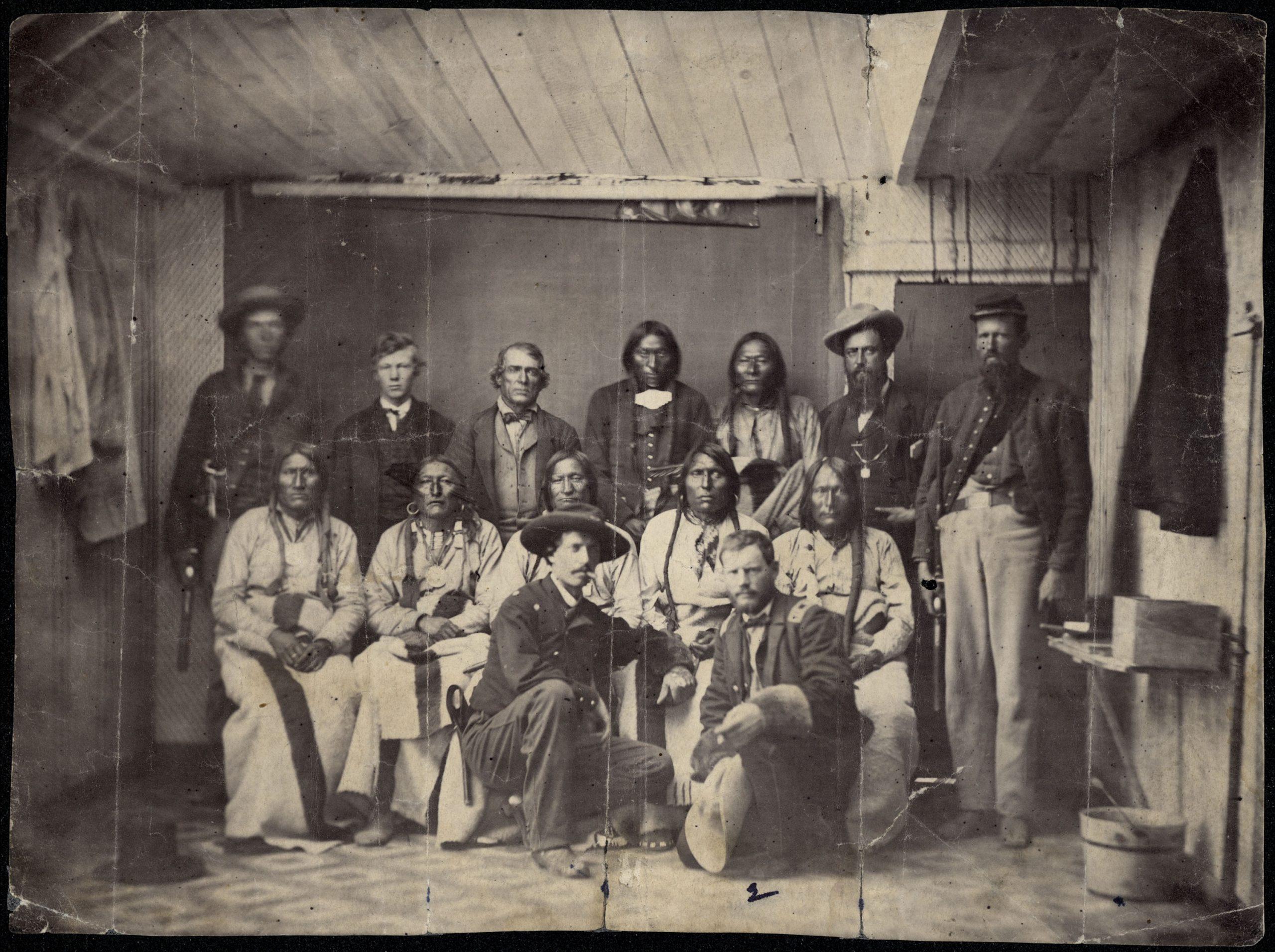
Sand Creek Massacre Site
On November 29, 1864, approximately 675 U.S. soldiers under Colonel John Chivington attacked a village of Cheyenne and Arapaho at Sand Creek in southeastern Colorado Territory. The Cheyenne and Arapaho believed they were at peace - their leader, Black Kettle, flew an American flag and a white flag over his lodge. The soldiers killed indiscriminately, targeting women and children, mutilating bodies, and taking scalps and body parts as trophies. Between 150 and 200 Cheyenne and Arapaho died, two-thirds of them women and children. Chivington, a former minister, reported a great victory over hostile warriors. When the truth emerged - through testimony from soldiers sickened by what they witnessed - the massacre was condemned by Congress and the Army. But no one was prosecuted. Sand Creek became a symbol of American violence against Native peoples, an atrocity that the nation eventually acknowledged but never punished.
The Context
By 1864, tensions between Colorado settlers and the Cheyenne and Arapaho had escalated to open warfare. White settlers, flooding into the territory for gold and land, demanded the removal of Native peoples. Some bands raided settlements and stagecoach routes. The territorial governor, John Evans, called for volunteers to fight the Cheyenne and Arapaho. Colonel John Chivington, a Methodist minister turned military officer, organized the Third Colorado Cavalry - 100-day volunteers eager for glory before their enlistment expired. Meanwhile, Black Kettle and other peace chiefs had traveled to Denver to negotiate. They were told to camp at Sand Creek, near Fort Lyon, where they would be under military protection. They believed they were safe.
The Attack
Chivington arrived at Fort Lyon on November 28 with 700 men. Some officers protested that the Cheyenne and Arapaho at Sand Creek were peaceful and under government protection. Chivington reportedly replied, 'Damn any man who sympathizes with Indians... I have come to kill Indians.' At dawn on November 29, his troops surrounded the sleeping village. Black Kettle raised an American flag given to him at the peace council, then a white flag beneath it. The soldiers opened fire anyway. 'We must kill them big and little,' one officer reportedly shouted. 'Nits make lice.' The killing continued for hours. Women were shot while fleeing. Children were hunted down. Bodies were scalped and mutilated.
The Aftermath
Chivington returned to Denver a hero, displaying scalps and body parts at a theater. The Rocky Mountain News celebrated the victory. But soldiers who had refused to participate began talking. Captain Silas Soule, who had ordered his company not to fire, wrote detailed accounts of the atrocities. Congressional investigations followed. Testimony described pregnant women cut open, children shot while pleading for mercy, genitalia taken as souvenirs. Congress and the Army condemned the massacre. But Chivington had mustered out of the Army; he couldn't be court-martialed. No one was ever punished. Black Kettle survived Sand Creek only to die four years later when George Custer attacked his village on the Washita River.
The Recognition
Sand Creek remained contested ground for over a century. Descendants of the Cheyenne and Arapaho kept the memory alive, but the site itself was lost - ranchers' fields covered the creek bed where the massacre occurred. In the 1990s, the National Park Service began working with tribal representatives to locate and document the site. Artifacts, including military buttons and arrowheads, confirmed the location. In 2007, Sand Creek Massacre National Historic Site was established, recognizing what occurred not as a battle but as a massacre. The federal government formally apologized to the Cheyenne and Arapaho nations. Oral histories were recorded. The dead were finally acknowledged.
Visiting Sand Creek
Sand Creek Massacre National Historic Site is located in Kiowa County, Colorado, about 170 miles southeast of Denver and 8 miles north of Chivington, a town named for the massacre's perpetrator. The site is remote and undeveloped - a visitor contact station provides orientation, and a one-mile trail leads to overlooks of the massacre area. The dry creek bed and rolling prairie look much as they did in 1864. There are no major facilities; the nearest services are in Eads, 25 miles north. The experience is one of stark emptiness - standing where hundreds died, with nothing but grass and wind and memory. Colorado Springs Airport (COS) is 115 miles west; Denver International (DEN) is 170 miles northwest. The site is typically accessible year-round but can be challenging in winter weather.
From the Air
Located at 38.55°N, 102.52°W in Kiowa County, Colorado, about 170 miles southeast of Denver on the High Plains near the Kansas border. From altitude, the site appears as unremarkable prairie - dry grassland with the seasonal creek bed of Big Sandy Creek visible as a depression. The terrain is flat and agricultural. The isolation that made the village vulnerable is apparent from the air.