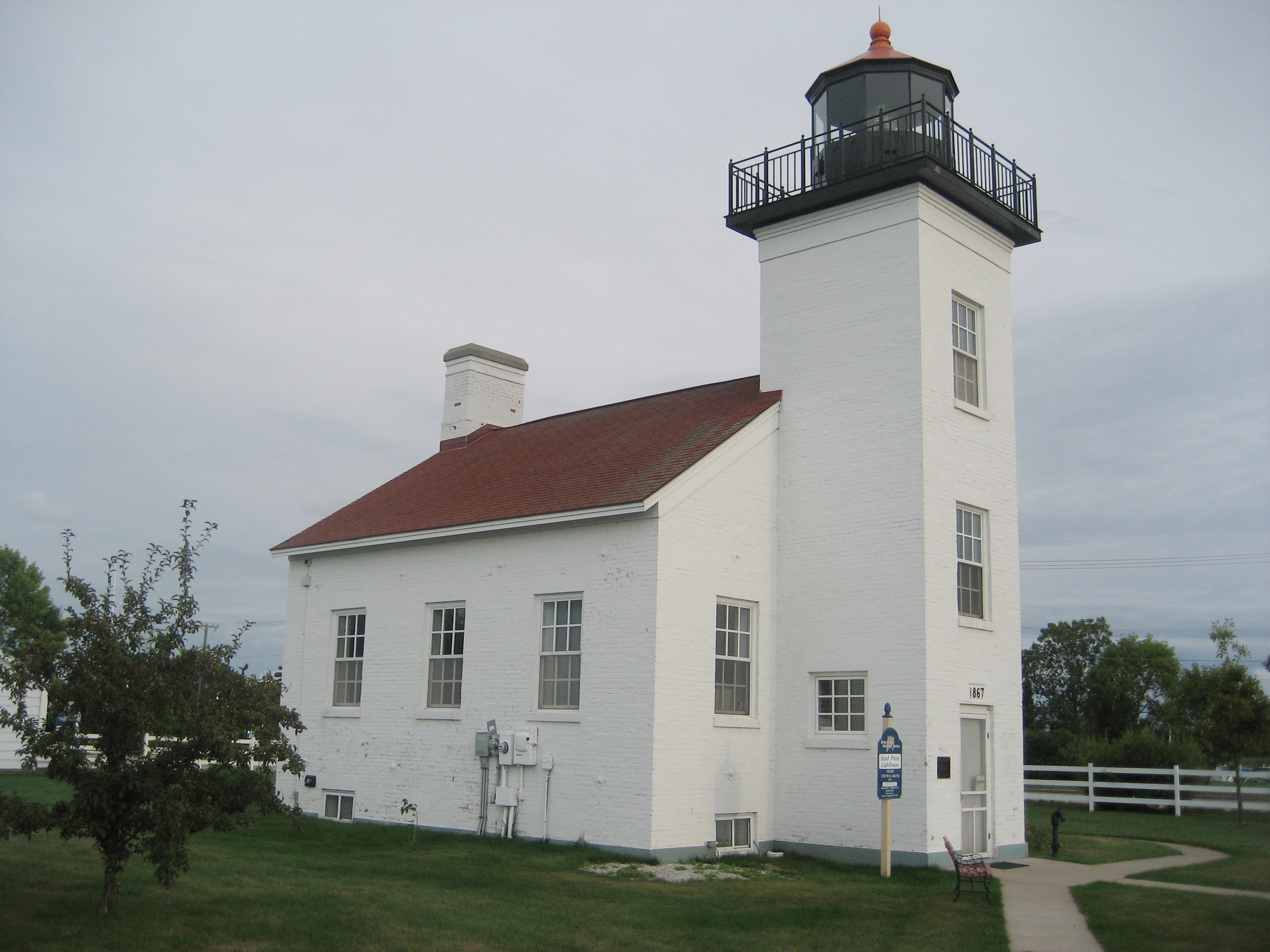
Sand Point Light
The tower faces the wrong way. Whether by design or blunder, the builders of the Sand Point Lighthouse in 1868 oriented its brick tower toward the land rather than the water it was meant to guide ships across. Nobody alive can explain why. That peculiar detail sets the tone for a lighthouse whose entire history reads like a series of improbable turns -- from the death of its first keeper before the lamp was ever lit, to the woman who took his place and ran the light for eighteen years, to the Coast Guard stripping it down to an unrecognizable barracks, to its painstaking resurrection more than a century after construction. The Sand Point Lighthouse stands today on the northern shore of Lake Michigan in Escanaba, Michigan, its fourth-order Fresnel lens once again casting light across the harbor, an unofficial aid to navigation and an official testament to stubbornness.
A Keeper's Widow Takes the Lamp
The United States Lighthouse Service approved the Sand Point Lighthouse at a cost of $11,000 in 1867, building it on a sandspit just south of Escanaba's harbor. The story-and-a-half rectangular building with its attached brick tower was completed in early spring 1868, its cast-iron lantern room housing a fourth-order Fresnel lens that threw a fixed red light across the water. John Terry was appointed the first keeper in December 1867, but he fell gravely ill and died in April 1868 -- a month before the lighthouse was ready for operation. With no replacement available, the Lighthouse Service appointed his wife, Mary Terry, making her one of the first female lighthouse keepers on the Great Lakes. Mary proved more than capable. She ran the light with efficiency and dedication for eighteen years, earning the respect of the Escanaba community. Her tenure ended in 1886 under circumstances that remain a mystery: a fire severely damaged the lighthouse and killed her. The south entrance door showed signs of forced entry, yet nothing was stolen. No one has ever determined what happened.
Nine Keepers and an Electric Bulb
Between 1868 and 1939, nine keepers and their families called Sand Point home. Lewis Rose took over after Mary Terry's death and the two-month restoration that followed. The lighthouse continued its steady, unglamorous work -- guiding iron ore ships and lumber schooners into Escanaba's harbor through the fog and dark of Lake Michigan's northern shore. The most significant upgrade came in 1913, when the lighthouse was connected to the city's electric supply. The kerosene lamp that had burned inside the Fresnel lens since 1868 was replaced with an incandescent bulb, a small change that ended the nightly ritual of trimming wicks and hauling fuel up the tower stairs. For the keepers who had done that work for forty-five years, it must have felt like the future arriving all at once.
Buried Alive in Aluminum
In 1939, the Coast Guard took over all navigational lights in the country and built an automated crib light several hundred feet offshore from Sand Point. The lighthouse was decommissioned but not abandoned -- it became housing for Coast Guard personnel stationed in Escanaba. What they did to the building was efficient and graceless. The lantern room was removed. The tower was cut down by ten feet. The roof was raised to create a full second floor. New windows were punched into the brick walls. The entire structure was wrapped in aluminum siding. By the time the Coast Guard finished, the Sand Point Lighthouse was barely recognizable as a lighthouse at all. It looked like any other mid-century government housing, its history hidden beneath a skin of metal.
Resurrection from the Blueprints
The Coast Guard vacated in 1985, and the Delta County Historical Society acquired the abandoned building the following year with plans that would have seemed absurd to anyone who saw it at the time: restore it to its 1868 appearance. They started with the original construction blueprints from 1867. Off came the aluminum siding, revealing the original brickwork beneath. Down came the raised roof to its original level. The new windows were bricked back in. The ten feet lopped off the tower were rebuilt. The hardest part was replacing what the Coast Guard had not saved. The society found a lantern room on nearby Poverty Island -- removed from the Poverty Island Light Station years earlier and left sitting on the ground next to the tower. In 1989, they installed it atop Sand Point along with a fourth-order Fresnel lens obtained from the Menominee Pier Light, both near-exact duplicates of the originals. The lighthouse was painted white, the interior furnished as a turn-of-the-century replica, and in July 1990, a dedication ceremony opened it to the public.
A Light That Persists
Today the Sand Point Lighthouse is open to visitors from Memorial Day through October 1. Climbing the restored tower, you can look out across the harbor and spot the automated crib light that replaced it in 1939 -- still flashing, still doing the job that nine human keepers once performed by hand. The lighthouse is listed on the National Register of Historic Places. Its Fresnel lens, borrowed from a different lighthouse entirely, casts light as an unofficial aid to navigation, a designation that carries no legal obligation but acknowledges that the beam is still there, still visible to mariners entering Escanaba's harbor. The backwards-facing tower, the murdered keeper, the decades under aluminum -- none of it extinguished the light. The building that the Coast Guard tried to turn into a barracks turned out to be, stubbornly, a lighthouse.
From the Air
Sand Point Lighthouse sits at approximately 45.744N, 87.044W on a sandspit at Escanaba's harbor on the northern shore of Lake Michigan. The white lighthouse structure is visible from low altitude against the waterfront. Delta County Airport (KESC) is located about 3 nm to the south, making it an easy landmark on approach. The Escanaba harbor and the automated crib light offshore are visible reference points. From higher altitudes, the distinctive shape of Little Bay de Noc narrows to the north, and the broader sweep of Green Bay extends to the south and west. Menominee and Marinette lie across the bay to the southwest.