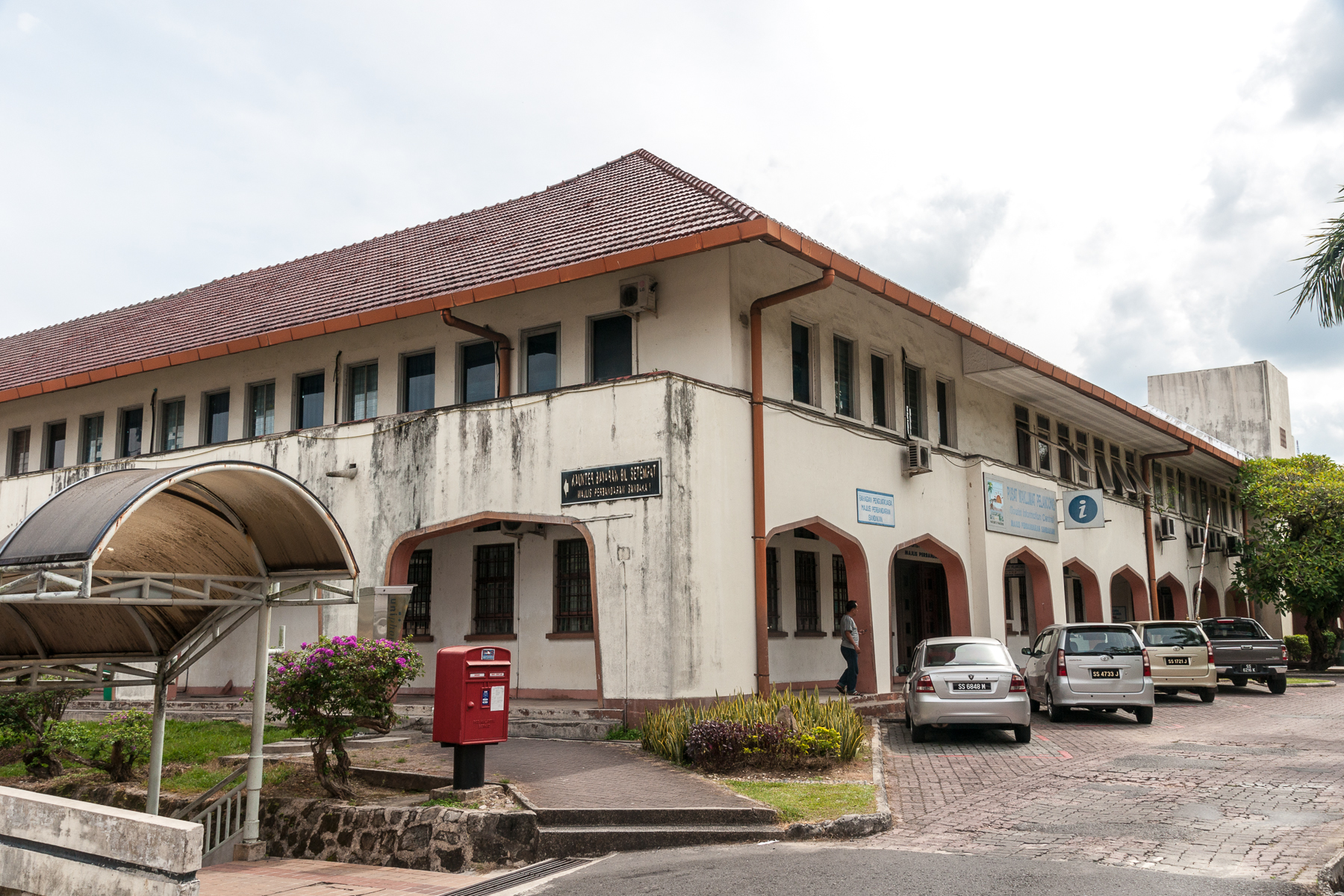
Sandakan Heritage Museum
Walk into the hallway of the Wisma Warisan building in Sandakan and an entire city stares back at you. A large wall mural depicts Sandakan as it looked in 1935 -- a bustling colonial port with orderly streets and timber wharves, the kind of place where the British North Borneo Company's administrators typed reports on heavy office equipment and local traders bartered goods from across Southeast Asia. That town no longer exists. Allied bombing and Japanese demolition during World War II leveled almost everything. The Sandakan Heritage Museum, occupying the first floor of this former British administration building, preserves what photographs, artifacts, and memory could salvage.
The Building That Survived
The Wisma Warisan building stands beside the Sandakan Municipal Council offices, a modest colonial-era structure that outlasted the devastation that consumed most of the town's pre-war architecture. Its survival was somewhat accidental -- Sandakan was one of the most thoroughly destroyed towns in Borneo during the war, and buildings that remained standing afterward became repositories of disproportionate historical weight. The museum occupies just the first floor, but within that compact space it has assembled a portrait of a town that existed for barely sixty years before the war erased it. The building itself, with its solid construction and administrative proportions, is as much an exhibit as anything inside it.
Artifacts of a Lost Town
The collection spans Sandakan's pre-war and post-war history through objects that ground the story in physical reality. Barter trade items recall the town's origins as a commercial hub where Chinese, Malay, Filipino, and European traders intersected. Authentic office equipment from the 1920s -- typewriters, ledgers, filing systems -- evokes the bureaucratic machinery of colonial administration. Traditional agricultural tools reflect the rural economy that surrounded the port town. Portraits of local leaders and early photographs of Sandakan's streets and waterfront line the walls, each image a window into a world that was comprehensively destroyed within a few years. The 1935 mural in the hallway is the museum's centerpiece, a panoramic depiction of Sandakan at its colonial peak, just a decade before everything changed.
Walking the Heritage Trail
The museum is one stop on the Sandakan Heritage Trail, a walking route that threads through the town's surviving historical landmarks. The trail connects sites spanning Sandakan's full arc -- from its founding by William Burgess Pryer in 1879 through its colonial heyday, wartime destruction, and postwar reconstruction. For a town that lost almost all its physical heritage to the war, the trail performs an act of narrative reconstruction, linking scattered monuments, cemeteries, and buildings into a coherent story. The museum serves as the trail's interpretive anchor, the place where visitors can see Sandakan's lost past before walking through the town that replaced it. A tourist information office on the ground floor of the same building helps orient visitors to the broader heritage landscape.
From the Air
Located at 5.840N, 118.116E in central Sandakan, Sabah, along the waterfront. The Wisma Warisan building sits near the Municipal Council offices. Nearest airport is Sandakan Airport (WBKS), approximately 10 km to the west. From the air, central Sandakan's grid layout is visible along the coast of Sandakan Bay. Best viewed at 2,000-3,000 feet on approach from the east.