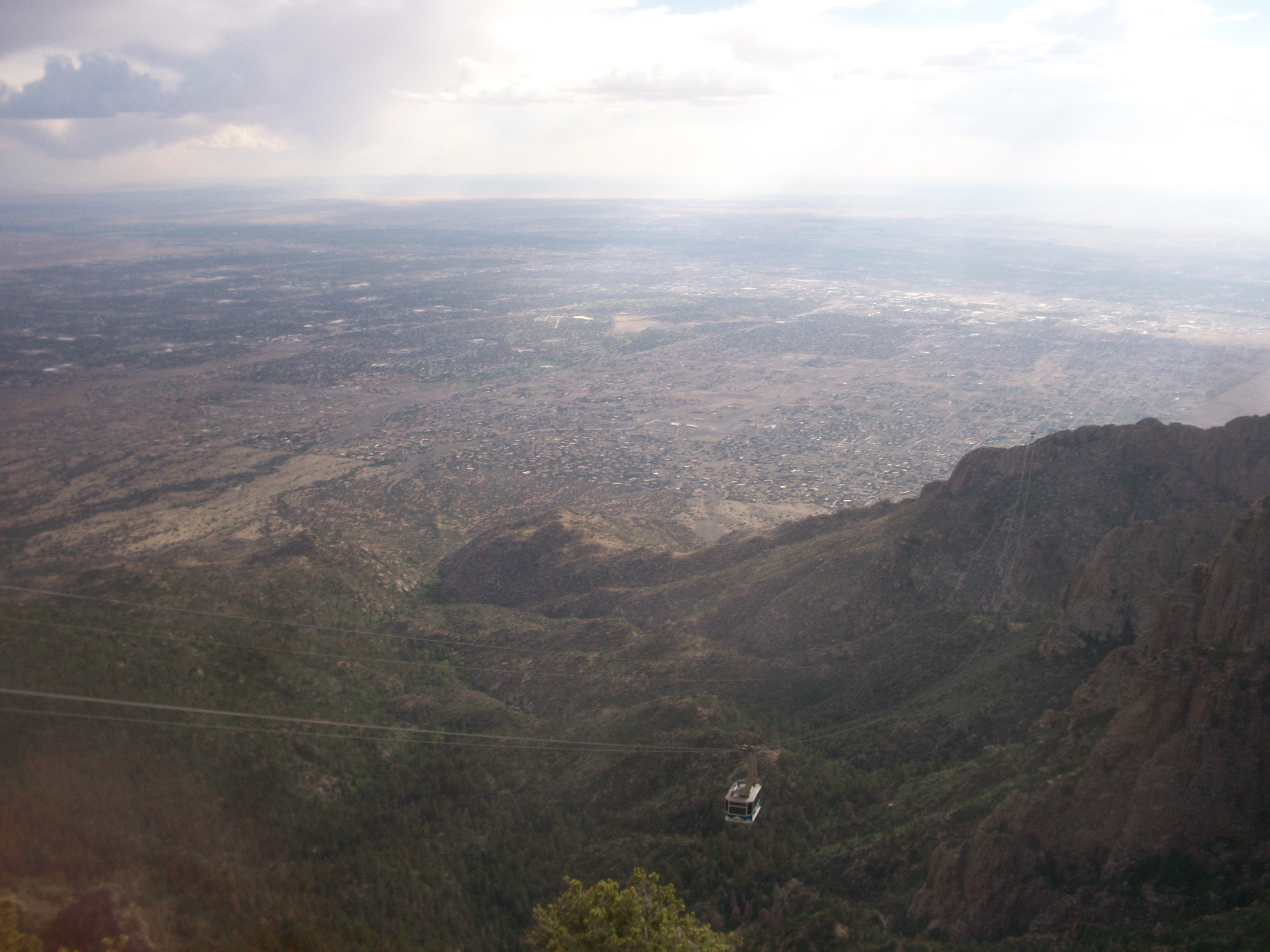
Sandia Peak Tramway
It took 5,000 helicopter flights just to build it. The Sandia Peak Tramway stretches 2.7 miles from the northeastern edge of Albuquerque to the crest of the Sandia Mountains, climbing nearly 4,000 feet in fifteen minutes. When it opened on May 7, 1966, it was the longest aerial tramway in the world. The idea came from a ski trip to Switzerland, where Robert Nordhaus watched alpine trams glide above the slopes and thought: we could do that in New Mexico. He partnered with Ben Abruzzo, a balloonist who understood thin air and ambitious engineering, and together they hired Bell Engineering of Lucerne to make the impossible real.
A Balloonist and an Economist's Father
The Sandia Peak Ski Company emerged from an unlikely partnership. Ben Abruzzo would later gain fame as a balloonist, but in the early 1960s he was a businessman with a vision for recreational development on the Sandia range. Robert Nordhaus was a lawyer and outdoorsman whose son William would go on to win the Nobel Prize in Economics. Nordhaus had seen the gondolas and tramways of the Swiss Alps and recognized that Albuquerque's dramatic mountain backdrop was perfect for something similar. The Sandia Mountains rise abruptly from the high desert, their western face a sheer wall of granite that seemed to dare anyone to build across it.
Engineering Against Gravity
The construction challenge was staggering. The tramway route crosses terrain so steep and rugged that conventional building methods were impossible. Workers and materials had to be airlifted by helicopter - over 5,000 trips in total. The second support tower alone required more than 2,000 helicopter flights to construct, with support rods driven deep into the granite bedrock. The finished tramway uses just two towers along its entire span, a testament to the engineering precision required. Bell Engineering of Lucerne, Switzerland designed a double reversible jigback system: as one car ascends, the other descends. Each car carries 50 passengers and includes multiple emergency braking systems and lightning protection.
New Year's Eve on the Cable
On December 31, 2021, the tramway reminded everyone that mountains do not negotiate with schedules. A winter storm caused the emergency cable to ice over and droop onto the track cables, freezing the system mid-course. Twenty people - nineteen restaurant employees from TEN 3 at the summit terminal and one tram operator - were trapped in the downhill car, suspended above the mountainside as wind and snow battered them through the night. A second operator was stranded alone in the uphill car. They hung there for over seventeen hours. On the afternoon of January 1, 2022, members of the Albuquerque Mountain Rescue Council helped passengers rappel down the upper tower, then hiked them to a point where a Bernalillo County Sheriff's helicopter could extract them. Everyone survived without injury.
Fifteen Minutes to the Top of the World
More than twelve million passengers have ridden the Sandia Peak Tramway since 1966. The fifteen-minute ascent climbs from the desert floor to the mountain crest, where the viewshed encompasses all of Albuquerque and stretches across roughly 11,000 square miles of New Mexico landscape. At the top, the tram terminal connects to the Sandia Peak Ski Area on the mountain's opposite face, along with Forest Service hiking and mountain biking trails that wind through the high-altitude forest. There is no public transit to the base station - you arrive by car, bicycle, or on foot, then step into a glass-and-steel cabin and trade the brown desert for green alpine forest in the time it takes to drink a cup of coffee.
From the Air
Located at 35.19N, 106.48W on the western face of the Sandia Mountains, immediately east of Albuquerque. The tramway cables are visible as thin lines running up the steep mountain face from the city edge to the crest. The Sandia range itself is unmistakable - a massive north-south granite wall rising abruptly from the Rio Grande valley. Nearest airport is Albuquerque International Sunport (KABQ), approximately 15 miles southwest. Caution: mountain wave turbulence common along the Sandia ridge in strong westerly winds.