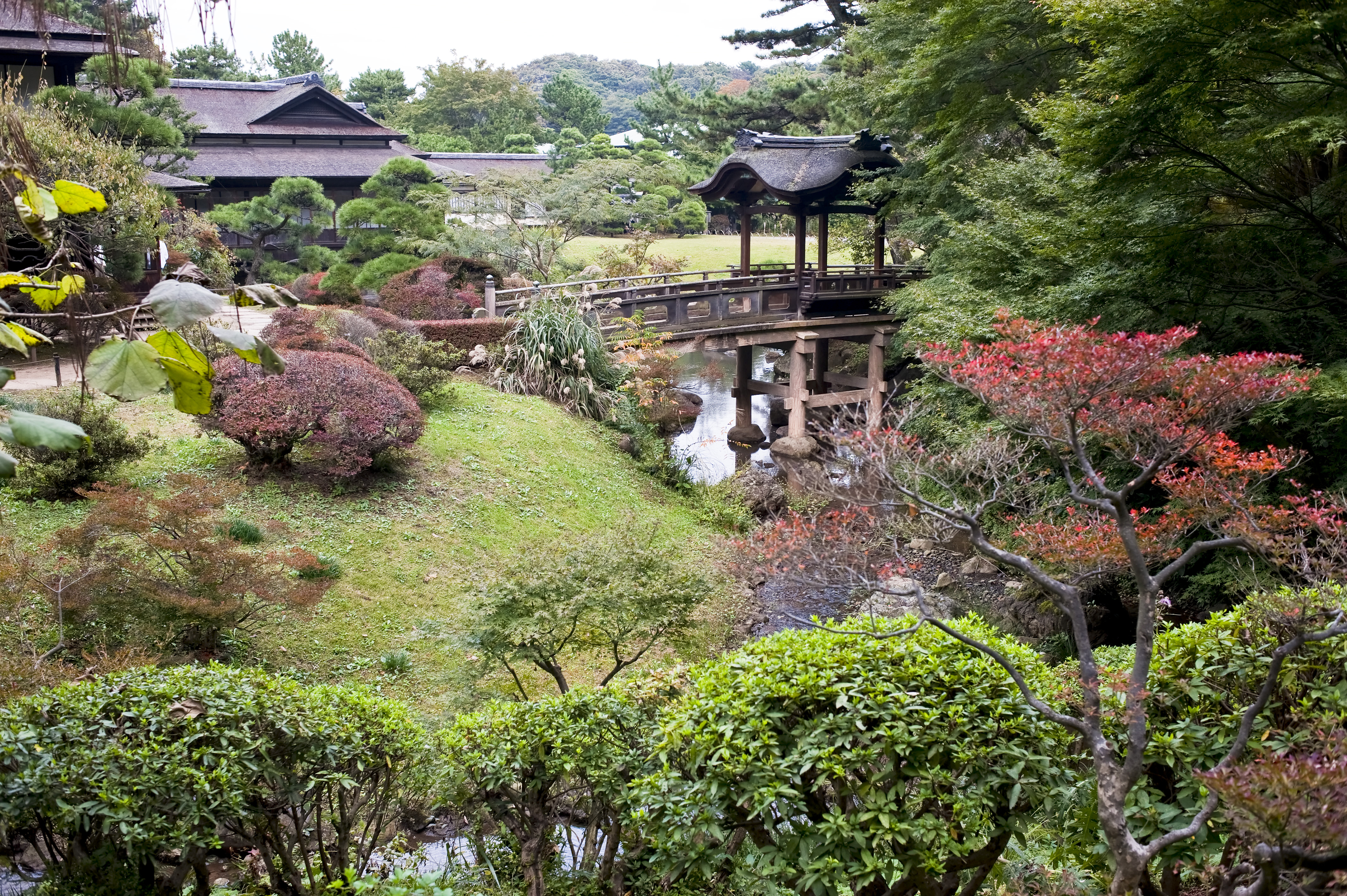
Sankei-en: The Silk Trader's Garden of Rescued Buildings
Most gardens are designed around plants. Sankei-en was designed around buildings. Tomitaro Hara, a silk trader who had married into one of Yokohama's wealthiest merchant families, began buying historic structures from across Japan in the late nineteenth century -- tea houses, pavilions, farmhouses, entire architectural treasures that might otherwise have been demolished or left to decay. He dismantled them, shipped them to his estate on the Honmoku waterfront in Yokohama's Naka Ward, and rebuilt them among carefully landscaped hills, ponds, and groves. Then, in 1906, he did something that Meiji-era industrialists almost never did: he opened the gates and let the public walk through for free. What visitors found was not just a garden but a portable museum of Japanese architectural history spanning nearly a thousand years, arranged so that a stroll around a single pond could carry you from the age of feudal warlords to the refined aesthetics of the Tokugawa shoguns.
A Warlord's Gift for His Mother
The oldest and most significant structure in Sankei-en is a building that Toyotomi Hideyoshi -- the peasant-born general who unified Japan in the late sixteenth century -- constructed in 1591 as a resting place for his mother. Designated an Important National Cultural Property, it is one of the few extant buildings attributable with certainty to Hideyoshi himself. That a structure built by Japan's most famous unifier ended up in a silk trader's garden in Yokohama speaks to the strange afterlife of Japanese architecture: buildings that survived wars, fires, and centuries of earthquakes sometimes could not survive neglect, and it took private collectors like Hara to give them a second existence. The building now stands among cherry trees and manicured paths, its sixteenth-century timbers holding firm in a landscape Hideyoshi never imagined.
Shoguns and Tea Masters
Two other structures in Sankei-en hold the Important National Cultural Property designation. The Choshukaku pavilion is traditionally attributed to Tokugawa Iemitsu, the third Tokugawa shogun, who consolidated his family's grip on Japan in the early seventeenth century. The pavilion opens to the public in spring and again in November, when visitors come for momiji-gari -- the traditional viewing of autumn colors that turns Japanese parks into living paintings of red and gold. Nearby stands the Shunsoro, a tea room believed to have been built for Oda Urakusai, the younger brother of the legendary warlord Oda Nobunaga. Urakusai chose tea over war. He became a renowned practitioner of the Japanese tea ceremony and his tea room reflects that sensibility -- intimate, austere, designed for the quiet ritual of preparing and sharing matcha. Hara placed these buildings in conversation with each other across the garden's landscape, so that the martial power of the Tokugawa and the cultivated restraint of the tea masters exist side by side, connected by gravel paths and the sound of water.
The Collector's Eye
Tomitaro Hara was born in 1868, the first year of the Meiji era, when Japan was reinventing itself at furious speed. The old feudal estates were being broken up. Castles were being sold for scrap. Temples that had stood for centuries lost their patrons and their purpose. Hara, who had taken the pseudonym Sankei, saw what others discarded as opportunity. His silk trading fortune gave him the means, and his aesthetic sensibility gave him direction. He did not merely buy buildings; he curated them. Each structure was placed within the garden's topography with the same care a museum director might use to hang a painting. Hills were graded, ponds were dug, trees were planted to frame views. The Kakushokaku, the Old Yanohara House, and the Rinshunkaku were all brought to Honmoku and rebuilt with painstaking attention to their original construction. Hara spent decades on this project, and by the time he opened the garden in 1906, he had created something Japan had never quite seen before: a private collection of architecture displayed as a public park.
A Garden for Everyone
Sankei-en still operates as a public garden today, spread across the Honmoku hillside overlooking Yokohama harbor. Cherry blossoms draw crowds in spring. The autumn foliage season brings visitors back for the blazing maples framing the Choshukaku. A three-story pagoda rises above the tree canopy and has become the garden's visual signature, photographed in every season against skies that shift from the pale blue of winter to the heavy gray of the June rainy season. Visitors can sit in the tea house, drink matcha, and eat dango -- sweet rice dumplings -- while looking out over a landscape designed by a man who believed that the best of Japan's past should not be locked behind estate walls. Hara died in 1939, but his garden endures as both an act of preservation and a statement of principle: that beauty built for one lord or one shogun belongs, in the end, to everyone willing to walk through the gate.
From the Air
Coordinates: 35.417°N, 139.660°E, on the Honmoku waterfront in Naka Ward, Yokohama. From the air, Sankei-en is identifiable as a large green space on the southeastern coast of Yokohama, distinguished from surrounding urban development by its mature tree canopy and traditional rooflines. The three-story pagoda is the most visible structure from altitude. The garden sits south of the main Yokohama waterfront and Minato Mirai skyline. Tokyo Haneda Airport (RJTT) is approximately 17 nautical miles to the north. Yokohama Bay Bridge is visible to the north-northeast. Best viewed at 1,500-3,000 feet AGL, where the contrast between the garden's green canopy and the dense urban surroundings is most striking.