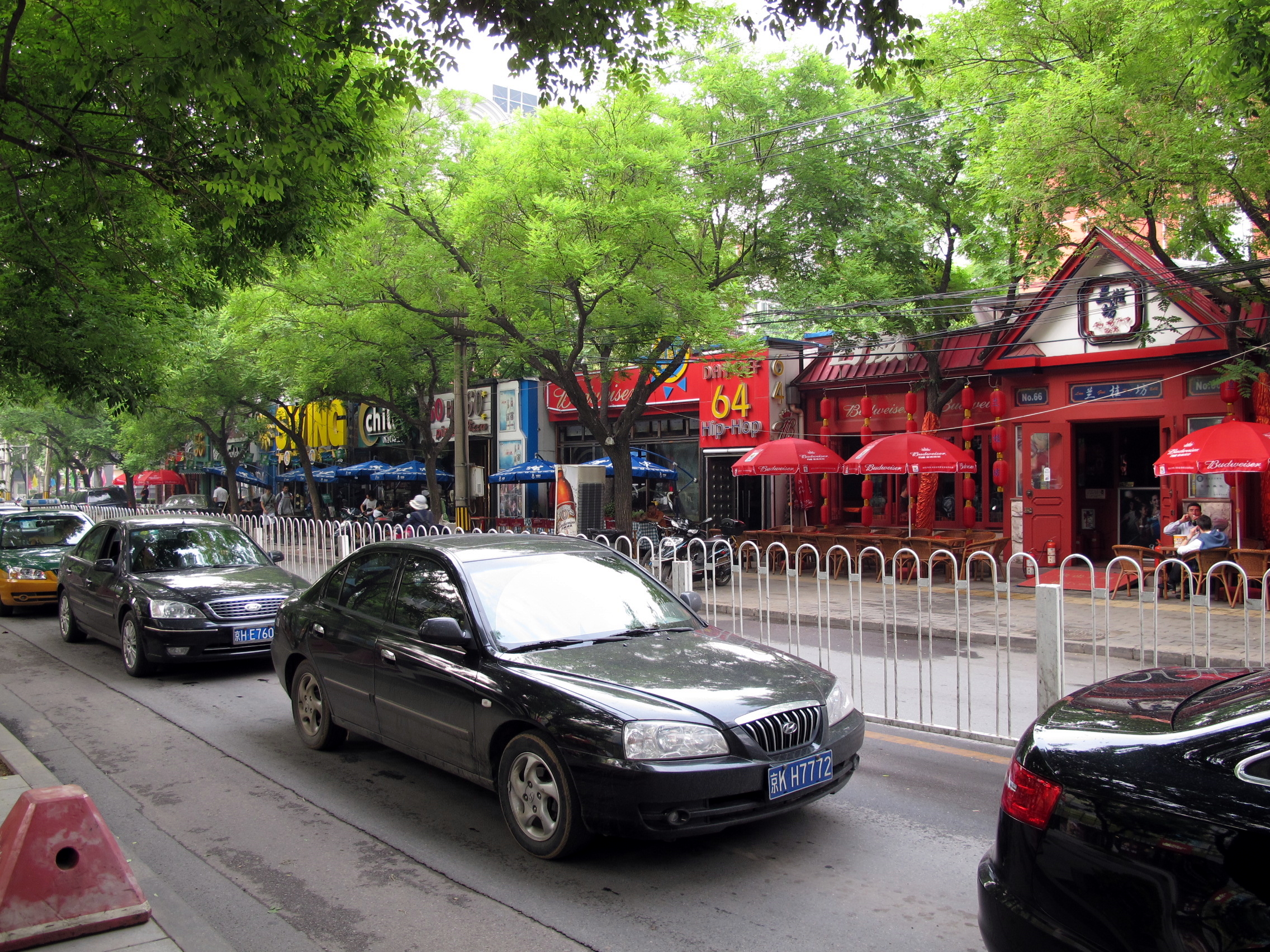
Sanlitun
The name is a measurement disguised as a place. San li means "three li" -- about 1.5 kilometers -- and tun means "locality." Sanlitun was simply the spot 1.5 kilometers from Dongzhimen Gate, one of Beijing's old city entrances. For centuries, that was all it was: a distance. Then the embassies arrived, then the bars, and then Sanlitun became something the precise Ming-era cartographers who named it could never have anticipated: Beijing's answer to the question of what happens when a communist capital discovers nightlife.
The Diplomatic Seedbed
Before 1949, the center of diplomatic activity in Beijing was the Legation Quarter near Tiananmen Square. When the People's Republic was established, the new government wanted the foreign embassies out of the inner city. Sanlitun was chosen as the relocation site in the late 1950s, and a cluster of embassy compounds transformed what had been unremarkable urban fringe into an international enclave. The embassies brought expatriates, and expatriates eventually wanted places to drink. International hotels introduced the first bars, but it was the 1990s -- during the economic liberalization that followed Deng Xiaoping's reform and opening-up policies -- that standalone bars began to appear. Accounts differ over which was first: one source credits Frank's Place in 1990, another the Cat Cafe in 1995.
Bar Street and Beyond
By the early 2000s, Sanlitun had become synonymous with Beijing nightlife. The first bar on North Sanlitun Road opened in 1995, and within three decades the district came to house roughly 70 percent of all bars in the capital. South Sanlitun Road, which once sold auto parts, was razed to make room for what became known as Bar Street. The 2008 Summer Olympics accelerated transformation: Sanlitun Village, a mixed-use development of shops, restaurants, bars, and a multiplex cinema, opened that year and was later renamed Taikoo Li Sanlitun. International brands poured in -- Uniqlo, Apple, Nike, Adidas, KFC. The district now hosts the largest Adidas store in the world, a fact that would have mystified the city planners who originally chose this patch of land for its convenient distance from a gate.
Gleaming and Gritty
Sanlitun's story is not all gleaming storefronts. In April 2008, a major police operation targeted drug trafficking in the district, closing four bars and resulting in executions for drug distribution -- an enforcement action widely criticized for its harshness and absence of due process. A beloved stretch of hole-in-the-wall restaurants and bars known as the "dirty street" was cleaned up in 2017 as part of Beijing's urban beautification campaigns. The district has also served as a setting for Chinese films and television, including Mr. Six and A Little Reunion, cementing its place in the popular imagination as the capital's most energetic, most cosmopolitan, and most unpredictable neighborhood.
Three Li from the Gate
Today, Sanlitun's geography encompasses the Workers' Stadium, Taikoo Li, Sanlitun SOHO -- designed by architect Kengo Kuma -- and the Mediterranean-styled Nali Patio. International schools, from the British School of Beijing to the Pakistan Embassy College, serve the diplomatic community that still forms the neighborhood's backbone. The area pulses with a restless energy that contrasts sharply with the historical gravity of the Forbidden City a few kilometers to the southwest. Sanlitun is where Beijing allows itself to be young, loud, and international -- still just three li from the gate, but a world away from the imperial capital it once served.
From the Air
Located at 39.935N, 116.450E in Chaoyang District, east of central Beijing. The Workers' Stadium and the embassy district are visible landmarks. The Taikoo Li shopping complex and surrounding bar streets form a dense commercial cluster. Nearby airports: Beijing Capital International (ZBAA) 20 km NE, Beijing Daxing International (ZBAD) 50 km S. Best viewed at 3,000-5,000 ft.