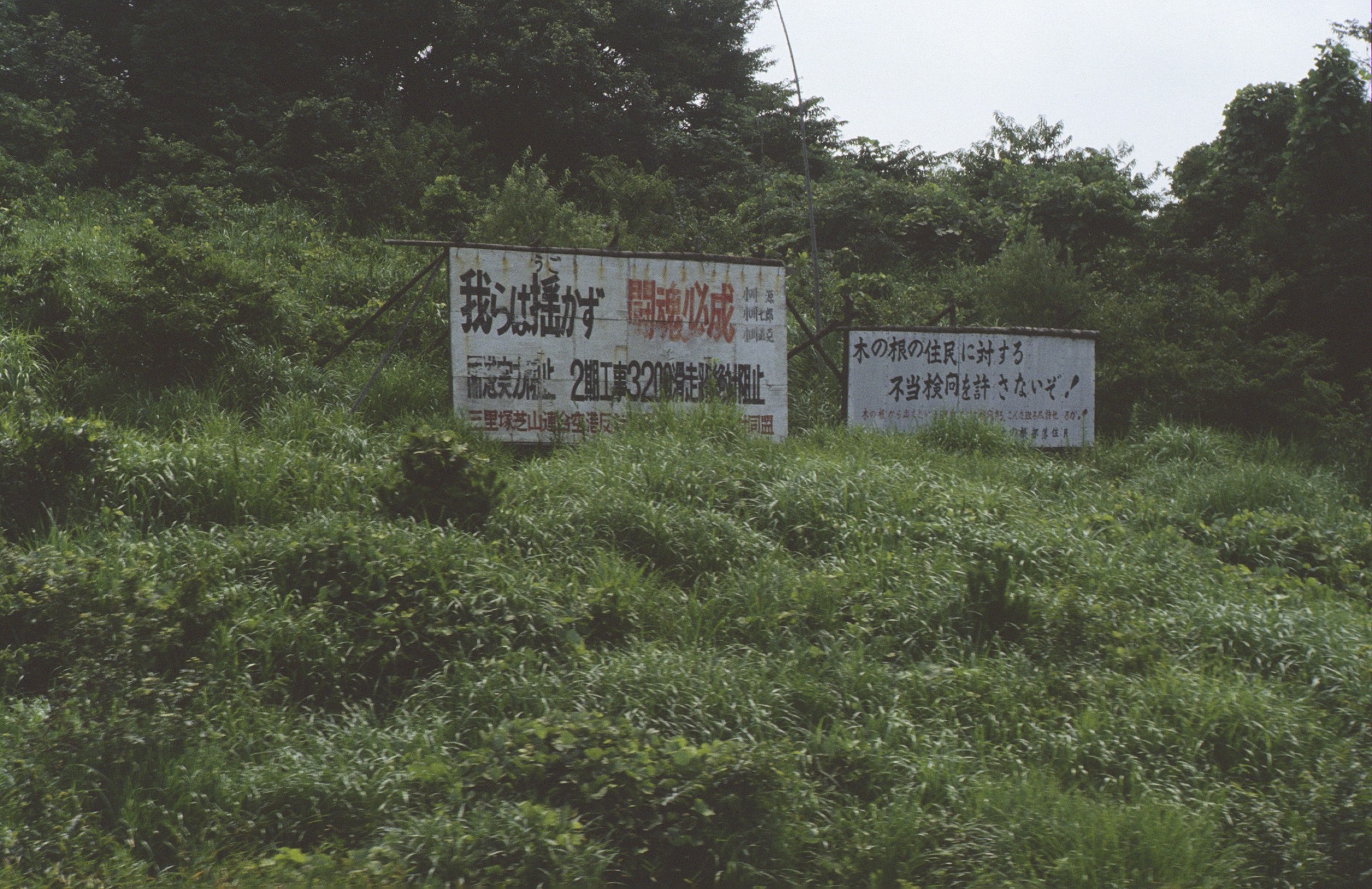
Sanrizuka Struggle
Nobody asked the farmers. On 18 November 1965, Chief Cabinet Secretary of the Sato government announced at a press conference that Japan's new international airport would be built in the agricultural heartland of Chiba Prefecture. The planned facility would consume half the town of Tomisato. Farmers who had worked the Shimosa Plateau for generations -- in some cases since the Edo period -- learned about the decision to erase their villages from a news broadcast. What followed was the Sanrizuka Struggle, one of the longest and most violent civil conflicts in postwar Japan: a decades-long battle pitting rice farmers, leftist students, and opposition politicians against riot police, construction crews, and the machinery of a government determined to give Tokyo a second airport. The airport eventually opened. But the struggle never truly ended.
Roots in Defiant Soil
The farmers of northern Chiba were not the sort to accept orders quietly. The region had been agricultural land since imperial times, when the emperor ordered horse and cattle pastures established on the Shimosa Plateau. Villages here since the Edo period were known as koson -- "old villages" -- and they carried a tradition of independence. Edo-era magistrates' jurisdiction never reached this far, fostering a culture of defiance toward political authority. Farmers' movements, unions, and strikes flourished here more than anywhere else in the prefecture. In the early twentieth century, the area became the Imperial family's Goryo Farm, where the Emperor's horses were stabled. Locals grew deeply attached to the farm's presence. When word spread that the airport would mean the Goryo Farm's disappearance, one resident recalled, it "made everyone around here go crazy." This was land people had fought for, worked, and defined themselves by. The government had chosen the wrong plateau.
The Decision No One Was Told About
Japan needed a second international airport. Haneda was overcrowded and could not expand. In November 1962, the Ikeda cabinet formally decided to build one, and by December 1963, the Aviation Council recommended the Tomisato area in Chiba Prefecture, making no mention of how the land would actually be acquired from the people living on it. Opposition movements sprang up immediately at every proposed site. The Tomisato-Yachimata Anti-Airport Union formed in 1963. When the Sato cabinet's 1965 announcement made the plan official, local farmers allied with the Japanese Communist Party and the Japan Socialist Party. Local government bodies that had been kept in the dark joined the resistance. The cabinet decision was temporarily suspended. But in 1966, facing the political impossibility of building at Tomisato, the Sato government quietly negotiated a switch to the nearby Sanrizuka site -- the very location of the Goryo Farm -- through secret talks with the Chiba prefectural governor and Liberal Democratic Party leaders.
Bamboo Spears and Underground Forts
The Sanrizuka-Shibayama Joint Anti-Airport Union formed in the summer of 1966, and opposition was nearly unanimous. Demonstrations, sit-ins, and petitions failed to halt the project. By 1967, the Japanese student movement was surging, and the union adopted a policy of accepting support "without regard for political faction." Students who had already clashed with riot police over the US-Japan Security Treaty brought their experience in confrontation. The struggle turned physical. Opposition members hurled raw sewage, chloropicrin gas, and stones. They fought with sickles and bamboo spears. They built fortifications on the contested land, some of them underground bunkers. On 22 February 1971, when the government enacted the first administrative subrogation to seize the land, supporters clashed directly with construction workers and riot police. The forts were demolished. But the resistance reshaped itself and continued.
Seventeen Thousand Strong
In January 1977, the Fukuda cabinet declared that Narita Airport would open within the year. On 17 April, the opposition mobilized 17,500 people -- the all-time peak of the movement -- for a general rally in a Sanrizuka public park. Thousands of riot police faced them. The airport eventually opened on 20 May 1978, but not without further violence. Anti-airport activists stormed the control tower the day before opening. The union's slogan shifted from "Certain Prevention of the Airport" to "Airport Abolition -- Stop Second Phase Construction." Then Issaku Tomura, the union's leader and psychological anchor, died of illness. With the airport operational and its leader gone, many participants withdrew. Leftist and student groups, originally supporters, gradually took charge of what remained.
The Land That Would Not Yield
Decades later, the struggle's physical traces remain visible around Narita Airport. Anti-airport slogans painted on farmhouse roofs. A steel tower erected by holdout farmers. Parcels of land within the airport perimeter that were never purchased, their owners' refusal a quiet monument to the original resistance. Manholes near the airport are sealed against infiltration by extremists. Police facilities dot the surrounding countryside. A plum tree monument erected in 1995 in Furugome common land carries wishes for coexistence -- an acknowledgment, decades after the first clashes, that reconciliation required more than concrete. The Sanrizuka Struggle transformed how the Japanese government approaches land acquisition and public consultation. It also left an airport surrounded by the evidence of its own contested birth, a place where the runways and the resistance exist in permanent, uneasy proximity.
From the Air
Located at 35.765°N, 140.386°E, directly adjacent to and surrounding Narita International Airport (RJAA). From the air, the legacy of the Sanrizuka Struggle is visible in the irregular patchwork of small agricultural parcels and holdout properties within and around the airport perimeter. Anti-airport protest signs on rooftops are visible at lower altitudes. The Yokobori steel tower, erected by opposition farmers, remains a landmark near the airport boundary. Best observed on approach to RJAA Runway 16R/34L, where the juxtaposition of active runway and resistant farmland is most dramatic.