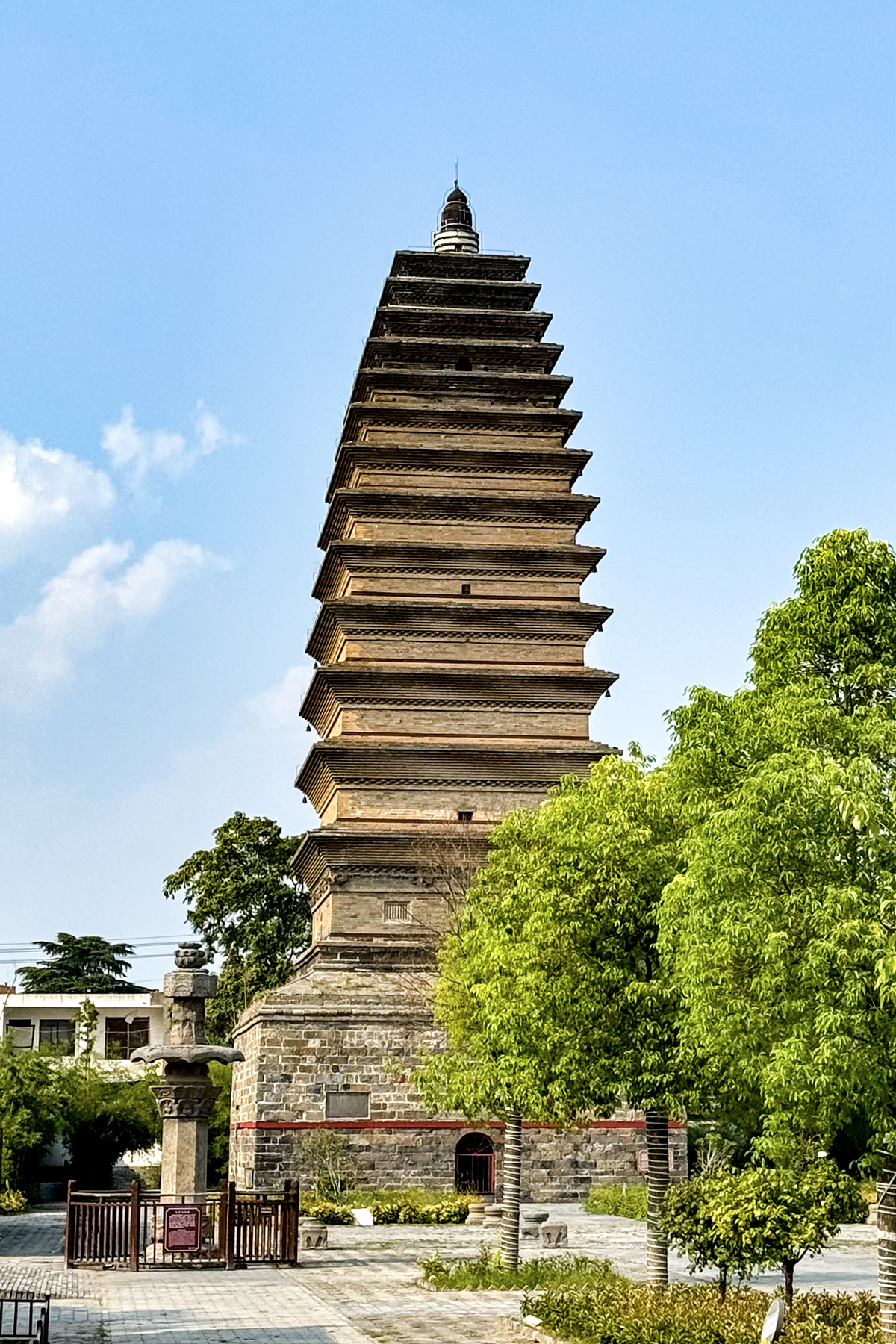
Sansheng Pagoda of Tianning Temple
Most pagodas taper in straight lines. The Sansheng Pagoda curves. Rising 32.76 meters above Qinyang in Henan province, its thirteen tiers of corbelled brick eaves trace a parabolic profile that gives the tower a silhouette unlike any other in the region. Built in 1171 during the Dading era of the Jin dynasty, it stands on a site where temples have been built and abandoned since the Sui dynasty -- a tower that outlasted the religious community that created it.
A Temple's Many Lives
The ground beneath the pagoda has carried different names through the centuries. A temple was first built here during the Sui dynasty (581-618) under the name Wanshou Temple. When the Tang dynasty took power, it was renamed Dayun Temple, and a wooden pavilion was added behind the main hall. During the Jin dynasty's Dading era, the complex was renamed again to Tianning Temple, and the Sansheng Pagoda was constructed on the exact spot where the Tang-era wooden pavilion had stood. The temple itself was eventually abandoned, leaving the pagoda standing alone -- a monument to a community that had dissolved around it.
Brick Upon Brick, Tier Upon Tier
The pagoda's construction reflects the Jin dynasty's sophisticated masonry traditions. Its square base covers over 140 square meters, with each side measuring 12.24 meters and rising 6.5 meters to a Sumeru pedestal. Above this platform, the thirteen layers of multi-eaved pagoda body stack upward, each tier slightly smaller than the one below, creating the distinctive parabolic curve. The corbelled eaves project outward at each level, casting bands of shadow that accentuate the tower's layered geometry. The overall effect is of a structure that seems to narrow not by stepping inward but by curving, as though the architects had bent straight lines into arcs through sheer persistence with brick and mortar.
From Abandoned Temple to National Treasure
After Tianning Temple fell into disuse, the pagoda stood for centuries as a solitary landmark. In 1984, the local government established the Qinyang Museum around it, giving the pagoda a new institutional context after its religious one had faded. On June 25, 2001, the State Council of China designated the Sansheng Pagoda as a National Key Cultural Relics Protection Unit, placing it among the country's most significant historical structures. The tower that once marked the back courtyard of a Buddhist temple now anchors a museum -- still standing, still curving skyward, more than 850 years after Jin dynasty builders laid its first course of brick.
From the Air
Located at 35.087N, 112.945E in Qinyang, Jiaozuo prefecture, Henan province. The pagoda stands 32.76 meters tall and is visible as a distinctive curved tower within the urban area of Qinyang. Nearest major airport is Zhengzhou Xinzheng International (ZHCC/CGO), approximately 100 km to the southeast. Luoyang Beijiao Airport (ZHLY) lies about 80 km to the southwest. Best viewed at 2,000-3,000 feet altitude in clear conditions where the parabolic profile is most distinctive.