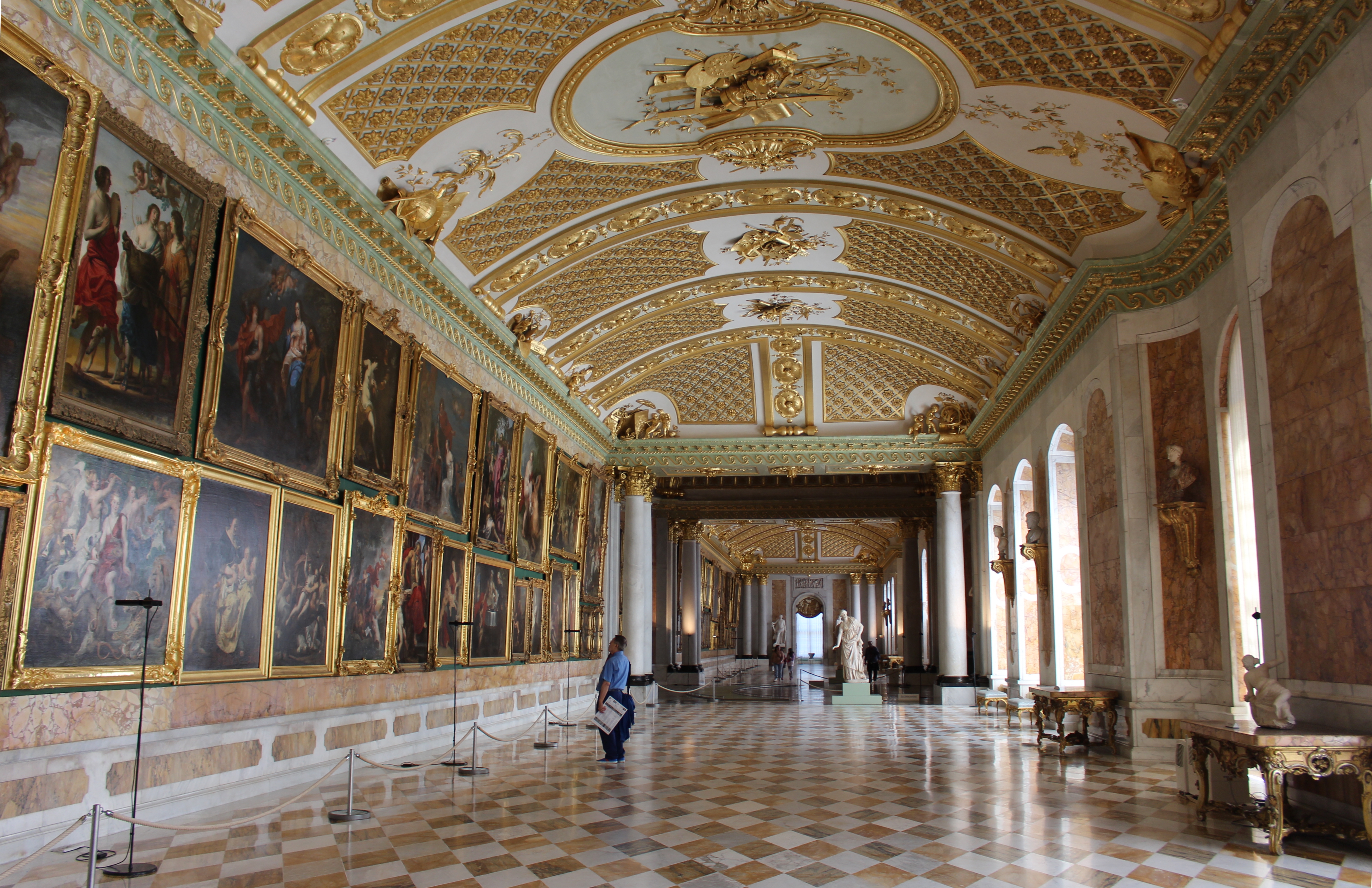
Sanssouci Picture Gallery
Frederick the Great kept a greenhouse east of his palace at Sanssouci where he grew tropical fruit, including pineapples, which were a serious flex in eighteenth-century Prussia. In 1755 he tore the greenhouse down and asked his court architect Johann Gottfried Buring to build a long, single-story yellow building with a domed center on the same footprint, this time for paintings. Construction took nine years. When it opened in 1764 it became the oldest purpose-built museum for a ruler anywhere in Germany. Frederick was a serious collector, and what he collected he hung densely on green silk walls in the baroque style, frame against frame, paintings stacked above one another. He acquired Caravaggio. He acquired Rubens. He acquired three Rembrandts. He hung them all in this one long room.
The collector king
Frederick II inherited the Prussian throne in 1740 and spent the next two decades fighting wars that doubled his kingdom. Between campaigns he played the flute, wrote philosophy in French, hosted Voltaire, and bought paintings. As a young king he favored the contemporary French Rococo and especially Antoine Watteau, whose dreamy fete galante scenes filled the walls of his rooms at Sanssouci itself. After he took the throne his taste shifted toward what eighteenth-century connoisseurs called history painting: large-scale narrative work from the Italian and Flemish baroque. By the time the Picture Gallery opened he had assembled 159 works, mostly Italian and Flemish, mostly biblical and mythological, with a few portraits. The gallery hall ran the long axis of the new building, with smaller paintings in an adjoining cabinet.
How the paintings have moved
When the Altes Museum opened in Berlin in 1829, the Prussian state moved about fifty paintings out of Sanssouci and into the new public museum, including a Correggio Leda, the three Rembrandts, several Rubens, the van Dycks, the Watteaus. The marble statues went too. Sanssouci kept what was left. In 1929 and 1930 the Prussian palace administration reversed course and brought 120 of Frederick's original 159 works back from Berlin. Then the Second World War scattered them again. The entire gallery collection was crated and moved to Rheinsberg Palace in 1944 for safekeeping. Only ten paintings were still there when the war ended in 1945. The rest had been seized by Soviet trophy brigades and shipped east. Most of what was taken came back in 1958 as part of a return of cultural property to the East German state. Some of it never came back, and remains in Russian museum storage to this day.
What hangs there now
Walk in today and the gallery hall is roughly as Frederick would have recognized it. The ceiling is curved and gilded with rococo ornament. The marble floor is laid in a rhomboid pattern of white and yellow Italian stone. The walls are still green, the frames still touch each other, the paintings still climb the walls in tiers. Caravaggio's Incredulity of Saint Thomas is here, the doubting apostle pushing his finger into the wound in Christ's side. Anthony van Dyck's Pentecost hangs here. So does the Four Evangelists from Rubens's Antwerp workshop and a Saint Hieronymus from the same studio. Some of the wall positions are guesses, since wartime documentation was incomplete, but the overall arrangement reproduces Frederick's intent: not a museum of isolated masterpieces but a baroque pleasure room saturated with paint.
The empty spaces
The Sanssouci collection is one of many cases where the looted-art question stays open. The trophy brigades that emptied German museums in 1945 were operating with explicit Soviet government sanction, in part as compensation for the Soviet cultural property that the Nazis had destroyed or stolen on the eastern front. The 1958 returns were partial. A 2000 Russian law formalized state ownership of works that had not yet been repatriated. Some of Frederick's paintings, including a Raphael Christ that has only ever been seen since the war as a copy made by the painter Alfred Lange in 1899 and preserved in a church in Szprotawa, Poland, are presumed lost or held in storage in Russia. Negotiations between Germany and Russia over trophy art have moved slowly for decades. The empty spaces in the gallery wall arrangement are filled now, but a researcher who knows the inventory can still see where things used to be.
From the Air
The Picture Gallery sits at 52.40 N, 13.04 E in Sanssouci Park on the western edge of Potsdam, just east of Sanssouci Palace itself. Berlin Brandenburg Airport (EDDB) is 45 km east. The long yellow building with its central dome is visible from low altitude as part of the Sanssouci complex, with the famous vine-terrace gardens descending in front of the palace and the Picture Gallery on the eastern flank.