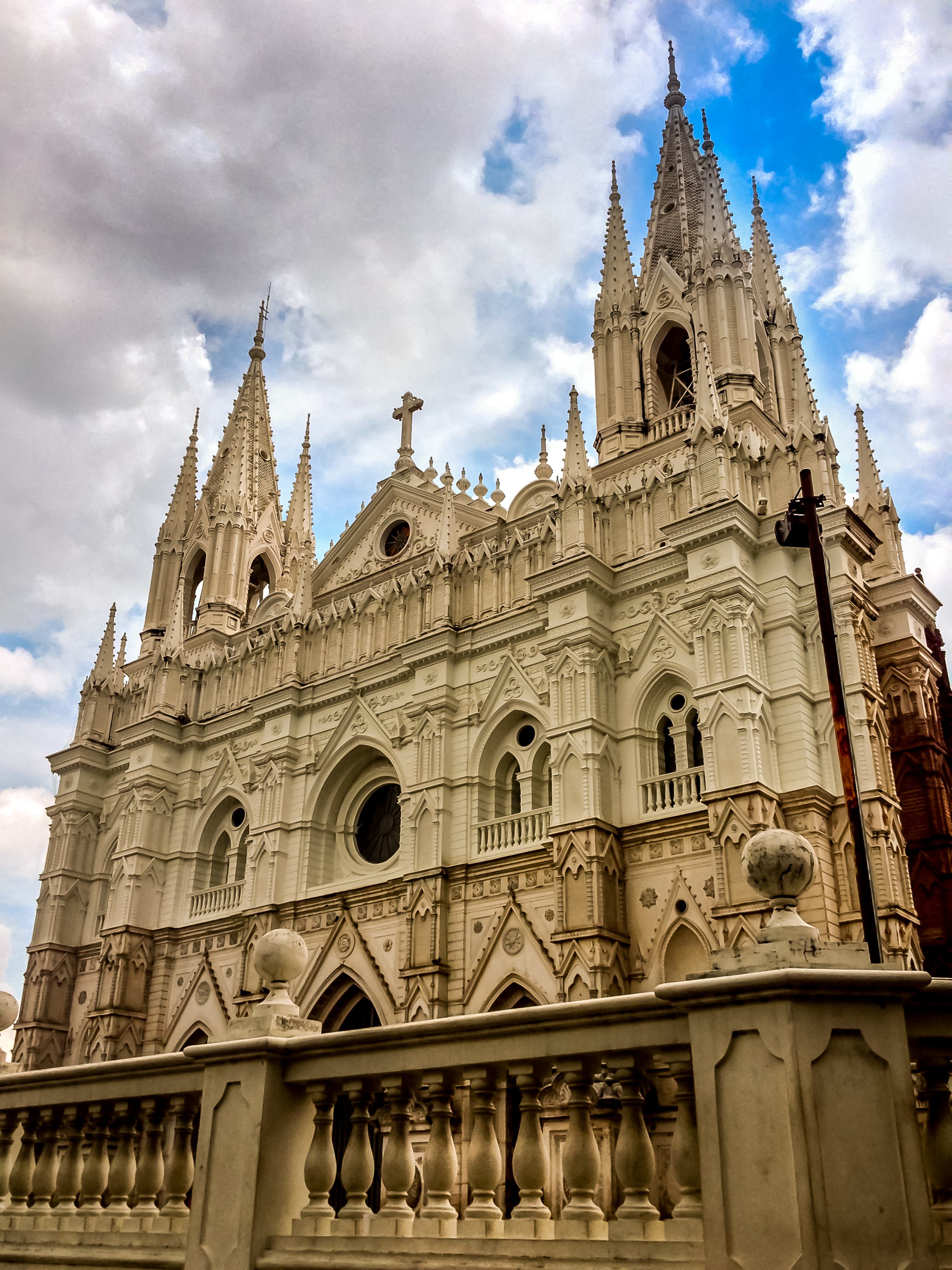
Santa Ana Cathedral, El Salvador
Lightning destroyed the first one. That detail alone sets the Cathedral of Our Lady Saint Anne apart from most churches in Central America, where earthquakes do the usual demolition work. The original parish on this site in Santa Ana, El Salvador, was built between 1575 and 1576, one of the earliest colonial churches in the region. When a bolt from the sky brought it down sometime in the 19th century, the congregation did not simply rebuild in kind. They chose something radically different -- a neo-Gothic cathedral in a country where every other major church follows the Spanish colonial template.
A Gothic Stranger in a Colonial Land
Walk through any city in El Salvador or broader Latin America, and the cathedrals follow a pattern: thick stucco walls, barrel vaults, baroque facades carved from local stone. Santa Ana's cathedral breaks every one of those rules. Its pointed arches, ribbed vaulting, and twin bell towers belong to the Gothic Revival tradition of northern Europe, not the sun-baked plazas of Central America. The reconstruction was authorized in 1904 and formally began on January 21, 1906. By February 11, 1913, the structure was consecrated, though it would take another 46 years of ongoing work before the marble altar bearing the image of Saint Anne was completed and consecrated on February 24, 1959. That span -- from groundbreaking to final altar -- covers two world wars, the Great Depression, and a half-dozen changes of Salvadoran government.
Bells from Two Worlds
The cathedral's twin towers each hold three bells, but they operate by different logics. The north tower's bells are rung by hand, pulled on ropes the way church bells have been rung for centuries. The south tower's bells arrived from the Netherlands in 1949 and are activated electronically -- a small technological revolution hidden inside a Gothic shell. The contrast captures something about the building itself: tradition and modernity layered together, neither fully displacing the other. Inside, the cathedral holds 28 paintings and statues, 4 confessionals, 118 pews, and 51 lamps. The numbers read like an inventory, but they represent decades of accumulation, each piece donated or commissioned as the decades of construction crawled forward.
Three Naves in the Shape of a Cross
The interior is organized around three naves that together form a cross. The central nave stretches 22 meters in both length and width, a generous square of open space beneath the vaulted ceiling. The two lateral naves are narrower, each measuring 8 meters wide. The proportions give the interior a sense of height and aspiration that the colonial churches of El Salvador rarely achieve. Light enters through the tall, narrow windows characteristic of Gothic design, casting long shadows across stone floors that have absorbed the footsteps of generations. On April 22, 1995, the Salvadoran government declared the cathedral a National Monument, an acknowledgment that the building had become more than a place of worship -- it was a landmark anchoring the identity of Santa Ana itself.
The City and Its Cathedral
Santa Ana is El Salvador's second-largest city, a place built on coffee wealth in the late 19th and early 20th centuries. The cathedral sits at the heart of the central plaza, facing the municipal theater and the old government palace in a triangle of civic pride that reflects the ambitions of the coffee elite who funded much of the city's infrastructure. The decision to build a Gothic cathedral rather than another colonial church was itself a statement -- an assertion that Santa Ana was cosmopolitan, connected to European culture, and willing to stand apart from the capital. More than a century later, the cathedral remains the most distinctive religious building in the country, its spires rising above a city that has weathered civil war, earthquakes, and economic upheaval while the bells -- some pulled by hand, some triggered by electricity -- continue to mark the hours.
From the Air
Located at 13.995N, 89.555W in downtown Santa Ana, El Salvador's second-largest city. The cathedral's twin neo-Gothic towers are a distinctive landmark from the air, especially notable for standing out from the colonial architectural style of surrounding buildings. Nearest major airport is El Salvador International (MSLP) approximately 55 km to the southeast. Santa Ana Volcano (Ilamatepec) rises prominently to the southwest.