Santa Cruz de Mompox
The river made Mompox, and then the river abandoned it. Founded in 1537 as a port on the Magdalena -- Colombia's great artery connecting the Caribbean coast to the Andean interior -- Santa Cruz de Mompox grew wealthy on the traffic of gold, goods, and enslaved people flowing between Cartagena and Bogota. A royal mint operated here. Goldsmiths hammered filigree from Antioquian gold. Then, in the early twentieth century, sediment choked the branch of the Magdalena that flowed past the town, and the shipping routes shifted to rival Magangue. Commerce left. The modern world mostly followed. What remained was an almost perfectly preserved colonial city, its churches and mansions standing exactly as they had for centuries, waiting for UNESCO to recognize in 1995 what neglect had accidentally conserved.
"Be Free or Die"
On August 6, 1810, inside the colonial City Hall that still stands on its original foundations, Mompox became the first town in Colombia to declare independence from Spain. The motto they chose -- "Ser libres o morir," be free or die -- appears on the town's red-and-white-cross flag to this day. Simon Bolivar arrived two years later, in 1812, and recruited 400 men from Mompox for his Admirable Campaign. His gratitude was specific: "If to Caracas I owe my life, to Mompox I owe my glory," he reportedly said. A monument called Piedra de Bolivar commemorates his time here. The town's revolutionary spirit was no accident -- as a wealthy trading hub with an educated elite, Mompox had both the resources and the ideological fervor to act before any other Colombian city dared.
Churches, Ironwork, and Baroque Domes
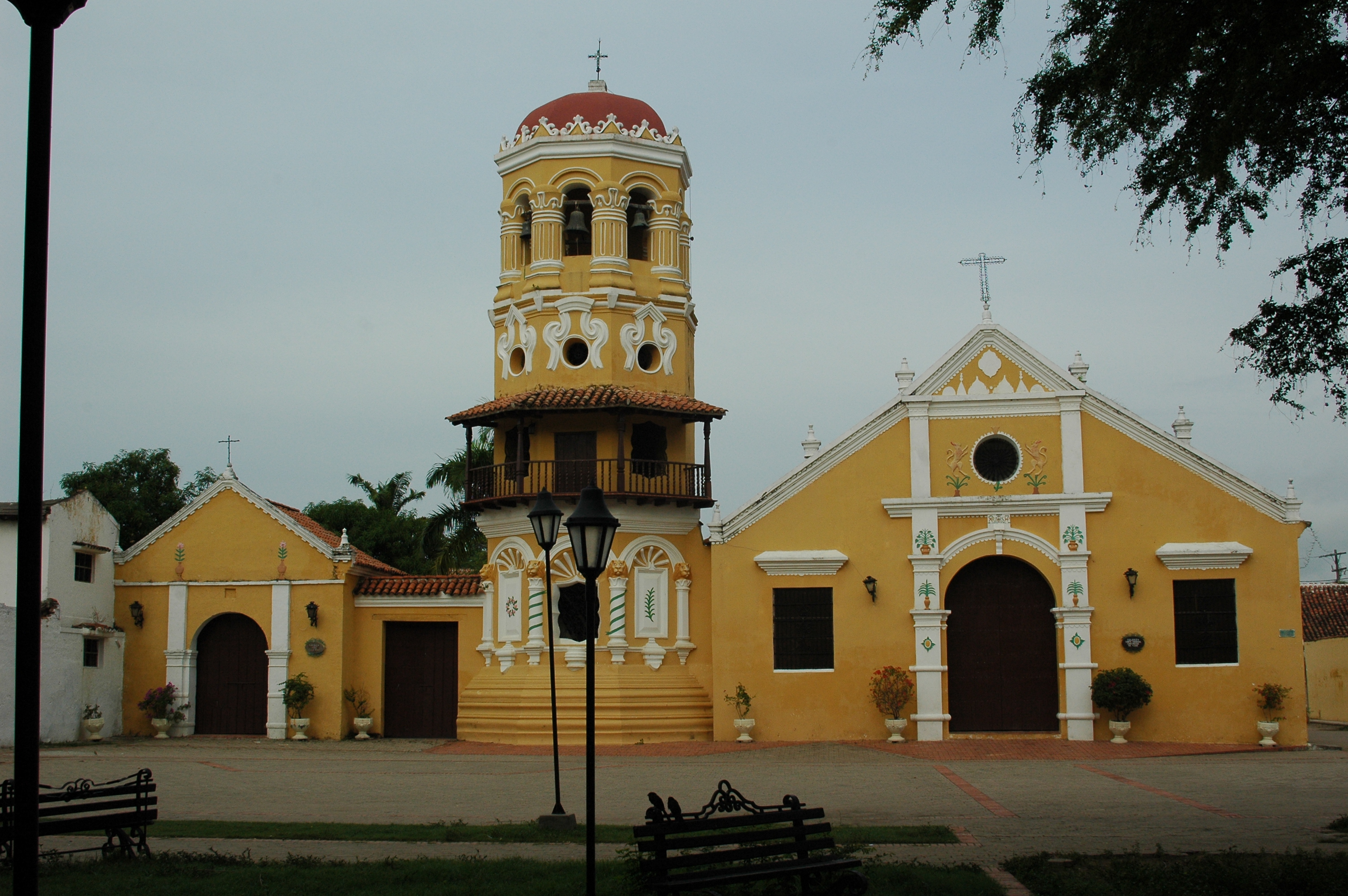
Three streets run the length of Mompox parallel to the river: Calle de la Albarrada along the waterfront, Calle Real del Medio through the center, and Calle de Atras at the back. Walking them is an exercise in colonial architecture largely unchanged since the seventeenth and eighteenth centuries. The Santa Barbara Church, completed in 1613, rises with a baroque bell tower decorated with moldings of palm trees, flowers, and lions, its three altars heavily gilded. San Agustin dates to 1606. The Church of the Immaculate Conception, originally built in adobe by Pedro de Heredia in 1541, was rebuilt so imposingly that locals considered it the town's cathedral. Wrought ironwork -- on doors, railings, and window grills -- gives the streetscapes a distinctive texture. San Juan de Dios Hospital, founded in 1550, is considered the oldest hospital in the Americas still operating in its original building.
Threads of Gold and Silver
Mompox filigree is not merely decoration. It is a craft born from the convergence of three traditions: indigenous casting techniques, metalworking knowledge brought by enslaved Africans, and the European filigree tradition that arrived with the Spanish. Artisan guilds established themselves here in the sixteenth century, and Mompox's position as a gold-trade crossroads ensured a steady supply of raw material. The technique involves weaving fine threads of metal into intricate spirals and organic forms -- flowers, leaves, vines -- creating jewelry and ornamental pieces of extraordinary delicacy. As gold prices have risen, contemporary artisans have increasingly worked in silver, adapting the craft to economic reality without abandoning its essential character. Walking through the workshops on Calle Real del Medio, you can watch the same techniques that have been practiced here for over four centuries.
Garcia Marquez's Ghost Town
Gabriel Garcia Marquez never set his novels explicitly in Mompox, but the town haunts his fiction. The isolation, the tropical decay, the sense of a place suspended between grandeur and forgetting -- these are the textures of Macondo, the fictional town at the heart of One Hundred Years of Solitude. The 1987 film adaptation of his novella Chronicle of a Death Foretold was partly shot here, the colonial streets providing a ready-made set that needed no decoration. Mompox's particular quality of magical realism is not literary invention but architectural fact: a town where seventeenth-century churches stand next to eighteenth-century mansions next to a cemetery whose chapel was built in 1846, all of it maintained not by deliberate preservation but by the economic stagnation that followed the river's retreat.
Holy Week and the Casabito
Each Holy Week, Mompox fills with pilgrims and tourists for celebrations that begin on Palm Sunday with a parade of flowers and candles honoring the dead. The processions wind through those three parallel streets, past the baroque churches, along the riverfront -- a living demonstration of the religious culture that built this town. The Mompox Jazz Festival and film festivals bring different crowds at different seasons. Year-round, the local gastronomy draws visitors: the casabito, a street-food omelet made with raw cassava, cheese, ground coconut, and sugar; queso de capa, a layered cheese with over a century of artisanal production; juice pressed from the purple corozo berry. The town that commerce forgot has found a new economy in its own past, selling not goods but the experience of a place where time moved differently and left its architecture intact as proof.
From the Air
Located at 9.24N, 74.43W on an island in the Magdalena River in northern Colombia. The town is visible as a compact colonial grid hugging the riverbank, with church towers marking its skyline. The Magdalena River's braided channels and wetlands spread across the surrounding floodplain. San Bernardo Airport (SKML) serves the town directly. Rafael Nunez International Airport in Cartagena (SKCG) is approximately 150 nm to the north-northwest. The 12-kilometer Reconciliacion bridge complex, inaugurated in 2020, is visible crossing the river to the west.