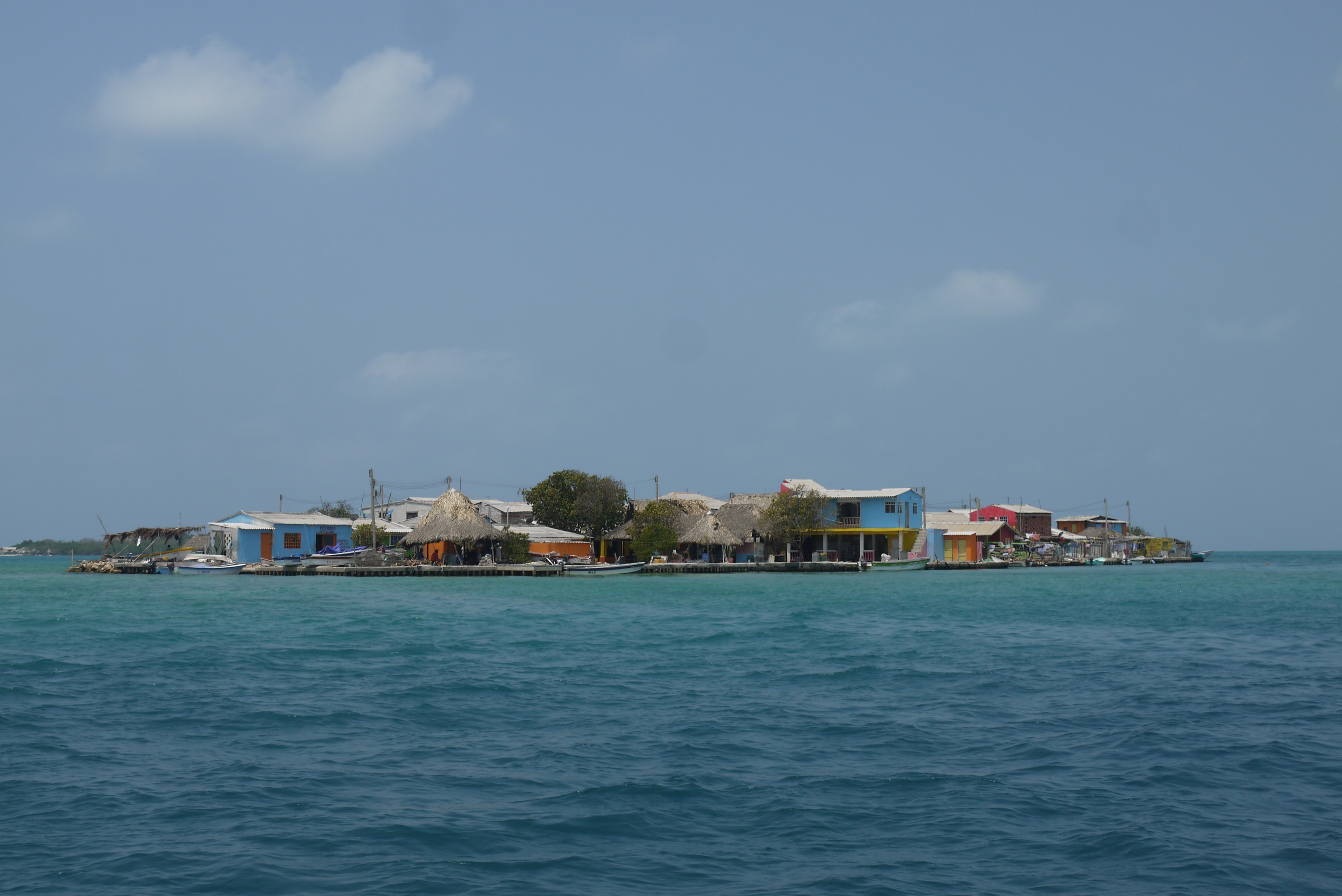
Santa Cruz del Islote
Nobody locks their doors on Santa Cruz del Islote. There is no police station, no jail, and by all accounts no crime -- not because of surveillance or enforcement, but because on an island smaller than two football fields, everyone knows everyone, and that knowledge is its own kind of order. This speck of coral and concrete off Colombia's Caribbean coast, barely three acres in the Archipelago of San Bernardo, holds roughly 500 people in about 100 houses. It has earned a reputation, sometimes exaggerated but never entirely wrong, as the most densely populated island on the planet.
Built from the Sea
The island was uninhabited until the 1860s, when fishermen from Cartagena and Tolu began stopping here to rest between catches and shelter from storms. They stayed. Then they expanded, using whatever the Caribbean provided -- seashells, coconut husks, tree trunks hauled from neighboring islands, sand, and even garbage. Over decades, the original coral platform grew outward as families piled material along its edges, creating new ground where the reef met the water. Today the island's 12,140 square meters hold a school, a health post, a restaurant that doubles as a port, and a small square centered on a Christian cross. There are no beaches and no mangroves, which the islanders credit for an unexpected blessing: no mosquitoes. The absence of sandy shoreline means there is no standing water where the insects breed.
The Numbers Game
The population figure that put Santa Cruz del Islote on the map -- 1,247 residents -- is almost certainly an exaggeration. A mid-2010s census fixed the number at 492, while another official source counted 779 for the broader administrative unit. What is not in dispute is the density: however you count the residents, roughly 500 people sharing three acres makes for a living arrangement tighter than most city blocks. The island holds 97 to 115 houses and 45 permanent families. Drinking water, food, and other essentials must be imported from the mainland. Power is limited and intermittent. Until August 2020, internet service was expensive and unreliable -- only then did the Colombian government establish a free 24-hour digital connection called Zona Digital Rural, allowing children to access distance education during the pandemic.
Caribbean Manhattan
Spanish-language media have called it "El pequeno Manhattan del Caribe" -- the little Manhattan of the Caribbean -- and the comparison is not entirely fanciful. From above, the island reads as a dense grid of rooftops packed edge to edge, with narrow passages serving as streets. Children play on the rooftops and swim from the island's concrete edges. Families rotate between the island and the mainland, fishing the surrounding waters and tending small plots ashore. The community's rhythms follow the sea: men leave early to fish, women manage the households, and the whole island gathers in the central square when the day's catch comes in. It is a place where community is not optional -- space is too scarce, resources too shared, and interdependence too obvious for anyone to be anonymous.
Resilience and Risk
In July 2021, Santa Cruz del Islote became the first territory in Colombia to be fully vaccinated against COVID-19 -- a distinction made possible precisely by its small size and tight-knit community. But that same compactness magnifies every threat. A tidal surge in 2018 flooded homes and damaged structures. Waste management remains a persistent challenge on an island with no landfill and limited infrastructure, though the community has contracted cleaning services to manage garbage. Tourism, drawn by the island's fame as the world's most crowded, brings both income and pressure. El Pais reported on efforts to protect the island from mass tourism, recognizing that too many visitors could overwhelm a community that depends on its own careful balance of space and social trust.
A Lesson in Living Close
What makes Santa Cruz del Islote remarkable is not the density statistic but what the density produces: a community where cooperation is structural rather than optional. Neighbors share walls, share water, share the narrow walkways between houses. Disputes are resolved within the community because there is no authority to escalate to. Children grow up surrounded not just by their own family but by every family on the island. The Guardian described the island as a place of "magical realism," and the comparison to Gabriel Garcia Marquez's literary world is apt -- a place where the improbable is simply ordinary, where 500 people coexist on a reef they built with their own hands from shells and refuse, three acres of human stubbornness floating in the Caribbean, without a locked door in sight.
From the Air
Located at 9.79N, 75.86W in the Archipelago of San Bernardo, off Colombia's Caribbean coast near Tolu and Covenas. From altitude, the island appears as a tiny rectangle of densely packed rooftops surrounded by turquoise water -- impossible to miss at low altitude, easy to overlook above 5,000 feet. The surrounding San Bernardo archipelago includes several larger islands and coral platforms. Nearest airports: Los Garzones Airport in Monteria (SKMU), approximately 80 nm south, and Rafael Nunez International Airport in Cartagena (SKCG), approximately 90 nm northeast.