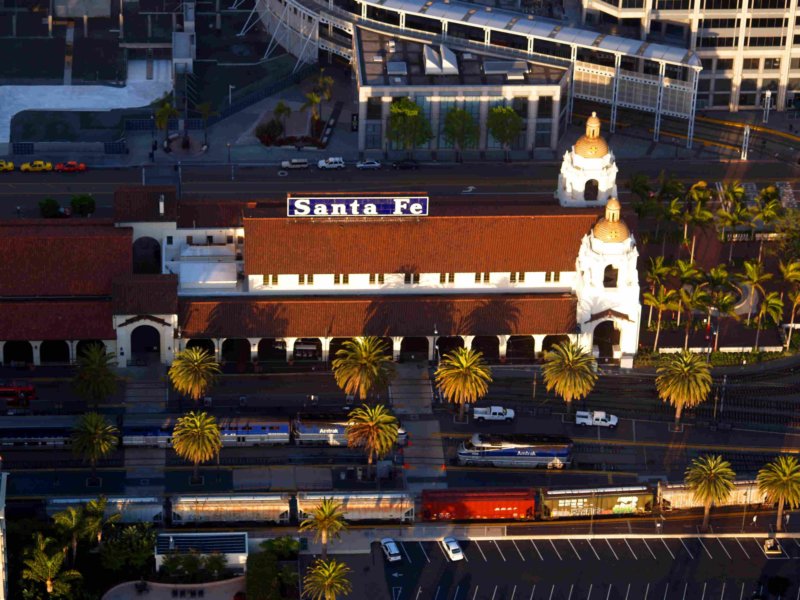
Santa Fe Depot (San Diego)
The twin tile-covered domes of the Santa Fe Depot rise over downtown San Diego like a promise made and only half-kept. The station opened on March 8, 1915 — timed precisely for visitors arriving to the Panama-California Exposition — and it was built with the ambition of a city that believed it would soon be the premier port on the Pacific. San Diego was wrong about the port. The station endured anyway, and it remains one of the finest Spanish Colonial Revival buildings in America.
A City Reaching for Transcontinental Glory
San Diego's railroad dreams were enormous and mostly frustrated. Since 1845, citizens had tried to establish a direct eastern rail link. When the Atchison, Topeka and Santa Fe Railway finally came, it came in stages — California Southern trains running the coast by 1882, then floods washing out the inland Temecula Canyon route, then a new coastal 'Surf Line' from Los Angeles. The fight for the transcontinental terminus was the bigger prize. Santa Fe needed a Pacific port, and San Diego had a natural deep-water harbor. But Los Angeles was 100 miles closer to the railroad's inland operations, and by 1911, when Santa Fe relocated its port to San Pedro's newly dredged harbor, San Diego's bid effectively ended. The new depot — which opened four years later — was built as though the city had already won.
The Building Itself
Architects John R. Bakewell Jr. and Arthur Brown Jr. designed the station, with Bakewell explicit about what they intended: 'decidedly not an archaeological replica of one of the old missions.' Instead, he designed something that drew from Spanish, Moorish, and Mexican architectural traditions without being beholden to any single model. The twin campanile towers, each capped by a glazed tile dome, frame a massive arched entrance. Inside, natural redwood beams cross the ceiling above walls tiled in elaborate Moorish patterns — green, yellow, blue, white, and black — manufactured just down the coast in National City. The covered concourse stretched 650 feet long and 106 feet wide. For 1915, it was an astonishing space. The original hundred-year-old oak benches still line the waiting room today.
Wartime Surge and Cold Peace
The depot reached its peak during World War II, when the 'Surf Line' carried the second-highest passenger volume of any rail corridor in the United States — surpassed only by the Pennsylvania Railroad's New York-Philadelphia run. Servicemen transiting through San Diego filled every train. Freight fell after the war, but passengers stayed, at least for a while. The San Diegan streamliner, inaugurated in 1938 on a two-and-a-half-hour schedule between San Diego and Los Angeles, became the city's link to the wider world. By January 1951, the last of the transcontinental connections through the depot had ended, leaving Santa Fe to run the station solo. The blue-and-white Santa Fe sign was added in the mid-1950s, a nostalgic gesture toward a railroad identity the station had already outlasted.
The Depot Today
Santa Fe Depot is still an active transportation hub — Amtrak's Pacific Surfliner, the COASTER commuter rail, the San Diego Trolley, and regional buses all converge here. In fiscal 2017, nearly 778,000 Amtrak passengers boarded or detrained, making it the third busiest station in California and tenth busiest in the national Amtrak system. The building is listed on the National Register of Historic Places and designated a San Diego Historic Landmark. The twin domes, the Moorish tile, and the century-old benches remain. The city never became the transcontinental railroad terminus it once imagined. But it kept the station.
From the Air
Located at 32.717°N, 117.170°W in downtown San Diego, just inland from San Diego Bay. Approach San Diego International Airport (KSAN) from the northwest — the twin domed towers of the depot are visible at low altitude, approximately 1 mile northeast of the runway threshold. Best viewed at 1,500-3,000 feet on a clear morning.