Santa Fe, New Mexico
Its full name is a mouthful: La Villa Real de la Santa Fe de San Francisco de Asis -- the Royal Town of the Holy Faith of Saint Francis of Assisi. Most people just say Santa Fe. Founded in 1610 as the capital of Spain's northernmost colonial province, this city at the foot of the Sangre de Cristo Mountains has never stopped being a capital, surviving the Pueblo Revolt of 1680, Mexican independence, the Mexican-American War, and the Civil War with its seat of government intact. At 6,998 feet, it is the highest state capital in the nation, and its thin, dry air produces the kind of light that has drawn painters, photographers, and dreamers for more than a century.
Four Flags Over the Plaza
The Plaza at the center of Santa Fe has watched flags change with remarkable regularity. The Spanish laid it out in 1610 according to King Philip II's Laws of the Indies, with the Palace of the Governors anchoring its north side. In 1680, Pueblo peoples drove the Spanish out entirely, governing from that same Palace for twelve years until Diego de Vargas reclaimed the city in 1692. Mexico's flag flew after independence in 1821, drawing traders along the Santa Fe Trail from Missouri. Then in 1846, General Stephen Kearny marched 1,700 soldiers into the plaza to claim it for the United States. For a few days in March 1862, even the Confederate flag flew here, before Union forces pushed General Sibley out after the Battle of Glorieta Pass. Through it all, Santa Fe endured -- not as a relic, but as a working capital.
Where Adobe Is Law
Santa Fe looks like no other American city, and that is by design -- literally. After the railroad bypassed the city in the 1880s, sending it into economic decline, civic leaders turned architectural unity into a survival strategy. They mandated the Pueblo Revival style: earth-toned stucco walls, flat roofs, vigas (exposed wooden beams), and canales (rain spouts). A 1957 ordinance made it official for all new construction in historic districts. The result is a city that appears to have grown organically from the desert floor, its buildings echoing the same palette of terracotta, sand, and ochre found in the surrounding landscape. Some locals call the stucco imposters 'faux-dobe,' but the overall effect is undeniable -- Santa Fe's streetscape is one of the most distinctive in North America.
A Canvas at 7,000 Feet
One-tenth of all employment in Santa Fe is connected to arts and culture, and writers and authors make up a higher proportion of the workforce than in any other American city. Canyon Road alone holds dozens of galleries in what was once a Pueblo trading path. Georgia O'Keeffe painted its landscapes. D.H. Lawrence, Cormac McCarthy, and George R.R. Martin all called it home. The Santa Fe Opera performs in an open-air theater carved into a hillside north of town, and Meow Wolf's House of Eternal Return -- backed by Martin -- turned a former bowling alley into an immersive art experience. In 2005, UNESCO inducted Santa Fe as the first American city in its Creative Cities Network, recognizing its concentration of folk art, craft, and indigenous artistic traditions.
The Secret Laboratory Next Door
Santa Fe's artistic reputation overshadows a parallel identity as a science hub. During World War II, the city served as the gateway to Los Alamos National Laboratory, just a 45-minute drive into the Jemez Mountains. The Manhattan Project's scientists bought their groceries and collected their mail here. That legacy persisted: in 1984, the Santa Fe Institute was founded to study complex systems, hosting Nobel laureates Murray Gell-Mann and Philip Anderson. The National Center for Genome Resources arrived in 1994. Today the city sits at one vertex of the New Mexico Innovation Triangle alongside Los Alamos and Albuquerque, balancing its identity as an arts capital with deep roots in physics, computation, and genomics.
Burning Old Man Gloom
Every September, as aspens turn gold in the Sangre de Cristos, Santa Fe holds its Fiestas -- a tradition dating to 1919 that commemorates Diego de Vargas's reconquest. The climax is the burning of Zozobra, a towering marionette representing 'Old Man Gloom.' Thousands gather to watch it writhe and collapse in flames, symbolically incinerating the anxieties of the past year. It is a ritual that captures something essential about Santa Fe: a city that has absorbed conquest, displacement, and reinvention across four centuries, yet still gathers in its ancient plaza to celebrate survival with fire and light.
From the Air
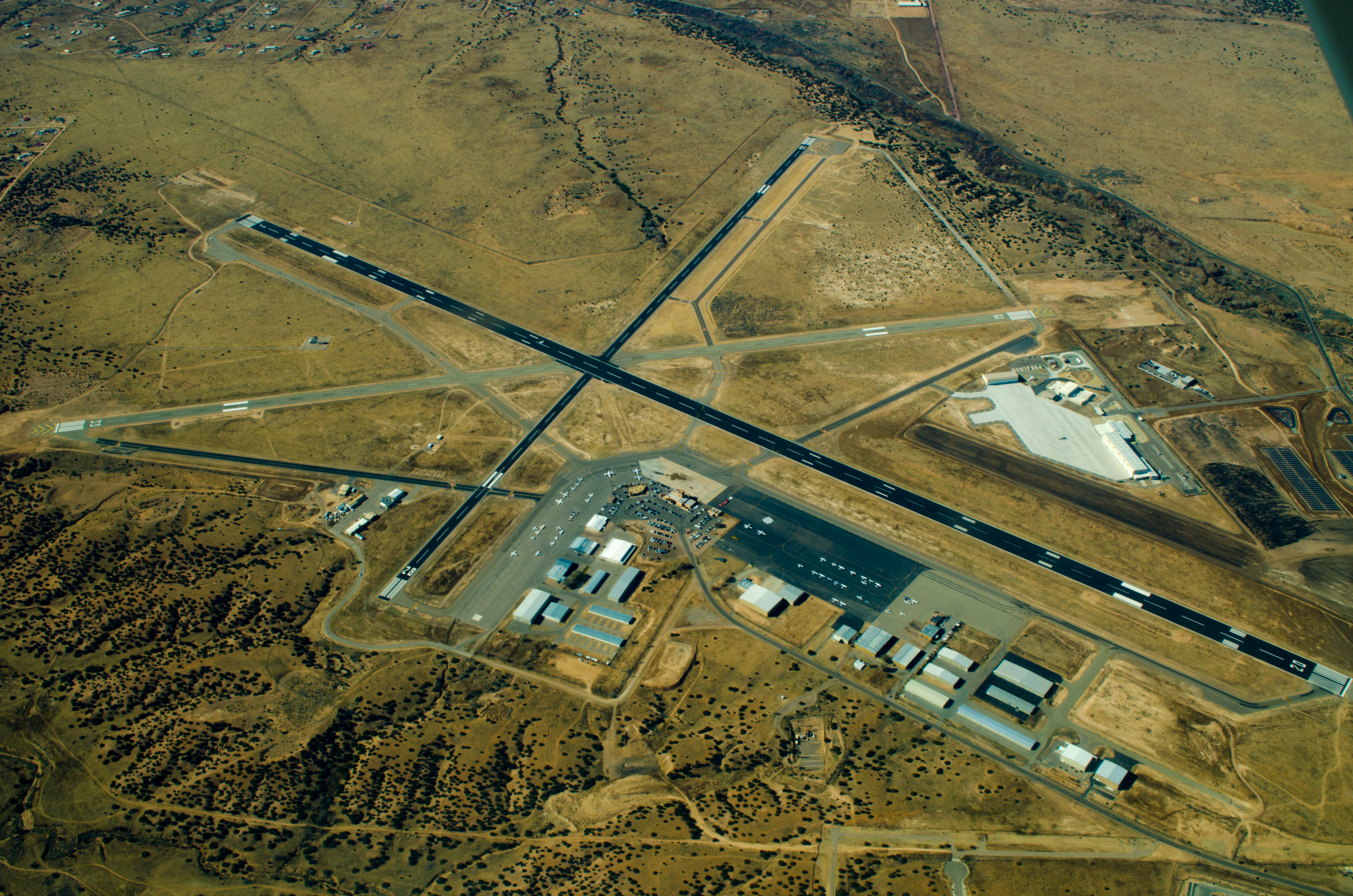
Santa Fe sits at 35.667N, 105.964W at 6,998 feet elevation in the foothills of the Sangre de Cristo Mountains. The city's distinctive adobe architecture and Plaza are visible from lower altitudes. Santa Fe Regional Airport (KSAF) serves the city directly. Albuquerque International Sunport (KABQ) is approximately 60 miles south via I-25. Los Alamos National Laboratory is visible to the northwest in the Jemez Mountains. The Sangre de Cristo ski basin lies northeast of the city.