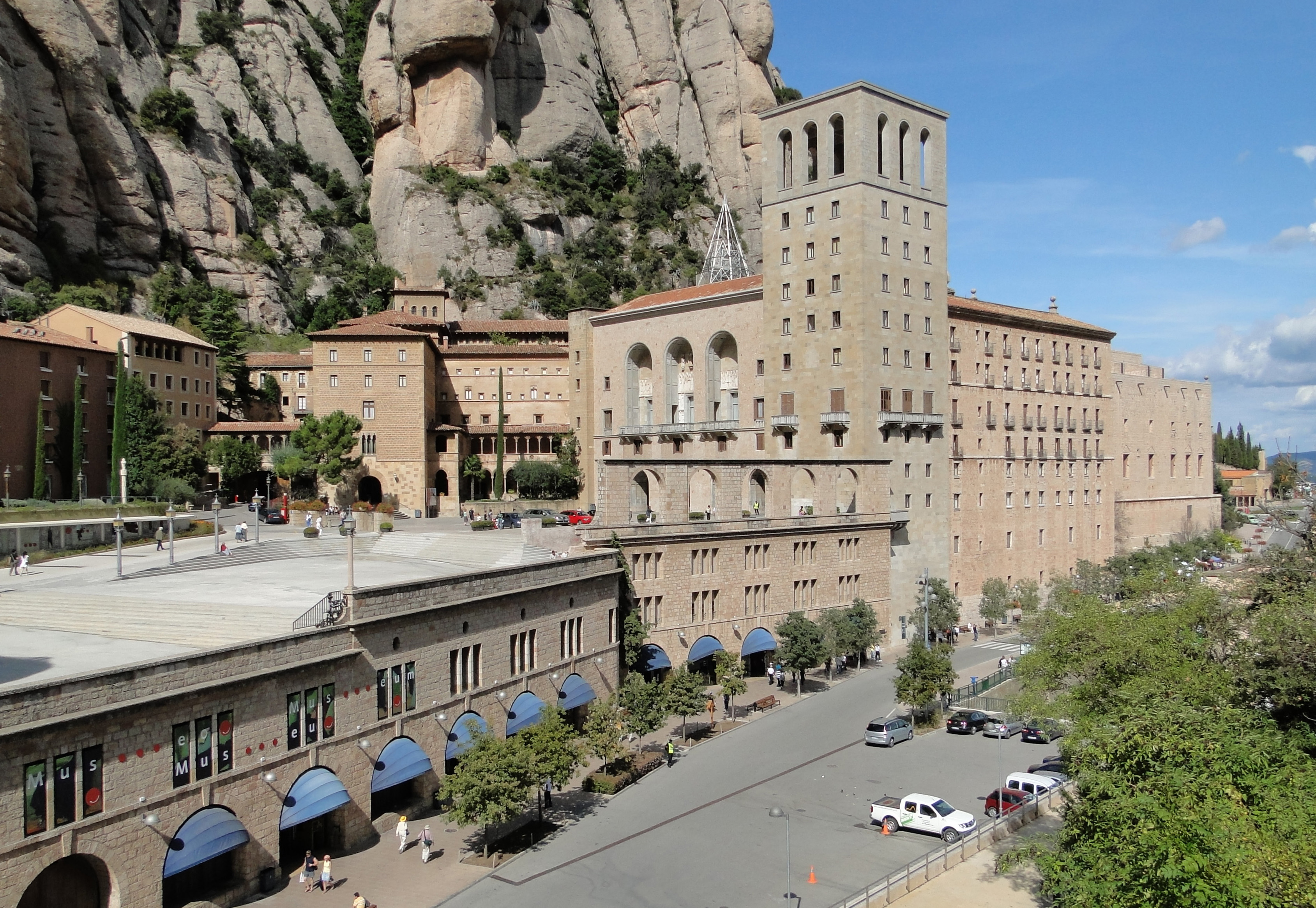
Santa Maria de Montserrat Abbey
To reach the Virgin, you must pass through a portal of alabaster carved with biblical scenes, climb above the main altar, and enter a small room where a wooden statue waits behind glass. She is dark -- La Moreneta, the little dark one -- a twelfth-century Romanesque figure blackened by centuries of candle smoke and devotion. Pilgrims queue for hours to touch her outstretched hand. Below, the Escolania boys' choir sings, their voices rising through a basilica that has been destroyed and rebuilt so many times it carries the scars of nearly every conflict in Catalan history. This is Santa Maria de Montserrat, founded in 1025, still home to some seventy Benedictine monks, and still the spiritual center of Catalonia.
From Hermitage to Abbey
The legend places the statue's discovery around 880, in a cave on the serrated mountain northwest of Barcelona. Four hermitages grew around the cult of the Virgin in the ninth century: Santa Maria, Sant Iscle, Sant Pere, and Sant Marti. Around 1011, a monk from the monastery of Santa Maria de Ripoll arrived to administer Santa Cecilia de Montserrat, bringing the mountain under the authority of Abbot Oliba. When Santa Cecilia resisted, Oliba founded a new monastery at the Santa Maria hermitage in 1025. By 1082, Santa Maria had its own abbot and no longer depended on Ripoll. The monastery's importance grew with the Virgin's fame -- pilgrims came from across the Iberian Peninsula and beyond, drawn by the statue and the mountain's austere grandeur.
A Basilica Remade by War
The basilica visitors see today is a palimpsest of destruction and reconstruction. Initial construction began in the sixteenth century. Napoleon's troops burned and sacked the abbey twice, in 1811 and 1812, looting its treasures. The monastery was closed entirely in 1835 and not restored until 1844. A new facade went up in 1901, designed by Francisco de Paula del Villar y Carmona in Plateresque Revival style. Then came the Spanish Civil War, which killed twenty-two of the abbey's monks. After the war, yet another facade was built between 1942 and 1968, bearing sculptural reliefs by Joan Rebull and the inscription Urbs Jerusalem Beata Dicta Pacis Visio -- Blessed city of Jerusalem, called the vision of peace. The church itself is a single nave, 68 meters long, 21.5 meters wide, and 33 meters high, with wooden columns carved by Josep Llimona representing the prophets Isaiah, Jeremiah, Ezekiel, and Daniel. A fifteenth-century cross by Lorenzo Ghiberti stands on the main altar.
Sanctuary Under Dictatorship
During the Franco era, Montserrat became something more than a monastery. It became a refuge. Scholars, artists, politicians, and students sought shelter within its walls, knowing that Franco's agents often waited for wanted individuals just a few miles down the mountain road. The abbey's status as sacred ground offered a fragile but real protection. From the 1940s onward, Santa Maria de Montserrat was increasingly identified with Catalan nationalism -- a symbol of cultural survival under a regime that sought to suppress the Catalan language and identity. On April 27, 1947, over 100,000 people attended a Mass celebrating the Enthronement of the Virgin of Montserrat, turning a religious ceremony into an implicit act of political defiance. In December 1970, three hundred Spanish artists and academics staged a sit-in at the abbey to protest death sentences imposed on Basque ETA members in Burgos. Police sealed off the monastery, but the protest helped convince the Francoist government to commute the sentences.
Art in the Mountain's Embrace
The monastery's museum holds a collection that would be remarkable in any capital city, and is astonishing in a mountain monastery. Its modern painting gallery includes works by Salvador Dali, Joan Miro, Antoni Tapies, Pablo Picasso, and Catalan masters like Santiago Rusinol and Ramon Casas. French Impressionism is represented by Renoir, Monet, Sisley, and Degas. The ancient painting collection features an important Saint Jerome by Caravaggio, alongside works by El Greco, Luca Giordano, and Giambattista Tiepolo. Beyond the museum, the monastery's publishing house, Publicacions de l'Abadia de Montserrat, has been printing books since 1499, making it one of the oldest presses in the world. The Escolania boys' choir, which still performs during daily religious ceremonies, is among the oldest in Europe.
A Thousand Years on the Mountain
The cloister, designed by architect Josep Puig i Cadafalch in 1929, is a two-story arcade of stone columns opening onto a garden that includes a Romanesque chapel and sculptures spanning centuries. On its walls, fragments from the tenth century survive alongside modern additions. The monastery sits at 720 meters on the mountainside, accessible by road, a rack railway from Monistrol, and two funiculars. From the summit of Sant Jeroni at 1,236 meters, reachable by footpaths from the monastery, nearly all of Catalonia unfolds below. In 2025, the monastery celebrated its millennium -- a thousand years of continuous monastic life through invasions, civil wars, and political upheaval. The motto chosen for the anniversary says it plainly: Ora lege labora rege te ipsum in communitate. Pray, read, work, govern yourself in community.
From the Air
Located at 41.59N, 1.84E on the mountainside of Montserrat, approximately 48 km northwest of Barcelona. The monastery complex is visible nestled among the distinctive serrated rock formations. Nearest major airport is Barcelona-El Prat (LEBL). The rack railway and cable car routes are visible from altitude. Best viewed at 3,000-5,000 feet; the basilica and monastery buildings stand out against the pink-grey conglomerate rock. Sant Jeroni summit at 1,236 m (4,055 ft) is the highest point nearby.