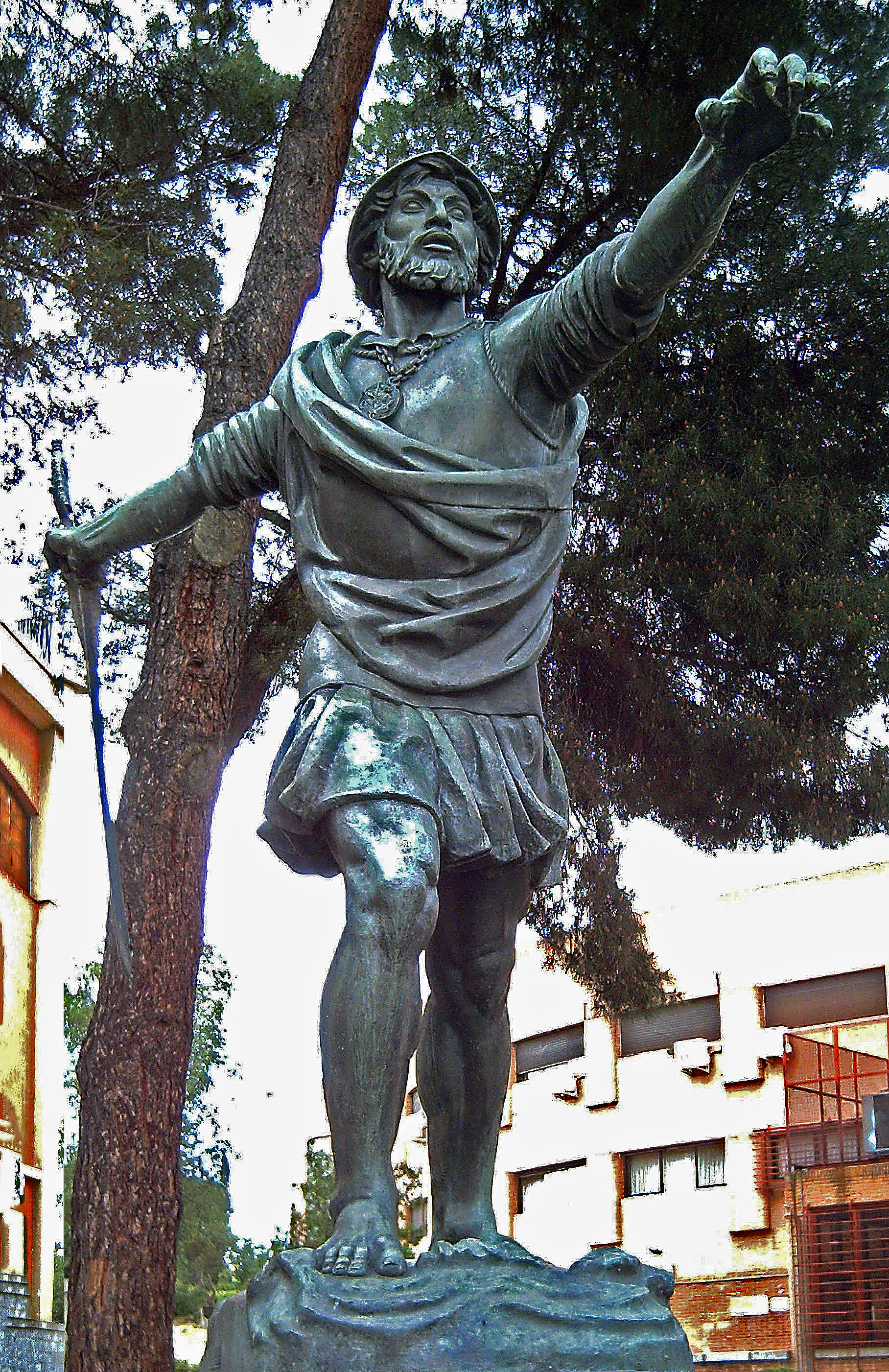
Santa María la Antigua del Darién
In 1510, a failed pig farmer named Vasco Núñez de Balboa smuggled himself aboard a supply ship in Santo Domingo, hiding inside a barrel with his dog Leoncico to escape his creditors. When discovered at sea, the captain threatened to abandon him on a deserted island. Instead, Balboa talked his way into command, led the expedition to a new location across the Gulf of Urabá, defeated the local chief Cémaco in battle, and founded the first permanent European settlement on the mainland of the Americas. He named it Santa María la Antigua del Darién, after a beloved image of the Virgin Mary in Seville Cathedral, fulfilling a vow his men had made before the fighting began.
A Stowaway's Gamble
Balboa's suggestion to relocate the expedition was not a guess. He had visited the Darién coast a decade earlier with the explorer Rodrigo de Bastidas and remembered the region as having fertile soil and indigenous inhabitants who, crucially, did not use the poisoned arrows that had devastated Spanish forces elsewhere. The earlier settlement of San Sebastián de Urabá, founded by Alonso de Ojeda, had already been destroyed by hostile indigenous groups and abandoned. When Enciso's relief expedition arrived to find only ruins, Balboa's knowledge of a better location suddenly made the fugitive debtor the most valuable man on board. After defeating Cémaco's warriors, the Spanish plundered the village and found a substantial quantity of gold ornaments -- enough to convince everyone that this swampy patch of jungle on the Gulf of Urabá was worth defending.
A City Rises in the Swamp
What began as a desperate camp grew quickly into something resembling a colonial capital. By 1514, Santa María had a cathedral church, a hospital, a main plaza, a trading house called the Casa de la Contratación, a Franciscan monastery, a prison, and a foundry. Archaeological evidence suggests the population reached approximately 5,000, including both Spaniards and indigenous peoples. That year, the Spanish Crown dispatched a massive fleet of 22 ships under Pedro Arias Dávila, known as Pedrarias, carrying between 1,500 and 2,000 additional colonists -- soldiers, artisans, doctors, and some women. It was one of the largest expeditions to the mainland at that time. The sudden influx overwhelmed Santa María's fragile resources. Food shortages and tropical diseases killed many of the newcomers within weeks, and the settlement that had seemed so promising began its slow decline.
The Bitter Rivalry
Pedrarias arrived as the new governor, but Balboa remained the more popular leader -- a dangerous imbalance. The newly appointed bishop, Juan de Quevedo, tried to broker peace by arranging a betrothal between Balboa and Pedrarias's daughter María, who remained in a convent in Seville and never traveled to the Americas. The arrangement failed to ease the tension. From Santa María, Balboa organized the expedition that would become his greatest achievement: in September 1513, he crossed the isthmus and became the first European to see the Pacific Ocean from the New World. But Pedrarias grew increasingly suspicious of his predecessor's ambitions. In 1519, he had Balboa arrested on charges of treason and executed by beheading. Bishop Quevedo, who had protested Pedrarias's cruelties against both Balboa and indigenous peoples, returned to Spain and presented two memorials to King Charles V criticizing the governor's rule. Quevedo died in Barcelona on December 24, 1519, his reforms unfinished.
Swallowed by the Jungle
Santa María's decline was overdetermined. The swampy climate of the Gulf of Urabá bred endemic fevers that sickened colonists year after year. Pedrarias's aggressive treatment of indigenous peoples destroyed the alliances Balboa had carefully cultivated, provoking attacks on Spanish supply lines. Gold panning yielded diminishing returns, and settler unrest mounted. In 1519, Pedrarias moved the colonial capital to the newly founded Panama City on the Pacific coast, and Santa María was formally abandoned by 1524. Indigenous groups attacked and burned what remained. The jungle moved in, covering the cathedral, the plaza, the monastery, and the prison in a green shroud that would last for centuries. The precise location of the settlement remained uncertain until archaeological expeditions in the twentieth century -- including one sponsored by King Leopold III of Belgium in 1956 -- began to piece together the ruins.
The Launchpad of Conquest
For all its brevity, Santa María's legacy shaped the course of the Americas. It was from this muddy outpost that Balboa launched his crossing to the Pacific, an achievement that reshaped European understanding of world geography. Francisco Pizarro served under Balboa at Santa María and later drew on the knowledge and connections he forged in the Darién to organize his conquest of the Inca Empire. The settlement established the first mainland diocese in the Americas and pioneered urban planning approaches that would be refined in later colonial cities across the continent. Today, nothing visible remains above the jungle floor. The site lies in present-day Colombia, roughly 40 miles south of Acandí in the municipality of Unguía, Chocó Department. Only archaeologists visit now, sifting through the soil for traces of a city that once held the entire future of European colonization in its hands.
From the Air
Located at 8.21°N, 77.02°W in the Chocó Department of northwestern Colombia, approximately 40 miles south of Acandí on the Gulf of Urabá. From the air, the site is invisible beneath dense jungle canopy -- no structures remain above ground. The Gulf of Urabá is the primary visual landmark, with the settlement site located on its western shore. Nearest airports: Acandí (ACDI) and Turbo (SKTU). Best viewed at lower altitudes (3,000-5,000 ft) where the coastline and river mouths are visible. The contrast between the gulf's open water and the dense Darién forest is striking from altitude.