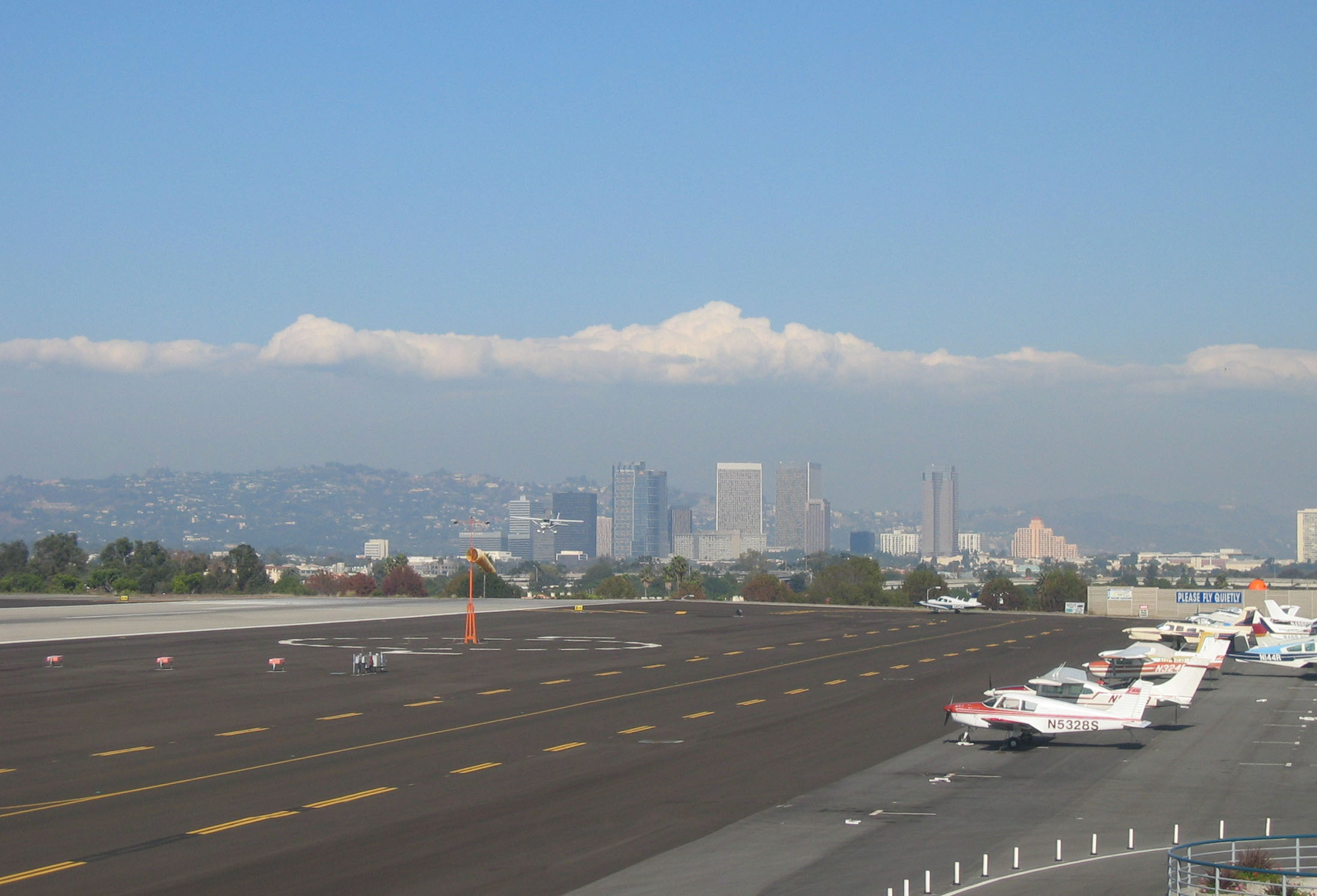
Santa Monica Airport
On March 17, 1924, four small biplanes lifted off from Clover Field in Santa Monica and turned their noses around the world. The United States Army Air Service had built the Douglas World Cruiser specifically for this mission: the first circumnavigation of the globe by air. Six months and 28,000 miles later, three of the four aircraft returned to the same field. The airport had been open for less than a year.
Where Flight Was Made
Clover Field — named for a World War I aviator, Greayer Clover — opened on April 15, 1923, on flat land near the Pacific Ocean, two miles from the water and six miles north of what would become Los Angeles International Airport. Its position made it a natural base for the Douglas Aircraft Company, which moved its operations here in the early 1920s.
The collaboration between Clover Field and Douglas Aircraft produced some of the most important aircraft in the history of commercial aviation. The DC-1, built as a prototype in 1933. The DC-2, the DC-3 — the plane that made commercial flight economically viable, that carried freight and passengers across the country and eventually across the world. The DC-4, DC-6, DC-7. Every propeller-driven Douglas commercial aircraft was built at Santa Monica, adjacent to Clover Field.
The Women's Air Derby of 1929 — the first cross-country air race for women, which Amelia Earhart called the 'Powder Puff Derby' — originated from Clover Field. Twenty women flew from Santa Monica to Cleveland, competing across the American West at a time when aviation itself was barely more than a generation old.
War and Camouflage
When Japan attacked Pearl Harbor in December 1941, the Douglas plant at Santa Monica was one of the most important military production facilities on the Pacific coast. Its exposure — visible from the ocean, within range of a carrier-based attack — made it an obvious target for concern.
What followed was one of the stranger architectural interventions in American military history. The Army Corps of Engineers, with assistance from Hollywood studio set designers, covered the entire factory complex with an elaborate false town. Viewed from above — from the perspective of a Japanese reconnaissance pilot or bomber — the Douglas plant disappeared under a constructed neighborhood of fake houses, fake streets, fake trees made from chicken wire and burlap, chickens wandering among rubber automobiles. The factory kept producing planes beneath an illusion of suburban normalcy.
During the war years, the plant built thousands of C-47 military transports — the military version of the DC-3, which became the workhorse of Allied logistics in every theater — along with B-18 bombers and C-54 transports. The war that the planes helped win was also the war that transformed the aviation industry, turning what had been an experimental enterprise into the dominant form of long-distance transportation.
Closing Time
Santa Monica Airport operated for a century as a general aviation facility, surrounded by a residential city that grew up around it and increasingly objected to the noise and the traffic. The city of Santa Monica spent decades in legal battle with the federal government over its right to close the airport, arguing that a 1948 agreement that had transferred land from federal to city control could be voided.
In 2014, a federal judge dismissed the city's quiet title action, ruling it barred by the statute of limitations. But the legal landscape continued to shift. Agreements were eventually reached that permitted Santa Monica to close the airport to operations — with a final deadline of the end of 2028.
What happens to 215 acres of flat land two miles from the Pacific Ocean, in one of the most expensive real estate markets in the world, when an airport closes, is a question that Los Angeles is watching carefully. The Frieze Art Fair moved its Los Angeles edition to the airport in 2023, occupying a vast temporary tent in the hangars. Whatever comes after aviation, the land that once launched the first flight around the world will not be empty for long.