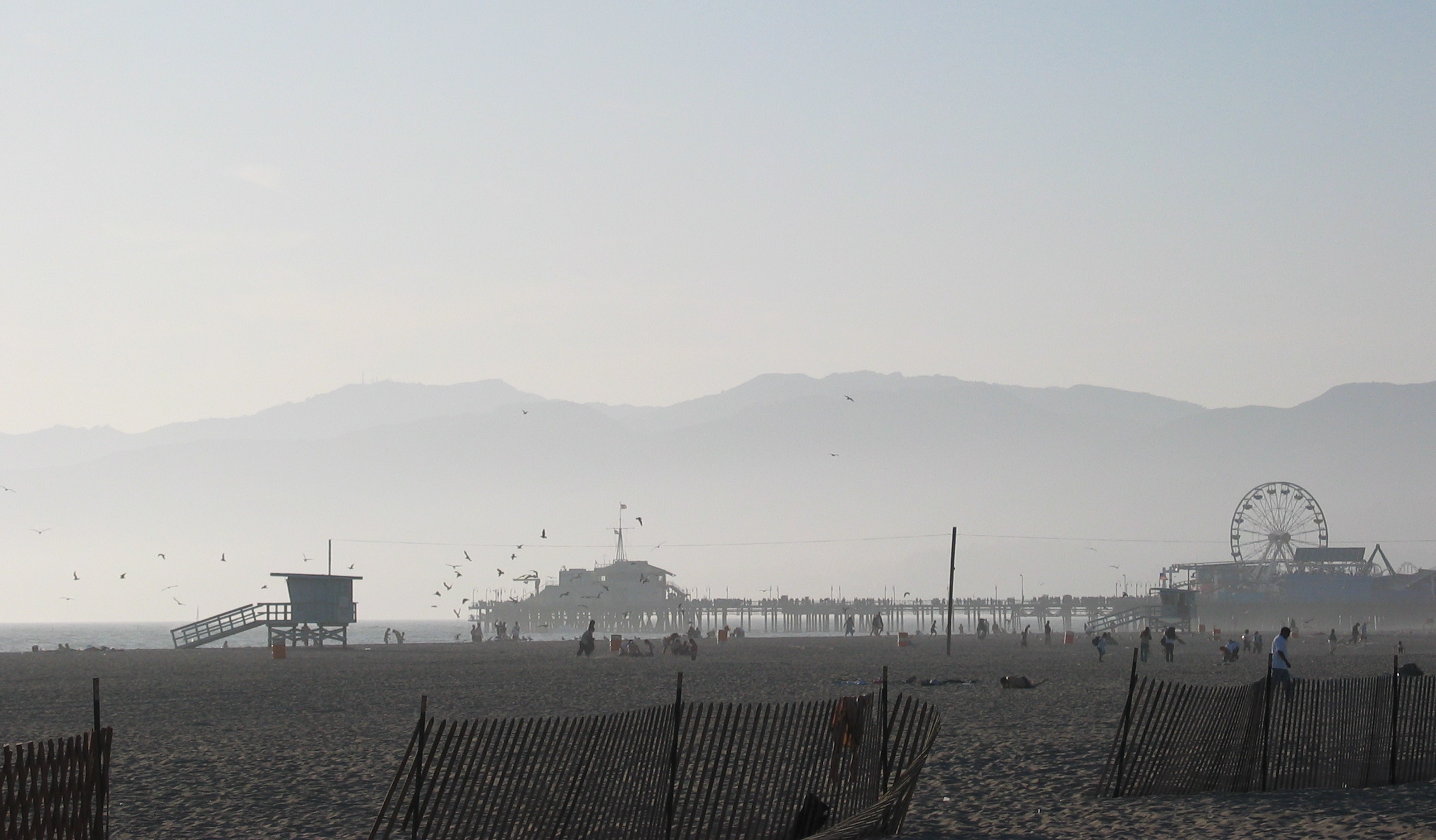
Santa Monica Pier
The Municipal Pier that opened on September 9, 1909, had no amenities. It was long, narrow, and built primarily to carry sewer pipes far enough beyond the surf that the ocean could dilute the discharge. The Pleasure Pier to the south — also known as Newcomb Pier — came in 1916, built by Charles I. D. Looff and his son Arthur, amusement park pioneers who had already built carousels around the country. What those two piers became, joined together over the following century, is one of the most recognized structures on the American coastline.
The Looff Hippodrome
The centerpiece of the 1916 addition was the Santa Monica Looff Hippodrome — a carousel building with hand-carved wooden horses that is now listed on the National Register of Historic Places. Charles Looff was one of the preeminent carousel builders of his era; the one he installed at Santa Monica was a work of the craft he had refined over decades. The Hippodrome building itself became as significant as the carousel inside it: its ornate facade is recognizable in decades of photographs and film footage. The Blue Streak Racer wooden roller coaster followed. Then came the La Monica Ballroom in 1924, at the time the largest ballroom on the West Coast, built at the end of the pier over the water. The pier had become a place in itself — not just a structure but a destination, with its own weather, its own light, its own relationship to the ocean that the shore could not provide.
Where Route 66 Ends
The Santa Monica Pier became the symbolic western terminus of US Route 66 — the road from Chicago that crosses the continent and arrives here, at the Pacific. A sign on the pier marks the endpoint. The association was partly official, partly mythological, and entirely durable. Route 66 as a functional highway was decommissioned in 1985, but its cultural weight persisted, and the sign on the pier continued to draw people who understood what it meant to reach the end of something that long. The pier is now part of the Santa Monica Mountains National Recreation Area — an administrative acknowledgment of what had already been true for a long time: that this place functions as a boundary between the city and something larger than the city.
Pacific Park and What Replaced What
The amusement attractions that occupy the pier today are gathered under the name Pacific Park — a family amusement park with a solar-paneled Ferris wheel that can be seen from a distance and is turned off during Earth Hour. There are pubs, restaurants, a trapeze school, a video arcade, and a pier aquarium operated by Heal the Bay. The pier's west end is a consistent spot for fishing. The carousel in the Looff Hippodrome still runs. The pier has appeared in so many films and television productions that it functions as a kind of default backdrop for Southern California — instantly recognizable in a way that serves Hollywood's need for immediately legible location. It appeared in Forrest Gump, The Sting, Iron Man, and countless others.
Storms and Survivals
The pier has been battered repeatedly by Pacific storms. Major damage occurred in 1983 and again in 1988, when sections of the structure collapsed into the ocean. Each time, the pier was rebuilt — not because it was economically rational to do so on a cost-benefit basis, but because the city was not willing to lose it. The pattern reflects something about what the pier means: it occupies a position in the Los Angeles imagination that makes its survival feel obligatory. The Looff Hippodrome survived, the carousel survived, and the westward extension into the Pacific that has been there in some form since 1909 survived. People still come to the end of it at sunset, as they have for over a century, to watch the light go off the water.
From the Air
The Santa Monica Pier extends into the Pacific at approximately 34.009°N, 118.499°W at the foot of Colorado Avenue in Santa Monica. The pier and its Ferris wheel are clearly visible from altitude as a distinctive structure projecting from the shoreline. Nearest airports: Van Nuys Airport (VNY) about 13 miles northeast, Los Angeles International Airport (LAX) about 5 miles south.