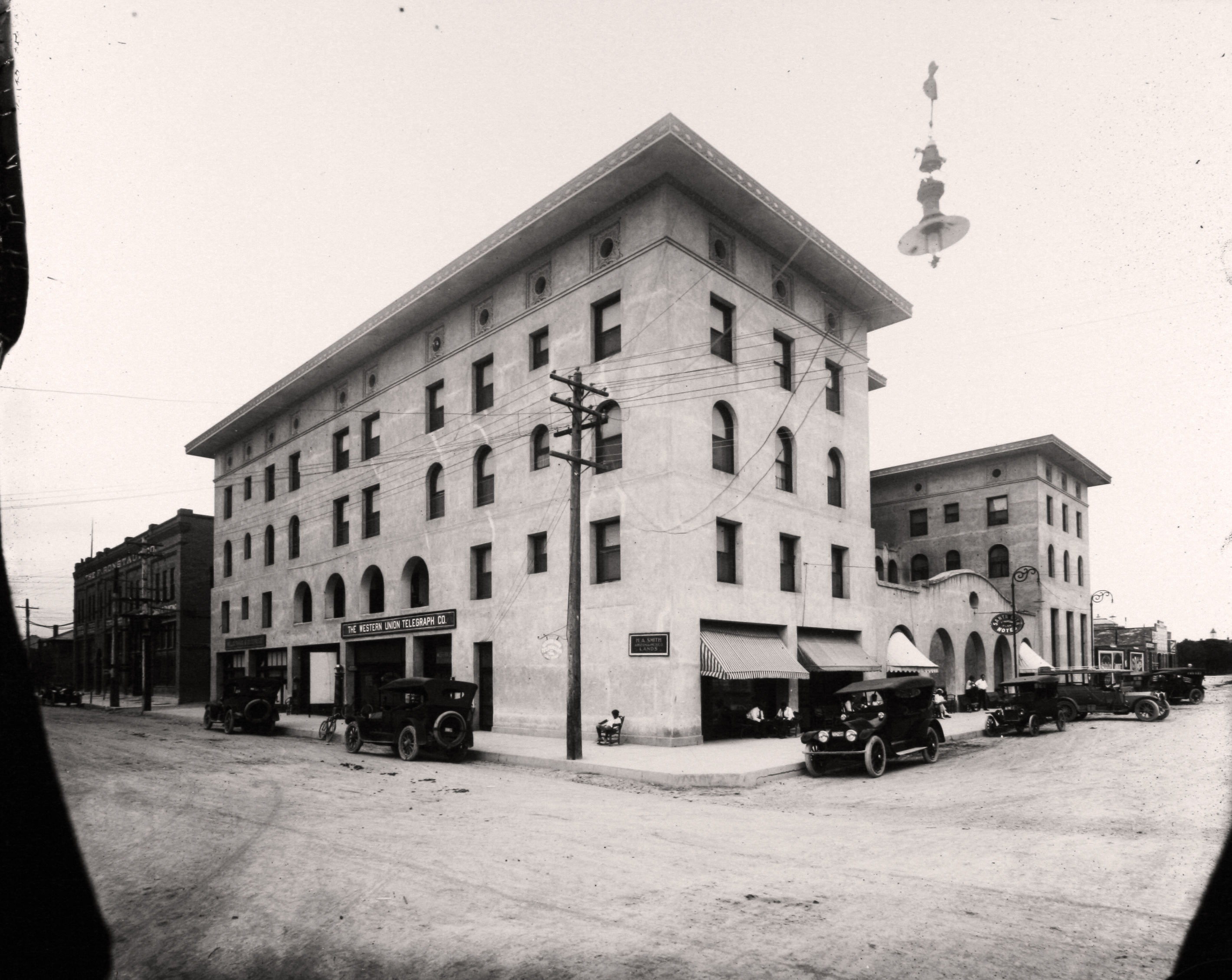
Santa Rita Hotel
On February 1, 1904, two thousand people crowded into downtown Tucson to witness something the Arizona Territory had never seen: a six-story hotel with electric elevators, private bathrooms in every room, and a rooftop dance hall. The Santa Rita Hotel opened that night to gasps of wonder from a quarter of the city's entire population. Fashionably dressed women in long gowns strolled through a tiled rotunda fifty feet by eighty feet, beneath ceilings soaring twenty-six feet high. They presented the hotel's visionary, Levi Manning, with a chest containing six hundred pieces of Gorham silver. For nearly seventy years, the Santa Rita would stand as a monument to Tucson's ambitions, hosting movie stars and civil rights leaders, before vanishing entirely from the downtown landscape.
Rising from the Old Cavalry Ground
The Santa Rita Hotel rose on land steeped in frontier history. The southeast corner of Broadway Boulevard and Scott Avenue had once been part of Military Plaza, where U.S. Cavalry troops stationed at Camp Lowell kept watch over the Arizona desert. When developer R.H. Raphael of Los Angeles won an auction for block 257, lots 2 and 3, the city extracted a promise: he would build a hotel worth at least $75,000. The project ultimately cost $175,000. Henry Trost, the architect who would define Southwestern style for a generation, designed the structure in Mission Revival fashion. Quintus Monier, a stonemason who had built the Cathedral of Santa Fe, laid its foundations. When Raphael sold the unfinished hotel to Arizona capitalist Charles M. Shannon in February 1903, local newspapers celebrated the deal as proof that 'Arizona people have confidence in Arizona investments.'
A Monument to Territorial Ambition
The finished hotel made no apologies for its grandeur. The main entrance on Scott Avenue opened onto balconies overlooking a courtyard thirty feet wide and thirty-two feet deep. Beyond lay the great rotunda with its tiled roof, leading to a lobby with a marble staircase ascending to the mezzanine level. Oak-finished dining rooms, a cafe, and a bandstand served guests in 101 rooms. Eight storefronts lined Scott and Broadway. Artist Gustav Zierold, an associate of Henry Trost, created all the ornamental plasterwork. The city council, eager to protect this new jewel, passed a resolution in August 1903 prohibiting gambling near the hotel to prevent 'blight,' then turned around in December and issued the Santa Rita a license to operate a bar and roulette wheel. That same month, the mayor approved Tucson's first electric streetcar line, running from the hotel to a park beyond the University of Arizona.
Witnesses to History
The Santa Rita became more than a hotel; it became a stage where American history played out in miniature. In 1949, Larry Doby arrived with the Cleveland Indians for spring training. Just months earlier, Doby had helped Cleveland win the World Series, becoming one of baseball's most celebrated players. But the Santa Rita turned him and his wife away. Doby, the first Black player in the American League and now a Baseball Hall of Fame member, could not sleep where his teammates slept. Thirteen years later, in 1962, Martin Luther King Jr. found a different reception. According to historian David Leighton, King stayed at the Santa Rita during his visit to Tucson that year. The hotel's walls held both the shame and the progress of the civil rights era. In 1963, the Santa Rita even appeared in Hollywood when David Janssen, playing Dr. Richard Kimble in the pilot episode of 'The Fugitive,' was filmed exiting its doors.
Expansion and Eclipse
In 1917, owner L.J.F. Iaeger commissioned a 160-room wing designed by the Los Angeles firm of William and Alexander Curlett. The cast concrete addition, built in Spanish Revival style, extended the hotel's life for another half-century. But downtown Tucson was changing. Suburban sprawl and new highways drew travelers to motor lodges on the city's edges. On April 30, 1972, the original 1904 building closed its doors and fell to the wrecking ball as part of a redevelopment plan. The 1917 wing survived for decades more, a ghostly reminder of past elegance. Then in 2009, UniSource Energy Services and its subsidiary Tucson Electric Power demolished the remaining structure, despite passionate pleas from preservationists who saw in its Spanish arches the last tangible connection to Tucson's territorial golden age.
What Remains
Today, nothing physical remains of the Santa Rita Hotel. The corner of Broadway and Scott hosts modern commercial development, and few pedestrians realize they walk on ground once graced by marble staircases and rooftop gardens. But the hotel's story endures as a window into Arizona's transformation from frontier territory to modern state. It captures the optimism of territorial boosters who believed a fine hotel could change a city's destiny. It preserves the complicated memory of an establishment that could host a civil rights leader while remembering the wrong done to a baseball hero. The Santa Rita stood for the Southwest's highest aspirations, and its absence reminds Tucson of what it lost when progress meant erasure.
From the Air
Located at 32.2209N, 110.973W in downtown Tucson. The former hotel site sits at the intersection of Broadway Boulevard and Scott Avenue, now occupied by modern commercial buildings. Best viewed from 2,000-3,000 feet AGL. Tucson International Airport (KTUS) lies 8 nm south. Ryan Field (KRYN) is 15 nm west. The downtown grid pattern remains visible from altitude, though no trace of the hotel structure survives.