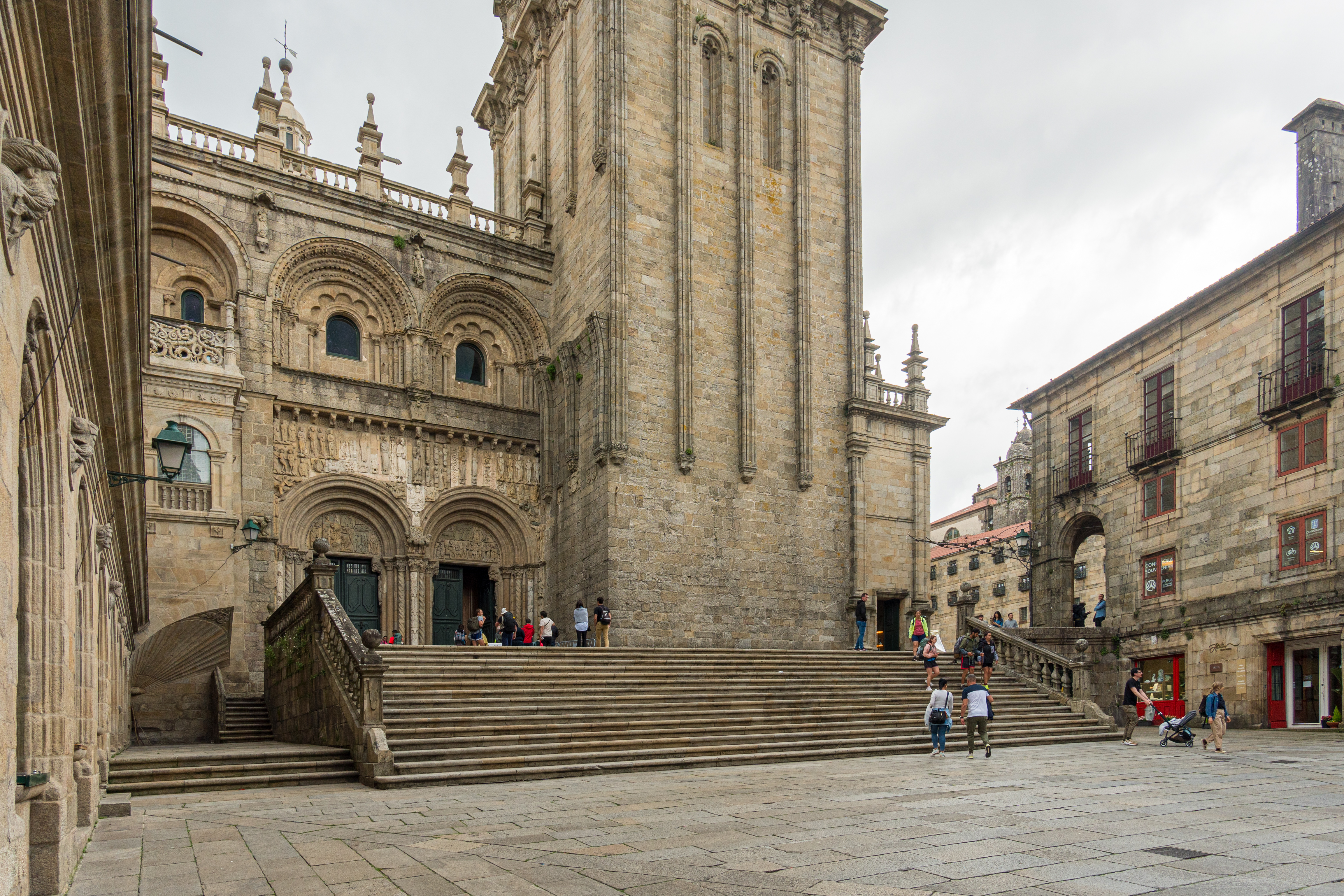
Santiago de Compostela Cathedral
Only four churches in the world claim to stand directly over the tomb of an apostle. St. Peter's Basilica in Vatican City is one. St. Thomas Cathedral Basilica in Chennai is another. The Basilica of St. John in Izmir is a third. And here, in the rain-washed northwest corner of Spain, Santiago de Compostela Cathedral completes the set -- the endpoint of a pilgrimage route that has drawn the faithful across Europe for more than a millennium.
From Discovery to Devotion
The story begins around 813, when a hermit named Pelayo reported seeing strange lights over a field. The local bishop investigated and declared the discovery of the remains of Saint James the Great, who tradition says preached in Iberia before his martyrdom in Jerusalem in 44 AD. King Alfonso II of Asturias ordered a chapel built over the site. A larger pre-Romanesque church replaced it under Alfonso III, who consecrated it in 899. When the Muslim commander al-Mansur sacked the city in 997, he destroyed the church but reportedly left the tomb itself untouched. The current Romanesque cathedral was begun in 1075 under Bishop Diego Pelaez and substantially completed by 1211. Its construction was financed by the enormous wealth that pilgrims brought to the city, and its design -- a cruciform plan with radiating chapels around the ambulatory -- was engineered specifically to manage the flow of crowds through the building.
The Portico de la Gloria
Behind the Baroque western facade lies one of the supreme achievements of medieval European sculpture. The Portico de la Gloria, carved by Master Mateo and completed in 1188, fills the cathedral's original western entrance with more than 200 figures arranged across three arched portals. Christ in Majesty occupies the central tympanum, surrounded by the four evangelists, angels bearing instruments of the Passion, and the twenty-four elders of the Apocalypse, each holding a different musical instrument. The figures possess an emotional expressiveness that was revolutionary for Romanesque art -- they smile, converse, and lean toward one another with a naturalism that anticipates Gothic sculpture by decades. For centuries, pilgrims placed their fingers in the grooves of the Tree of Jesse column below Saint James, wearing five deep hollows into the marble. The portico was restored between 2006 and 2018, and visitors now view it on guided tours to preserve the stonework.
Incense and Silver
The cathedral's interior operates on the scale of ritual. The Botafumeiro, one of the largest censers in the world, hangs from a pulley system in the transept crossing. Weighing approximately 80 kilograms when filled and standing over 1.6 meters tall, it swings in a massive arc across the transept, trailing clouds of fragrant smoke. The tradition dates to at least the 14th century, originally serving the practical purpose of masking the smell of unwashed pilgrims who had walked for weeks. Below the high altar, a crypt holds the silver reliquary containing what are venerated as the remains of Saint James. Pilgrims descend to view it after embracing the jeweled statue of the saint that sits behind the altar, a ritual that has continued without interruption for centuries.
Layers of Stone and Time
Walking through the cathedral is an architectural education. The core remains Romanesque: barrel-vaulted nave, round arches, tribunes above the side aisles that once allowed additional pilgrims to witness services from above. Gothic chapels were added in the 13th and 14th centuries. The cloister, rebuilt in the 16th century, introduced Renaissance proportions. Then came the Baroque transformation that gave the cathedral its current public face: the Obradoiro facade, completed around 1750 by Fernando de Casas Novoa, erupts skyward in a riot of broken pediments, scrollwork, and the figure of Saint James presiding from the summit. The Clock Tower, the Treasury facade, and the Azabacheria entrance each add their own era's vocabulary. The result is not chaos but conversation -- each generation speaking to the last in stone, all of them surrounding that small crypt where the whole endeavor began.
From the Air
Located at 42.881N, 8.544W in Santiago de Compostela, Galicia. The cathedral is the dominant structure in the Old Town, identifiable by its twin Baroque towers on the western facade. Santiago de Compostela Airport (LEST) is approximately 12 km east. Recommended viewing altitude 2,000-4,000 ft AGL. The cathedral's cruciform plan is visible from directly above. The surrounding Old Town forms a dense medieval grid clearly distinct from modern development.