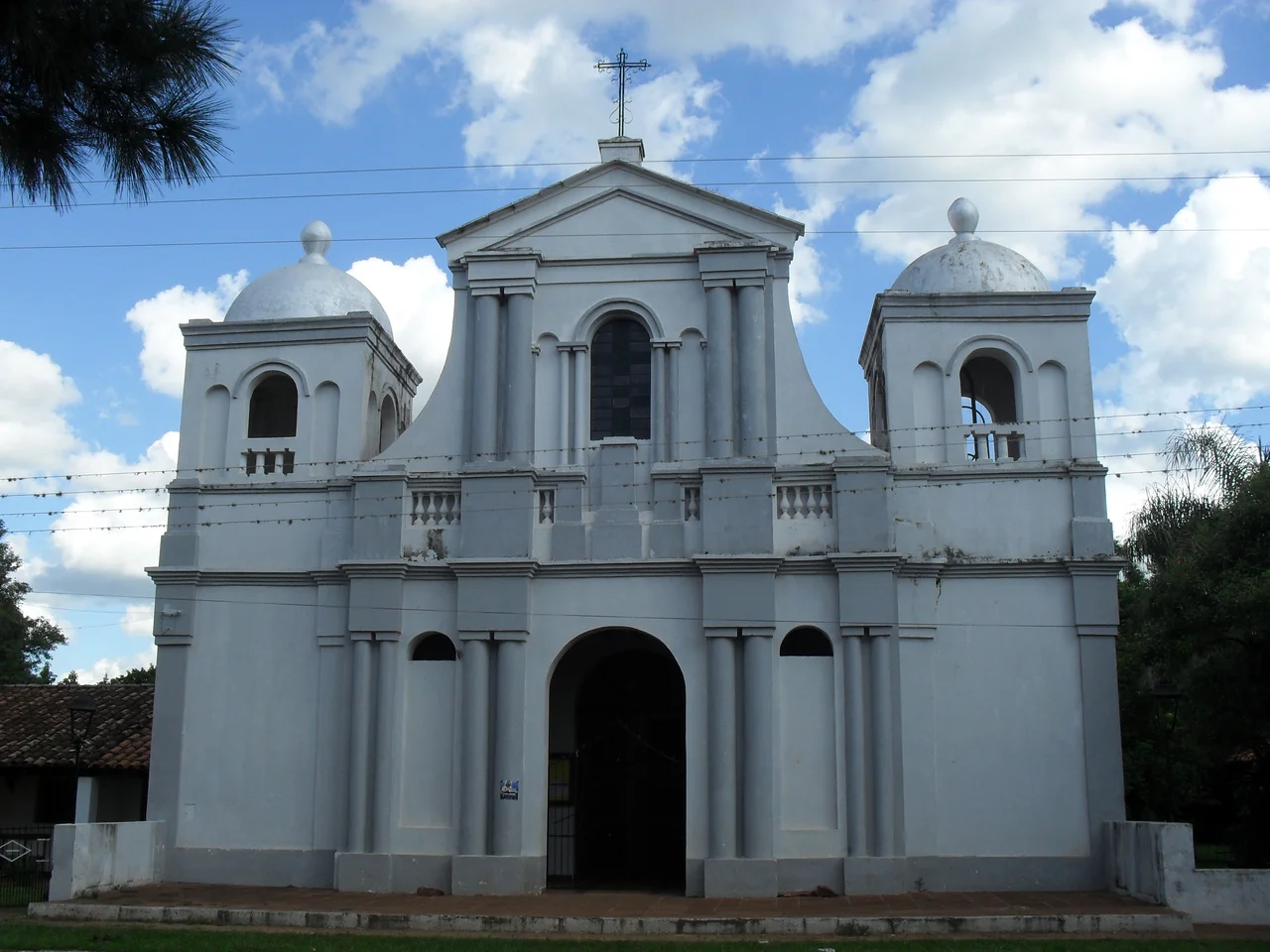

Santiago, Paraguay
Inside the parish church at Santiago stands the only complete Jesuit altarpiece left in all of Paraguay - and above it, carved in wood, Saint James rides into battle. The figure is an equestrian sculpture of Santiago Apóstol, the town's namesake, shaped by Guaraní hands under Jesuit direction more than two and a half centuries ago. Most of the mission that produced it is gone. The altarpiece and the horseman remain, and they are reason enough to climb the hill to this quiet town in southern Paraguay.
A Town That Moved and Was Renamed
Santiago did not start where it stands, or even under its current name. It was first founded as San Ignacio de Caaguazú, then re-established in the Misiones Department in 1669 as Santiago Apóstol - Saint James the Apostle. Like its neighbors, it was a Jesuit reduction, one of the chain of mission towns that grew out of San Ignacio Guazú after 1610, and it still preserves the marks of that origin: the broad colonial square, the surviving sacred art, the layout of a planned mission community. At its colonial height around 3,000 people lived here, Guaraní families and the priests who organized their work. The mission endured until the Jesuits were expelled from Spanish America in 1767, after which the buildings passed out of their hands and much was lost. Santiago then became what it largely remains: a small agricultural town that happens to sit on top of an extraordinary inheritance.
The Guaraní Baroque in Wood
Santiago's collection is among the finest survivors of the Jesuit-Guaraní world. The Museo Diocesano de Arte Sacro Jesuítico Guaraní, set in an old Jesuit building with four exhibition rooms, holds baroque statues and the salvaged remnants of the original church. These carvings were not imported. They were made here, by Guaraní sculptors working in a style that fused Spanish baroque form with local sensibility - the same tradition the region around San Ignacio claims as its own. The equestrian Santiago that crowns the parish church shows the saint as Spain long imagined him, a mounted warrior, yet the hands that shaped the wood and the colors that brought it to life were Guaraní. The town also preserves what colonial documents call the "house of the Indians," itself now a small museum of saints - a reminder that the people who lived in these missions were craftsmen and citizens of their communities, not footnotes to a European project. The skill in the woodwork is theirs, and so is the patience that has kept it intact.
Hills, Forest, and the Tebicuary
Santiago sits on a hill between the towns of Ayolas and San Patricio, in a landscape of rolling country, dense forest, and grassland - the Paraguayan Chaco off to the west, the Paraná Plateau rising to the east. The Tebicuary River threads through the region, watering the farms and feeding a local fishing trade that has long drawn on its variety of fish. The climate is subtropical and mostly warm, but cool air sweeps up from the south often enough to flip the weather from clear to stormy in a hurry; a few winter nights brush freezing. From October to April the rains come reliably, and the hills turn lush. It is the kind of countryside that rewards a slow approach.
Life on the Square Today
About 7,700 people live in Santiago now, and the rhythms of a small mission town persist around its unusually large main plaza. During the holidays the community has staged the Opera of Santiago, an ambitious bit of local culture for a place this size. But the deepest pull is still the art. Travelers who make the detour off Route 1 come for the altarpiece and the carved saints, and for the sense - rare and specific - of standing inside a working church that has kept faith with the people who built it. The missions of Paraguay are often visited as ruins. Santiago offers something quieter and more intimate: a town that simply never stopped using what the Jesuits and the Guaraní made together.
From the Air
Santiago sits on a low hill in the Misiones Department of southern Paraguay at 27.15°S, 56.78°W, about 278 km from Asunción and between the towns of Ayolas and San Patricio. From the air the hilltop setting stands out against surrounding forest, grassland, and farmland, with the broad colonial plaza marking the town center and the Tebicuary River system tracing the lowlands nearby. Best viewed from 2,000-3,500 ft AGL; the mix of dark forest and open pasture gives strong visual contrast for orientation. Nearest major airport is Encarnación's Teniente Amín Ayub González (ICAO SGEN) to the southeast; Asunción's Silvio Pettirossi International (ICAO SGAS) lies roughly 280 km northwest. Clearest flying is on cool, stable winter days (June-August); expect quick shifts from clear to stormy when southerly air masses arrive, and reliable afternoon rain in the October-April wet season.
Nearby Stories
- Santa Rosa, Paraguay 7.8 km away
- Fortress of Humaita 45 km away
- Trinidad and Jesús: Paraguay's Unfinished Cathedrals in the Forest 51 km away
- Ibera National Park 92 km away
- Pilar, Paraguay 99 km away
- Battle of Mbororé: The Day the Guaraní Turned the Tide 136 km away
- Iberá Wetlands 140 km away
- Triple Frontier 220 km away