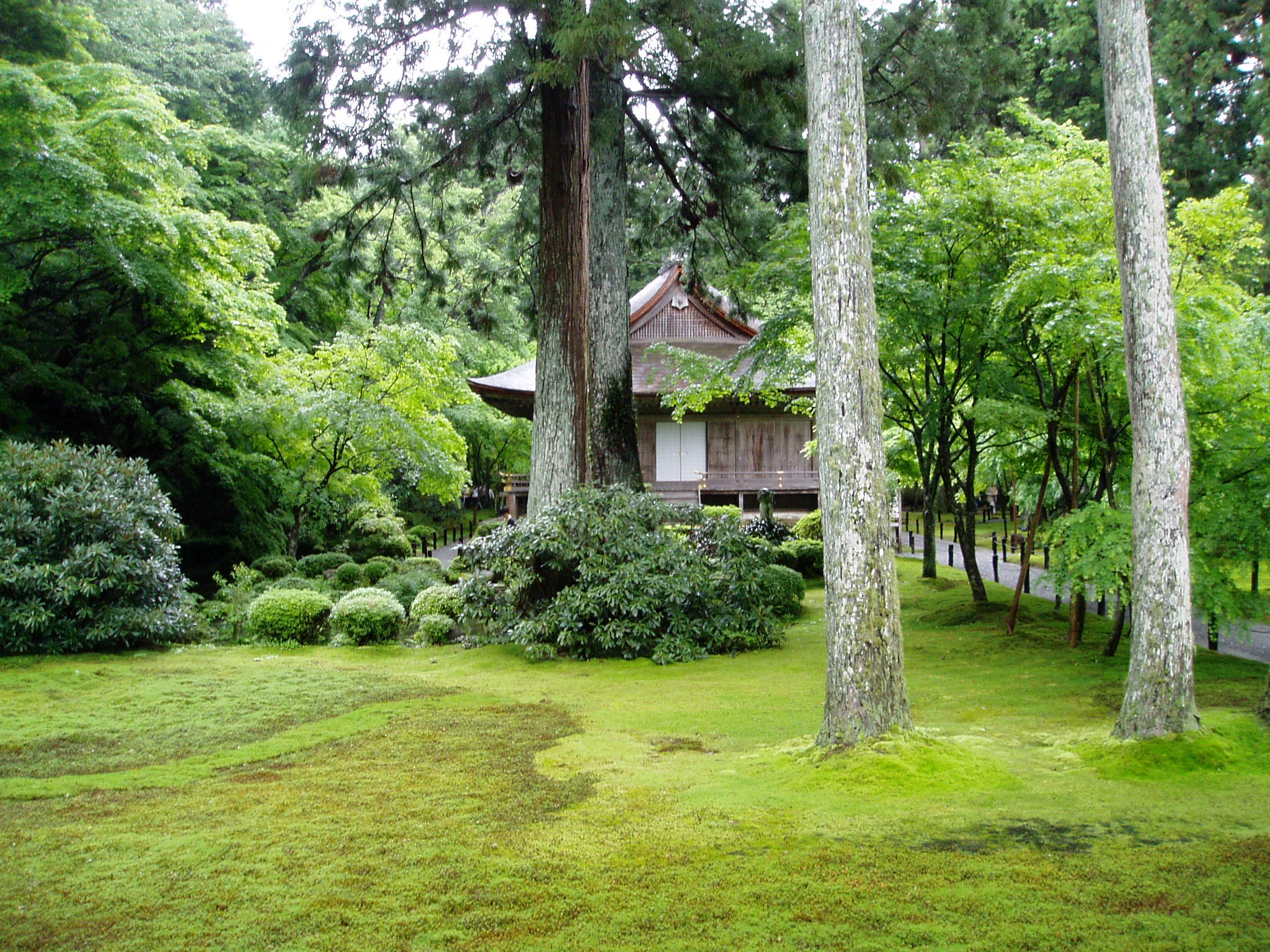
Sanzen-in: Where Moss Holds a Thousand Years of Silence
Small stone figures peek out from a carpet of velvet moss, their faces worn smooth by centuries of rain and dappled light. They look almost mischievous, as if they chose to sink into the green earth rather than stand on pedestals. This is Sanzen-in, a temple where stillness feels intentional -- where every element conspires to slow your breathing. Nestled in the village of Ohara, an hour north of central Kyoto in a valley ringed by cedar-covered mountains, Sanzen-in occupies a world apart from the crowds and commerce of the city's famous temple circuit. The monk Saicho founded it in 804, the same year he returned from China bearing the teachings that would establish Tendai Buddhism in Japan. For over twelve centuries, this has been a place where imperial blood and monastic discipline met in quiet seclusion.
A Lineage of Emperors and Monks
Sanzen-in belongs to a rare class of Japanese temples known as monzeki -- monasteries whose head priests were drawn from the imperial family. Only a handful of such temples existed, and the designation carried enormous prestige and political weight. For centuries, younger sons of emperors who would never inherit the throne found purpose and authority here as abbots. This imperial connection shaped everything about Sanzen-in, from the refinement of its architecture to the quality of its artistic commissions. The Kyakuden, or guest hall, still displays works of Japanese calligraphy and painted fusuma sliding doors that reflect the aesthetic standards of a court culture transplanted to a mountain retreat. The building opens onto the Shuhekien Garden, a composed landscape of pond and hillside that frames the natural world with aristocratic precision.
The View That Defines the Temple
From the Shinden, Sanzen-in's main hall, visitors encounter the scene that has drawn pilgrims and poets for centuries. Through a frame of maple and cedar branches, across a rolling expanse of luminous moss, stands the Ojo Gokuraku-in Hall -- the Hall of Rebirth in Paradise. The Shinden itself holds three Buddhist statues: a central Amida Buddha flanked by the attendants Kannon and Fudo Myoo. But it is the outward gaze that captivates. In mid-November, about a week before autumn color peaks in central Kyoto, the maples surrounding the moss garden ignite in shades of crimson and gold, and the Ojo Gokuraku-in seems to float in a pool of fire and emerald. The slightly earlier timing of the autumn colors here, owed to Ohara's higher elevation and cooler mountain air, means visitors can catch the spectacle before or after the peak-season crowds descend on Kyoto's more famous temples.
A Hall Built in the Year of Paradise
The Ojo Gokuraku-in is the oldest surviving structure at Sanzen-in. Originally built in 985 during the late Heian period, it was most recently rebuilt in 1143 -- and even that reconstruction has endured nearly nine centuries. Inside rests Sanzen-in's most treasured possession: a triad of Amida Nyorai designated a National Treasure of Japan. The central figure of Amida Buddha sits in serene meditation, flanked by two attendant deities -- Kannon on one side and Seishi on the other. The hall's name translates roughly to "Rebirth in the Pure Land of Utmost Bliss," reflecting the Tendai belief that contemplation of Amida Buddha in the correct setting could transport the faithful directly to the western paradise. The intimate scale of the hall, surrounded on all sides by the moss garden's soft green carpet, gives the experience an immediacy that grander temples cannot replicate.
Stone Guardians in the Moss
Beyond the Ojo Gokuraku-in, a wandering path leads deeper into the temple grounds. This is where Sanzen-in reveals its quieter personality. Dozens of small stone statues -- jizo figures and miniature representations of Kannon -- emerge from the moss like woodland spirits caught mid-conversation. Some were carved by artisans; many are miniature Kannon statues donated by visitors over the years, arranged in patient rows at one clearing in the garden. Their weathered faces and moss-covered shoulders blur the boundary between sculpture and nature. Farther along, a treasure house displays additional artifacts from the temple's long history. But the real treasure is the walk itself: the crunch of gravel underfoot, the filtered light through the canopy, the sense that you have stepped into a painting where time pooled and settled centuries ago.
From the Air
Located at 35.12N, 135.83E in the Ohara valley, approximately 15 kilometers north of central Kyoto. From 3,000-5,000 feet AGL, the village of Ohara sits in a narrow valley flanked by forested mountains, noticeably more rural than the urban sprawl of Kyoto proper to the south. The temple grounds are surrounded by dense cedar forest. Follow the Takano River valley north from Kyoto to locate Ohara. Nearest major airport is Osaka Itami (RJOO), approximately 30 nautical miles southwest. Kansai International (RJBB) is about 55 nautical miles to the south. Lake Biwa, Japan's largest freshwater lake, is visible to the east.