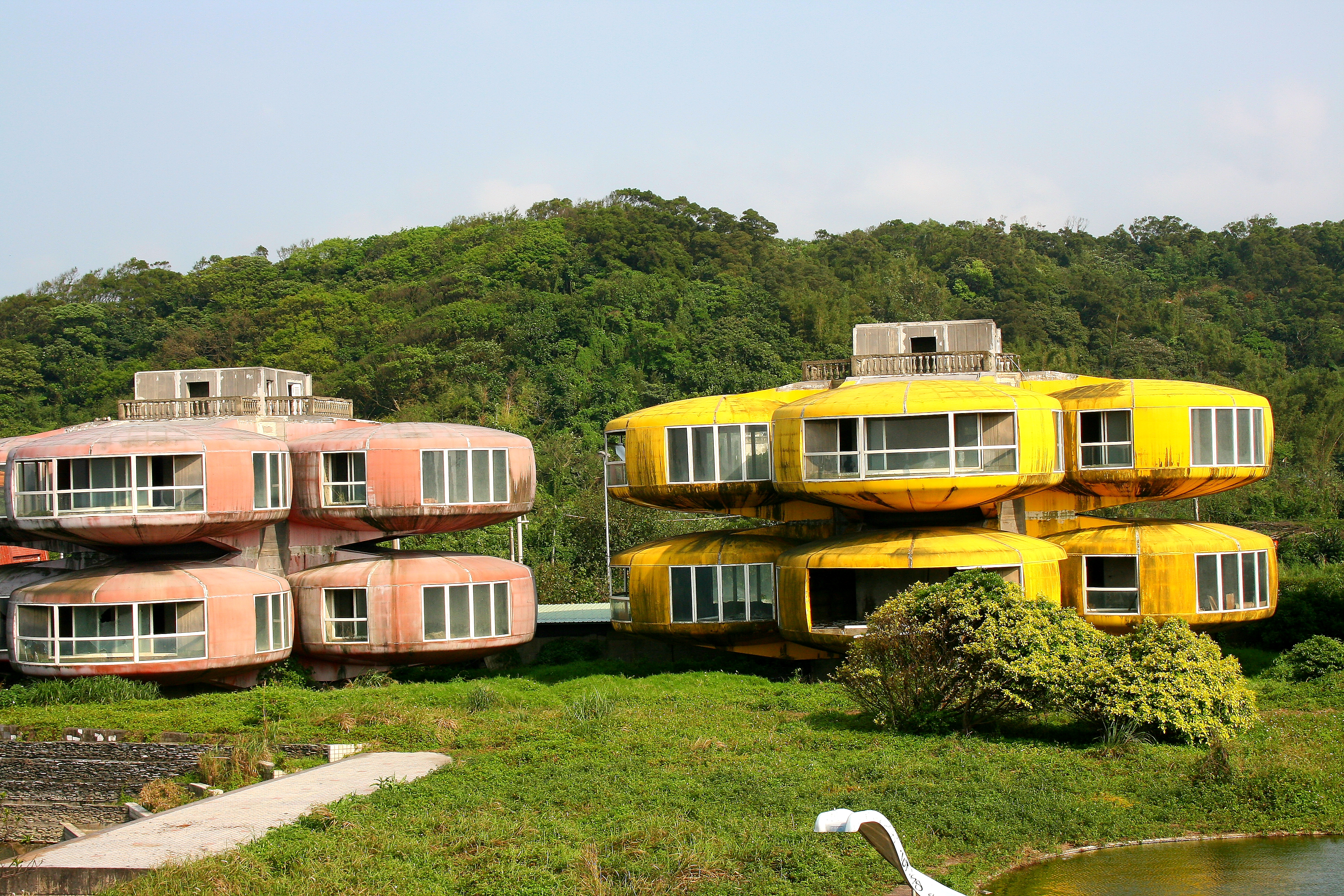
Sanzhi UFO Houses
They looked like something from a 1960s science fiction film -- clusters of pastel-colored pods perched on stilts along the coast, their round windows staring blankly at the Taiwan Strait. The Sanzhi UFO Houses were supposed to be a beach resort for American military officers stationed in East Asia. Instead, they became one of the most photographed ruins in Taiwan, a place internet explorers called a ghost town and architectural critics dubbed the "ruins of the future." Nobody ever checked in. Nobody ever lived there at all.
A Resort for an Empire That Left
Construction began in 1978 in Sanzhi District, on the northern tip of what is now New Taipei. The pod-shaped structures resembled Futuro houses, the fiberglass flying-saucer homes designed by Finnish architect Matti Suuronen in the late 1960s. The Sanzhi development was backed by the Hung Kuo Group and aimed at a leisure market that included American servicemen. But the project ran into trouble almost immediately. Investment losses mounted, and a series of fatal car accidents and worker suicides during construction spooked investors and laborers alike. Local belief attributed the misfortune to an act of desecration: to widen the road to the building site, workers had bisected a Chinese dragon sculpture near the resort gates. By 1980, just two years after breaking ground, the project was abandoned.
Ghosts in Fiberglass
For nearly three decades, the empty pods sat on the Sanzhi coast, slowly being reclaimed by vegetation and salt air. They became a minor tourist attraction -- the kind of place people visited precisely because they were not supposed to. Photographers documented the eerie rows of colorless pods, their futuristic shapes rendered melancholy by decades of neglect. MTV used the site as a filming location. Online forums debated whether the buildings were haunted. The pods occupied a strange cultural space: too modern to be ruins, too derelict to be architecture, too weird to ignore. They were simultaneously a failed real estate venture and an accidental art installation.
Demolished Over Protest
In 2008, the New Taipei government announced plans to demolish the UFO houses and redevelop the site into a commercial seaside resort with hotels and beach facilities. An online petition circulated, calling for at least one structure to be preserved as a museum piece -- a testament to an architectural vision that, however failed, was unlike anything else in Taiwan. The petition did not succeed. Demolition began on 29 December 2008, and by 2010 the last of the pods had been torn down. The site was cleared for a waterpark and resort development, replacing one unrealized vacation dream with another.
Afterlife in Pop Culture
The Sanzhi UFO Houses may be gone from the physical landscape, but they persist in the cultural one. The site appeared in the 1987 action film White Phantom. In 2012, the game developers behind Call of Duty: Black Ops II recreated the buildings as a multiplayer map in the Apocalypse DLC pack, letting millions of players run through a digital version of structures that no longer exist. German pianist Hauschka named a track after them on his 2014 album Abandoned City. In their demolition, the UFO houses achieved something they never managed in life: they became famous. The pods that no one ever lived in became one of Taiwan's most recognized architectural curiosities, proof that failure, given enough time and the right aesthetic, can become legend.
From the Air
The former site is located at 25.26°N, 121.48°E on the coast of Sanzhi District, New Taipei, along the Taiwan Strait. The buildings no longer exist -- demolished by 2010 -- but the coastal site remains identifiable near the Sanzhi shoreline. Nearest major airport is Taipei Songshan (RCSS), approximately 25 km southeast. Taiwan Taoyuan International Airport (RCTP) lies roughly 30 km south. Best viewed at 2,000-4,000 ft altitude along Taiwan's northwestern coastline.