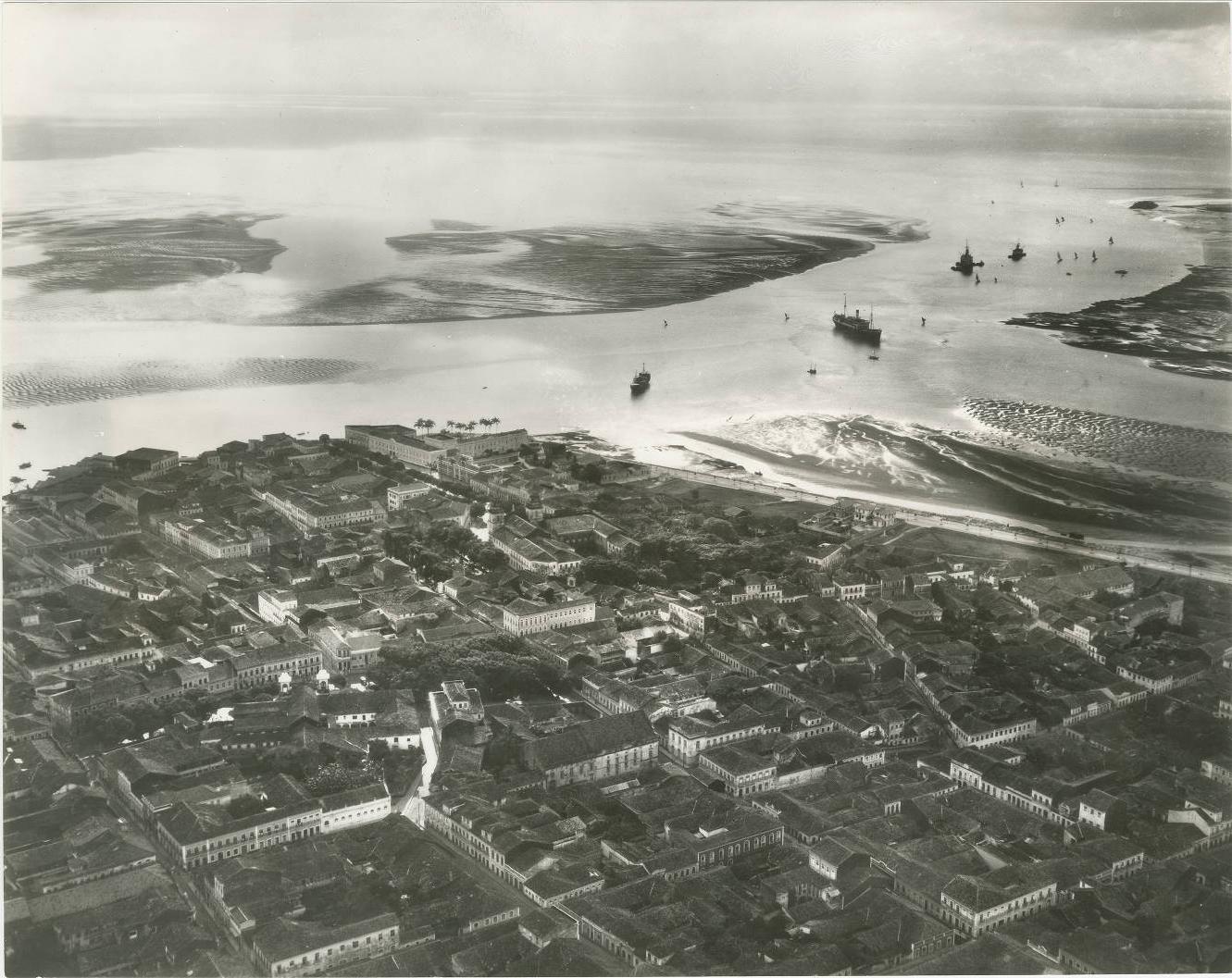
São Luís, Maranhão
Count the facades in the historic center and you will lose count, because almost every one of them is covered in blue, green, and white azulejos - the glazed ceramic tiles the Portuguese inherited from the Moors and then sent across the Atlantic to face their overseas sobrados. São Luís has the largest collection of exterior azulejos anywhere in Brazil, and the habit was practical as much as decorative: the tiles reflect heat and shed rain, both of which arrive in quantities this close to the equator. The historic center is also the only UNESCO-listed rare example of a Portuguese colonial city built on a rectangular grid in Brazil - a planner's map laid over a tropical estuary - and the whole thing began, improbably, as a French project.
A French Capital in Portuguese Hands
The Tupinambá had a village here when the French arrived in 1612 under Daniel de la Touche, Seigneur de la Ravardière, and Admiral François de Razilly. They built a fort and named it Saint-Louis de Maragnan after the reigning king Louis XIII and his sainted ancestor Louis IX. Their larger ambition was France Équinoxiale - Equinoctial France - a tropical colony to complement the French foothold further north. It did not last. By 1615, Portuguese forces under Jerônimo de Albuquerque won the Battle of Guaxenduba, the French withdrew, and the city became São Luís. Then in November 1641 a Dutch force of 1,000 troops under Admiral Jan Cornelisz Lichthart arrived as part of the wider Dutch invasion of Brazil. They sacked the city, destroyed Catholic imagery, and held out for 27 months before surrendering in February 1644. After two European empires and one indigenous nation, São Luís settled into a long Portuguese century - still the only Brazilian state capital founded by France.
Cotton, Cash, and Colonial Stone
The wealth that built the azulejo-clad sobrados came, largely, from a cruel export economy. From the late 18th century into the 19th, Maranhão shipped cotton to the textile mills of Liverpool and Manchester, much of it grown by enslaved Africans on plantations in the interior. When the American Civil War interrupted the flow of Southern cotton to Britain in the 1860s, São Luís briefly filled the gap, and a boom followed - enough money to finance Italian opera tours, French literary subscriptions, and the stone-paved streets still walked today. The city became the third most populous in Brazil. That prosperity ended in the final decades of the 19th century, and the city spent most of the 20th searching for another economic identity until the 1970s, when the Carajás iron mines came online and the Ponta da Madeira port on São Luís Island turned the metropolitan area into one of Brazil's most important cargo hubs. The enslaved labor that paid for those sobrados is a permanent part of the tile's story.
The Island of Poets
Somewhere along the way São Luís picked up a second nickname - the Brazilian Athens - for a disproportionate roll of writers born or made here. Gonçalves Dias, the country's foundational Romantic poet, was maranhense; so were the novelist Aluísio Azevedo, the playwright Artur Azevedo, the modernist Graça Aranha, the memoirist Josué Montello, and the 20th-century poet Ferreira Gullar, whose work includes the harrowing "Dirty Poem" written in Argentine exile during the military dictatorship. The Teatro Arthur Azevedo, on Rua do Sol, is the second-oldest theater in Brazil. At the other cultural pole, São Luís calls itself the Brazilian Jamaica - reggae arrived in the 1970s through the port and never left, and in 2018 the city opened the Reggae Museum of Maranhão, the second in the world after Jamaica's own. The two nicknames are not in tension. They describe the same city in different keys.
Streets That Survived
Walking the historic center today is walking a 17th-century Portuguese grid that somebody had the stubbornness to keep. Since 1989 a sustained restoration program has worked through the sobrados block by block - propping up facades, replacing rotten floors, rehanging azulejos that had fallen in the wet-season rains. The Palácio dos Leões, seat of the state government, looks out over São Marcos Bay from the high ground where the French fort once stood. Ribeirão and Pedras fountains still supply public water of a kind. The Metropolitan Cathedral of Our Lady of Victory, the Church of Pantaleão, and the Convent of Mercês punctuate the skyline. When the Bumba Meu Boi festival peaks in late June, hundreds of groups perform nightly in the squares - Settlers, Indians, spirit workers, enslaved Africans and forest spirits all played out in costume to matracas and drums, a comic tragedy that is also a harvest festival with a bull at its center. The tiles on the walls catch it all, reflected in blue.
From the Air
São Luís at 2.53°S, 44.30°W, on the northwestern lobe of São Luís Island between São Marcos Bay and the Anil River estuary. Cruise at 5,000-8,000 feet for a clear view of the UNESCO-listed colonial grid, the Palácio dos Leões on the bay-facing ridge, and the Ponta da Madeira and Itaqui port complexes to the south and west. Marechal Cunha Machado International Airport (SBSL) sits about 13 km southeast. Alcântara's spaceport (SBAL) lies across São Marcos Bay to the west, with the French-aligned Alcântara Space Center. Best visibility in the August-November dry season.