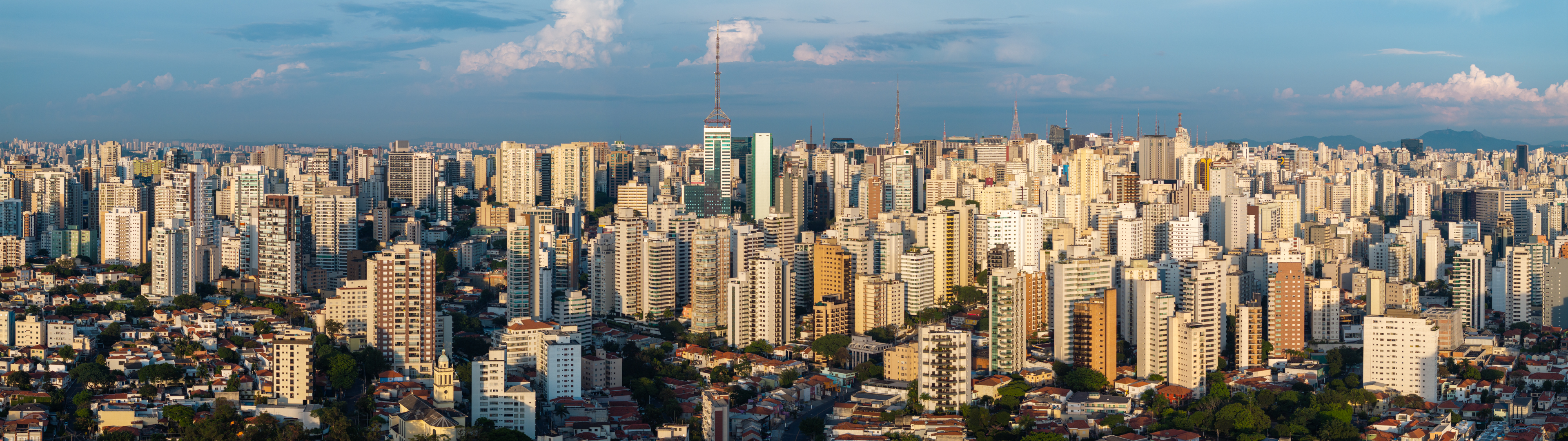
Sao Paulo
Twelve million people live in the city proper. Twenty-two million fill the metropolitan area, making it the largest in the Southern Hemisphere. Sao Paulo is Brazil's financial capital, and it never stops growing. Coffee wealth built its first fortunes in the 19th century; industry drew millions more in the 20th. Immigrants arrived from everywhere, transforming a provincial plateau town into a polyglot metropolis. Japanese, Italian, Lebanese, Korean, northeastern Brazilian: every community layered itself into the urban fabric, and none fully dissolved. Today executives fly helicopters over traffic jams averaging 180 kilometers long, while below them, museums and restaurants rival any world city. Sao Paulo is everything at once, and it makes no apologies for the contradiction.
The Scale
Stand on any high point and the skyline extends to every horizon. Neighborhoods here would qualify as cities anywhere else, and crossing Sao Paulo end to end is not a commute but a journey. Coffee money planted the seed in the 19th century. Industry made it explode in the 20th, and migrants from Brazil's impoverished northeast arrived alongside immigrants from Portugal, Italy, Japan, and dozens of other countries, all of them filling space that kept expanding outward.
This relentless scale produces both paralysis and possibility. Daily traffic jams stretch 180 kilometers on average, and infrastructure strains under a population it was never designed to serve. Yet the sheer critical mass also sustains world-class culture, cuisine, and commerce. Brazilians love to complain about Sao Paulo. They also cannot stop moving there, because nowhere else in South America offers what it does.
The Immigration
Walk through Liberdade and you pass beneath a torii gate into the largest Japanese community outside Japan. Shopkeepers speak Japanese here despite a Brazilian government that once banned it. A few kilometers away, Mooca and Bras carry the imprint of Italian settlers who reshaped Paulistano cuisine and character. Lebanese merchants anchored themselves in commercial districts. Each wave of immigrants established a foothold, maintained an identity, and changed the city in the process.
This layered migration built the food culture Sao Paulo is famous for. Pizza arrived with Italians and became something distinctly Brazilian. Sushi came with Japanese immigrants and Paulistanos adopted it as their own. Arab kibbeh and sfeeha crossed every neighborhood boundary. No other city in Brazil matches this cosmopolitan depth, and it is immigration, more than anything else, that explains why.
The Culture
MASP holds a collection that rivals European capitals. Down the road, the Pinacoteca documents centuries of Brazilian art, and outside on the streets, murals cover entire buildings in color. Inside a restored train station, the Sala Sao Paulo concert hall hosts world-class orchestras. Theaters line Avenida Paulista. Wealth has funded much of this cultural infrastructure, and residents consume it hungrily.
But culture here is also democratic. Museums open their doors for free on certain days. Art installations appear in public parks without warning. Street performers, graffiti artists, and neighborhood festivals create a layer of culture that money cannot buy and gatekeepers cannot control. Michelin-starred restaurants and Fashion Week grab headlines, but the real cultural engine runs on accessibility and sheer volume.
Avenida Paulista
Coffee barons built this boulevard. Corporations colonized it. Now Avenida Paulista is Sao Paulo's undisputed main street, the address that signals importance. Lina Bo Bardi's elevated MASP building anchors one stretch; bank towers and multinational headquarters fill the rest. When Brazil has grievances, Paulista is where the protests converge.
On Sundays, everything changes. The avenue closes to traffic and Paulistanos reclaim the asphalt for walking, biking, and impromptu cultural performances. Human scale returns to a street that weekdays surrender entirely to commerce and congestion. Weekday Paulista and Sunday Paulista feel like different cities. Both versions are real, and both reveal something essential about how Sao Paulo lives.
The Neighborhoods
Vila Madalena is where bohemia concentrates, its walls blanketed in street art. Jardins displays wealth through boutiques and upscale restaurants. In Pinheiros, gentrification is steadily converting an industrial past into a creative-class present. Each neighborhood maintains its own identity despite the homogenizing pressure of a 22-million-person metropolis, and these are the places where Sao Paulo is actually lived rather than merely endured.
Brazil's inequality finds sharp expression here as well. Favelas house millions in conditions that the city's prosperity has passed by entirely. Gated communities seal the wealthy behind walls and private security. Between these extremes, middle-class neighborhoods hold most Paulistanos in a daily routine of long commutes and weekend gatherings. Walk through enough of them and the aggregate statistics dissolve into individual streets, each telling a different story about what this city really is.
From the Air
Sao Paulo (23.55S, 46.63W) sprawls across a plateau 760m above sea level in southeastern Brazil. Guarulhos International Airport (SBGR/GRU) sits 25km northeast as the main gateway, with two parallel runways: 09L/27R (3,000m) and 09R/27L (3,700m). For domestic flights, Congonhas Airport (SBSP/CGH) lies just 8km south of downtown. From the air, the city's immense scale becomes unmistakable: urban sprawl extends to the horizon in every direction. The Tiete and Pinheiros Rivers wind through the concrete expanse below. Expect subtropical highland weather, mild year-round, with wet summers from October through March and dry winters. Afternoon thunderstorms build frequently during summer months.