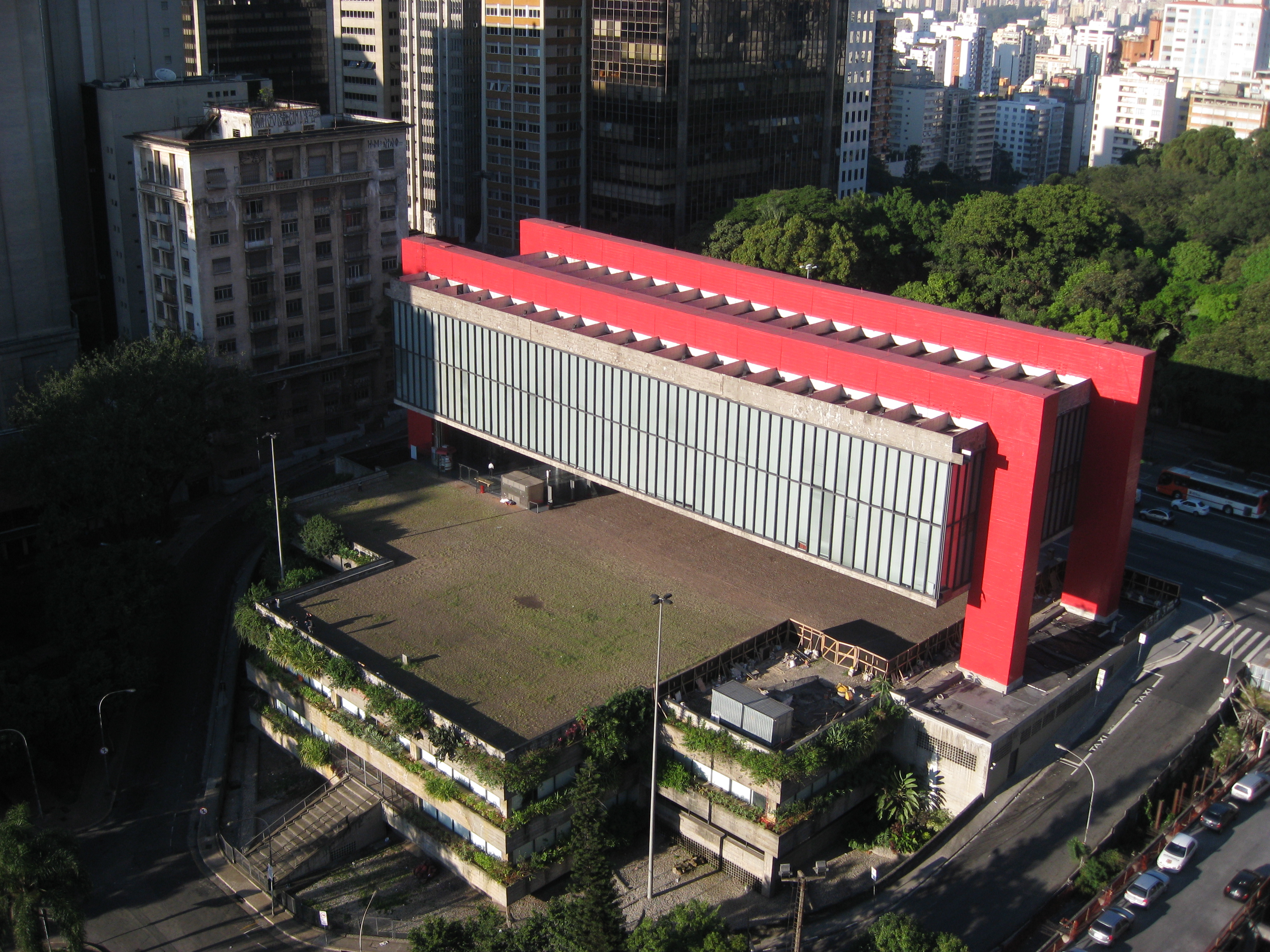
Sao Paulo Museum of Art
The building appears to float. Eight meters of open air separate the main gallery floor from the ground, held aloft by four massive concrete pillars connected by prestressed beams that span 74 meters without intermediate support. When architect Lina Bo Bardi designed the Sao Paulo Museum of Art -- MASP -- she was honoring a condition attached to the land: the view from Paulista Avenue down to the city center and the valley beyond must never be obstructed. Her solution was to lift the entire museum into the sky and leave the ground free. The result, inaugurated in 1968 by Queen Elizabeth II, became one of the most audacious structures in modern architecture.
A Media Baron's Obsession
MASP exists because Assis Chateaubriand wanted it to exist, and Chateaubriand was accustomed to getting what he wanted. As founder and owner of Diarios Associados, Brazil's largest media conglomerate in the 1940s, he commanded the resources and connections to attempt something outrageous: assembling a world-class European art collection in a country that had never possessed one. He originally considered Rio de Janeiro but chose Sao Paulo, where industrial wealth was concentrating rapidly. The timing was deliberate. World War II had devastated the European art market, making masterpieces available at prices that would have been unthinkable a decade earlier. Chateaubriand recruited Pietro Maria Bardi, an Italian art critic and former gallery owner from Milan and Rome, to lead the acquisitions. Bardi intended to stay for a year. He stayed for life.
Raphael by Telegram
Between 1947 and 1960, Bardi and Chateaubriand built one of the most remarkable collections in the Western Hemisphere. While other museums deliberated through curatorial committees, MASP bought fast -- sometimes by telegram from Christie's, Sotheby's, or Wildenstein. This speed drew criticism and suspicion about authenticity, but the results speak across the gallery walls: Raphael's Resurrection of Christ, Botticelli's Virgin and Child, Rembrandt's Portrait of a Young Man with a Golden Chain, five Cezannes, twelve Renoirs, five Van Goghs, three Picassos, and four Goyas. The Brazilian collection runs equally deep, with seventeen Portinari canvases and works by Tarsila do Amaral, Anita Malfatti, and Di Cavalcanti. In total, more than 8,000 pieces earned designation as Brazilian national heritage.
Paintings on Glass Easels
Lina Bo Bardi's innovations extended beyond the building's structure into how visitors encountered art. She mounted paintings on tempered crystal sheets set into concrete block bases, mimicking a painter's easel and freeing canvases from the wall. Visitors could walk behind the works, reading labels on the reverse, and approach paintings from angles that traditional hanging never permitted. The effect was democratic and intimate -- art presented not as shrine artifacts behind velvet ropes but as objects meant to be examined from every side. The museum abandoned this display method in the late 1990s, ironically just as foreign institutions began adopting it. Bo Bardi's interior philosophy matched her exterior honesty: exposed concrete, whitewashed walls, industrial black rubber flooring, flagstone in the civic hall. "I didn't search for beauty," she wrote. "I've searched for freedom."
Three Minutes in the Dark
At 5:09 on the morning of December 20, 2007, three men broke into MASP with a hydraulic jack and a crowbar. In three minutes, they removed two paintings: Candido Portinari's O Lavrador de Cafe and Pablo Picasso's Portrait of Suzanne Bloch, together valued at approximately $55 million. The heist exposed an embarrassing truth -- the museum had no alarm system, no motion sensors, and security cameras that lacked infrared capability. None of the collection was insured. Police recovered both paintings on January 8, 2008, in the city of Ferraz de Vasconcelos in Greater Sao Paulo. The incident followed a pattern of financial distress: just two years earlier, MASP had been forced to close temporarily when its power was cut for unpaid bills.
Lifting the Floor, Again
Between 1996 and 2001, a controversial renovation replaced Bo Bardi's original flooring, installed a second elevator, added a third underground level, and substituted her water mirrors with gardens. Architects protested that the changes distorted Bo Bardi's vision. But the museum's ambitions kept expanding. In 2021, MASP announced plans for a 14-story, 72-meter annex -- the Edificio Pietro Maria Bardi -- connected to the original building by an underground passage. Completed and opened in March 2025 at a cost of 250 million reais, the black monolith expansion nearly doubled the exhibition space from roughly 10,500 to nearly 22,000 square meters. The original building, with its impossible suspension and open civic plaza below, remains the icon. But the collection that Chateaubriand and Bardi assembled through sheer will and well-timed telegrams now has room to breathe.
From the Air
MASP sits on Paulista Avenue at approximately 23.561S, 46.656W, directly on the ridgeline that defines Sao Paulo's central spine. The building's distinctive feature -- a glass and concrete box suspended above open ground on four red concrete pillars -- is recognizable from low altitude. The new 14-story black annex (completed 2025) rises adjacent to the original structure. Nearest airports: Congonhas (SBSP) approximately 5nm south, Guarulhos International (SBGR) approximately 25nm northeast. Best viewing altitude: 1,500-3,000 feet AGL. The open plaza beneath the elevated structure is visible as a gap in the urban roofline along the Paulista ridge.