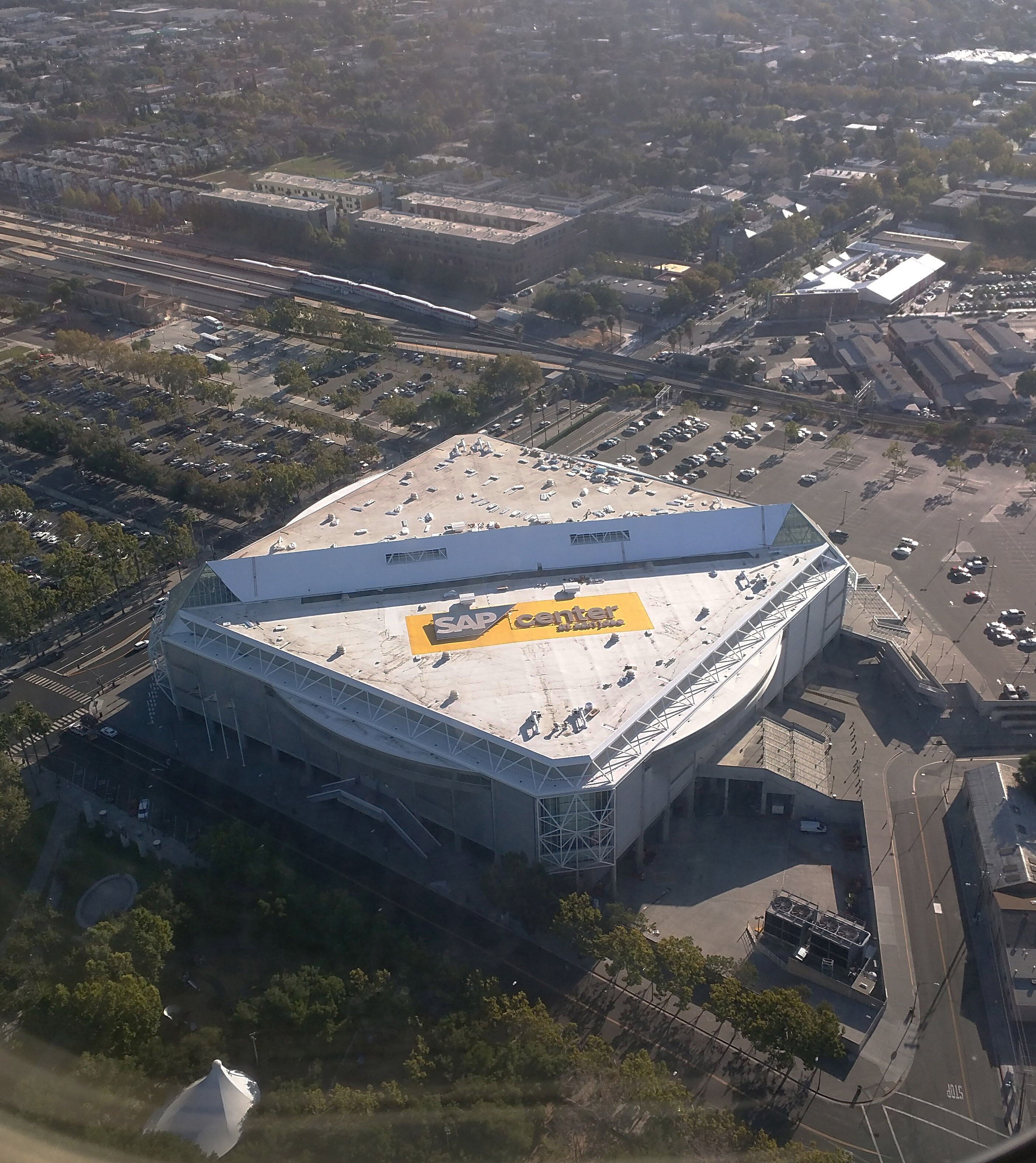
SAP Center
Four names in thirty years. San Jose Arena became Compaq Center, which became HP Pavilion, which became SAP Center - each rebrand tracking the tectonic shifts in Silicon Valley's corporate landscape as neatly as a stock ticker. But step inside on a hockey night and you'll hear only one name shouted from the stands. The Shark Tank. That nickname, bestowed by the fans who have filled these seats since 1993, has outlasted every sponsorship deal and every logo change. It tells you something about what this building actually is: not a corporate venue with a hockey team attached, but a hockey arena that happens to sell its forehead to the highest bidder.
Citizens Who Wanted a Tank
The SAP Center exists because a group of San Jose residents decided, in the mid-1980s, that their city deserved a world-class arena. They called themselves Fund Arena Now - FAN - and they lobbied city officials, courted NHL and NBA executives, and pushed for a public vote on tax funding. On June 7, 1988, the measure passed by a razor-thin margin. Construction began in 1991, the same year the NHL granted an expansion franchise to San Jose. There was a problem: the original design wasn't suitable for professional hockey. The new Sharks demanded luxury suites, a press box, and more seats. Denver architect Charles Sink, of Sink Combs Dethlefs, redesigned accordingly. By 1993, the arena opened its doors as the San Jose Arena - a building that wouldn't have existed without ordinary citizens pushing harder than any corporation.
The Name Game
In 2001, Compaq bought the naming rights, and the arena became the Compaq Center at San Jose. A year later, Hewlett-Packard swallowed Compaq whole, and the building was rechristened HP Pavilion - sharing a name, somewhat awkwardly, with a line of consumer laptops. Then in 2013 came the current arrangement: German software giant SAP paid $3.35 million per year for the privilege, a deal that carried a personal twist. SAP co-founder Hasso Plattner also happened to be the owner of the San Jose Sharks. In August 2025, the Sharks signed a lease extension keeping them at the arena through 2051, with $425 million in planned upgrades to the concourse, club levels, locker rooms, and infrastructure. The arena's name may change again. The commitment to this corner of downtown San Jose will not.
Where the Sharks Swim
The Sharks have never won a Stanley Cup, but they came closer than anyone expected in 2016, reaching the Finals for the first time in franchise history. Games 3, 4, and 6 were played at the SAP Center, the building electric with decades of accumulated hope. The Pittsburgh Penguins won the series after Game 6, and the Cup was hoisted on San Jose ice by the visiting team - a bittersweet memory that still lingers in the rafters. The arena seats 17,435 for hockey after a 2023 renovation converted seven suites and three rows of seats into a 10,000-square-foot penthouse lounge. In 2022, a new center-hung scoreboard system from Daktronics debuted with more than 9,300 square feet of LED surface area, doubling the old display. Sharks fans are not short on spectacle, even when the wins are scarce.
Far More Than Hockey
In 2006, the SAP Center sold 633,435 tickets to non-sporting events alone - more than any other venue in the western United States, and the fourth-highest total in the world behind Madison Square Garden, Manchester Arena, and Scotiabank Arena in Toronto. The list of events that have passed through these doors reads like a cultural encyclopedia: the 1997 NHL All-Star Game, five U.S. Figure Skating Championships, the 1999 NCAA Women's Final Four, USA Gymnastics Olympic Trials in 2012 and 2016, WWE pay-per-views from the 1998 Royal Rumble to TLC in 2018, and UFC cards stretching from 2011 to 2014. Intel Extreme Masters brought esports here in 2014 and 2015. Before Super Bowl 50 in nearby Santa Clara, the arena hosted the event's opening media activities. In September 2025, the Golden State Valkyries of the WNBA played their first playoff game here when a scheduling conflict displaced them from Chase Center, drawing 18,543 fans for a one-point heartbreaker against the Minnesota Lynx.
Silicon Valley's Living Room
From the air, the SAP Center is an unassuming gray rooftop near the tangle of freeways south of San Jose International Airport. It doesn't gleam like the newer Chase Center in San Francisco, and it lacks the tech-campus glamour that Silicon Valley projects to the world. That is part of its charm. This is a building that belongs to its city in a way that few modern arenas do - born from a citizen initiative, funded by local taxes, anchored by a hockey team that took its name from the great whites patrolling the waters off the California coast. The Shark Tank is where San Jose stops being a suburb of somewhere else and becomes, loudly and unmistakably, itself.
From the Air
Located at 37.33N, 121.90W in downtown San Jose, California. The arena's large rectangular roof is visible just south of the interchange of I-87 and W Santa Clara Street. Norman Y. Mineta San Jose International Airport (KSJC) is approximately 2.5 nautical miles to the northwest. Moffett Federal Airfield (KNUQ) lies about 8nm to the northwest. Reid-Hillview Airport (KRHV) is roughly 6nm to the southeast. Best viewed at 3,000-5,000 feet AGL. On game nights, the surrounding parking lots will be full and illuminated.