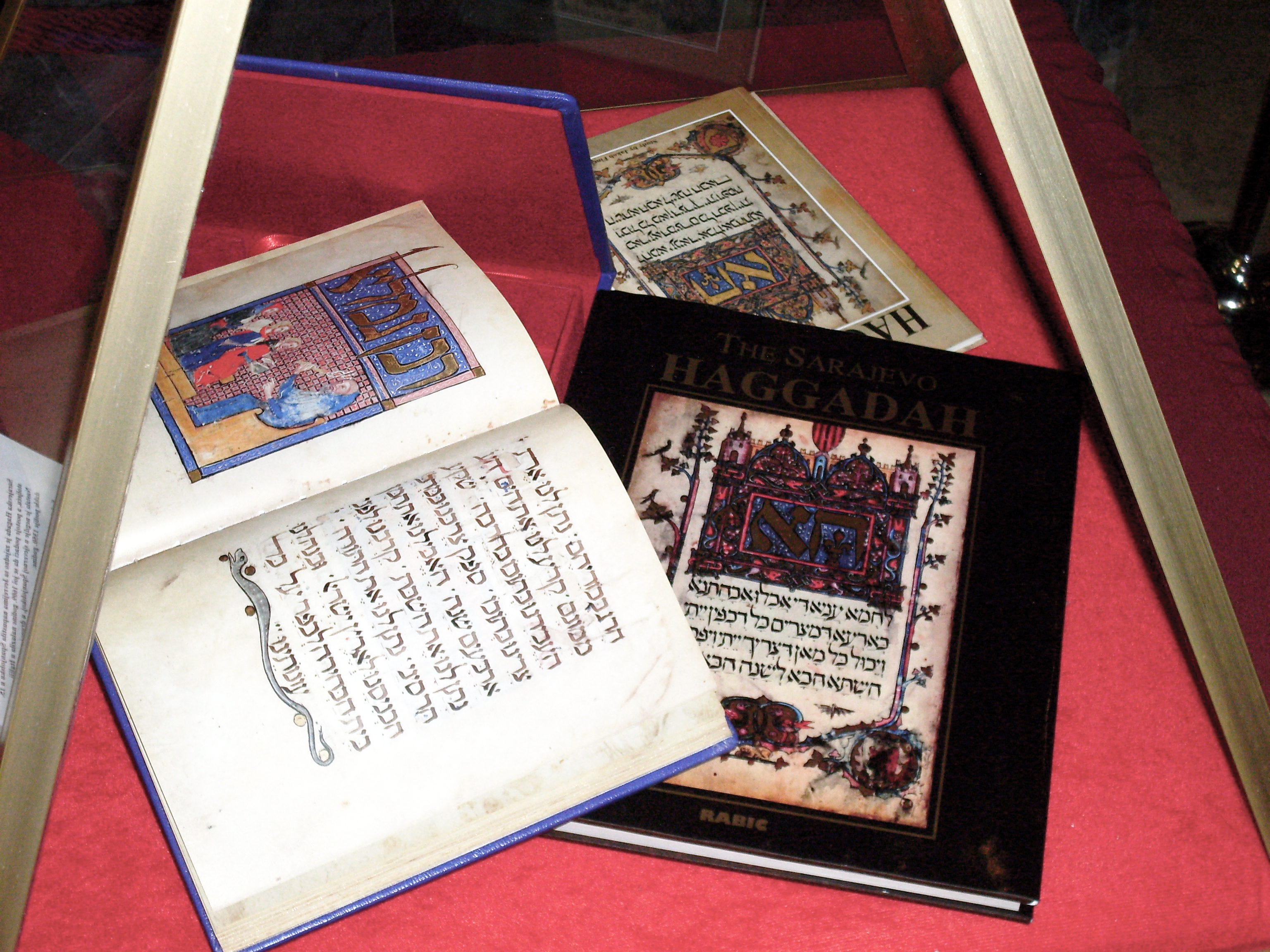
Sarajevo Haggadah
Its pages are stained with wine. Not from damage or neglect, but from use -- centuries of Passover Seders where families passed the book, read the prayers, and spilled a little in the process. The Sarajevo Haggadah is a 14th-century illuminated manuscript created around 1350, most likely in Barcelona, its calfskin vellum pages filled with Hebrew text and gold-leafed illustrations depicting scenes from Genesis through the death of Moses. It is one of the oldest Sephardic Haggadahs in existence. And it has no business still being here. Expelled from Spain, smuggled through Italy, hidden from the Nazis by a Muslim librarian, rescued from a flooded basement during the Bosnian War -- this book has survived more catastrophes than most civilizations.
From Barcelona to the Balkans
The Haggadah was probably created as a wedding gift, joining two families whose coats of arms appear on its opening page. For a century and a half, it was used at Passover tables in Catalonia. Then came the Alhambra Decree. In 1492, Spain expelled its Jewish population, and the Sephardic diaspora scattered across the Mediterranean and Ottoman lands. The Haggadah travelled with them. Margin notes in Italian suggest it surfaced in Italy during the 16th century, perhaps in Venice, before making its way to the Balkans. In 1894, a man named Joseph Kohen sold it to the National Museum in Sarajevo, where it has remained -- technically -- ever since. The qualifier matters, because the book has spent considerable time outside the museum, hidden in locations ranging from a mountain mosque to a city bank vault.
Saved by a Muslim Librarian
When the Nazis and their Ustashe allies occupied Sarajevo during World War II, the museum's chief librarian, Dervis Korkut, understood what the Haggadah's seizure would mean -- not just the loss of a priceless artifact but a symbolic victory for an ideology built on erasing Jewish culture. Korkut smuggled the manuscript out of the museum and gave it to a Muslim cleric in a village on Mount Bjelasnica, where it was hidden in a mosque for the duration of the war. Korkut simultaneously sheltered a young Jewish woman named Mira Papo, hiding her from deportation. Decades later, when Korkut's own daughter needed refuge during the Bosnian War of the 1990s, it was Mira Papo -- now elderly and living in Israel -- who helped secure her safety. The story loops back on itself: a Muslim saved a Jewish book and a Jewish girl; the girl, grown old, saved the Muslim's daughter.
Surviving Another War
In 1992, as the siege of Sarajevo began and the city descended into violence, the National Museum was broken into and its basement flooded. The safe holding the Haggadah was in that basement. Professor Enver Imamovic, an archaeologist who had assumed directorship of the museum, entered the damaged building with police escort to search for the manuscript. They found it in the safe, waterlogged but intact. The book was moved to a bank vault, where it spent years in less than ideal conditions. In 2001, international conservators were called in to assess the damage. A proper climate-controlled vault was eventually constructed with French funding, and the Haggadah returned to public display in 2018. Before a 1992 exhibition in Spain, the book was insured for $7 million, but its true value is incalculable -- measured not in currency but in the number of times someone risked everything to keep it from being destroyed.
A Book That Belongs to Everyone
In 2003, the Sarajevo Haggadah was inscribed as a National Monument of Bosnia and Herzegovina. Reproductions have become collector's items; in 2006, a Sarajevo publisher announced 613 hand-printed copies on parchment, the number alluding to the 613 commandments in Jewish law. The Grand Mufti of Bosnia presented a copy to Tony Blair as a symbol of interfaith cooperation, and another to a representative of Israel's Chief Rabbinate. The gesture captures something essential about the Haggadah's meaning in Sarajevo: a Jewish book, written in medieval Spain, saved by Muslims, rescued by a secular academic, and claimed by a country that is majority Bosniak. It belongs to no single faith or nation. Its 34 pages of biblical illustrations -- creation, exodus, wandering, covenant -- tell a story of survival that the book itself has lived. The wine stains on its pages are the most human detail: proof that for centuries, before it became a national treasure, it was simply a family's book, used at the table, read aloud, passed down.
From the Air
The Sarajevo Haggadah is housed in the National Museum of Bosnia and Herzegovina, located at 43.855N, 18.402E in central Sarajevo, along the south bank of the Miljacka River near the Marijn Dvor district. The museum building is identifiable from the air as a large neoclassical structure with a quadrangular layout and interior courtyard. Sarajevo International Airport (LQSA) is approximately 6 km to the southwest. Mount Bjelasnica, where the manuscript was hidden during World War II, is visible to the southwest at 2,067 metres elevation.