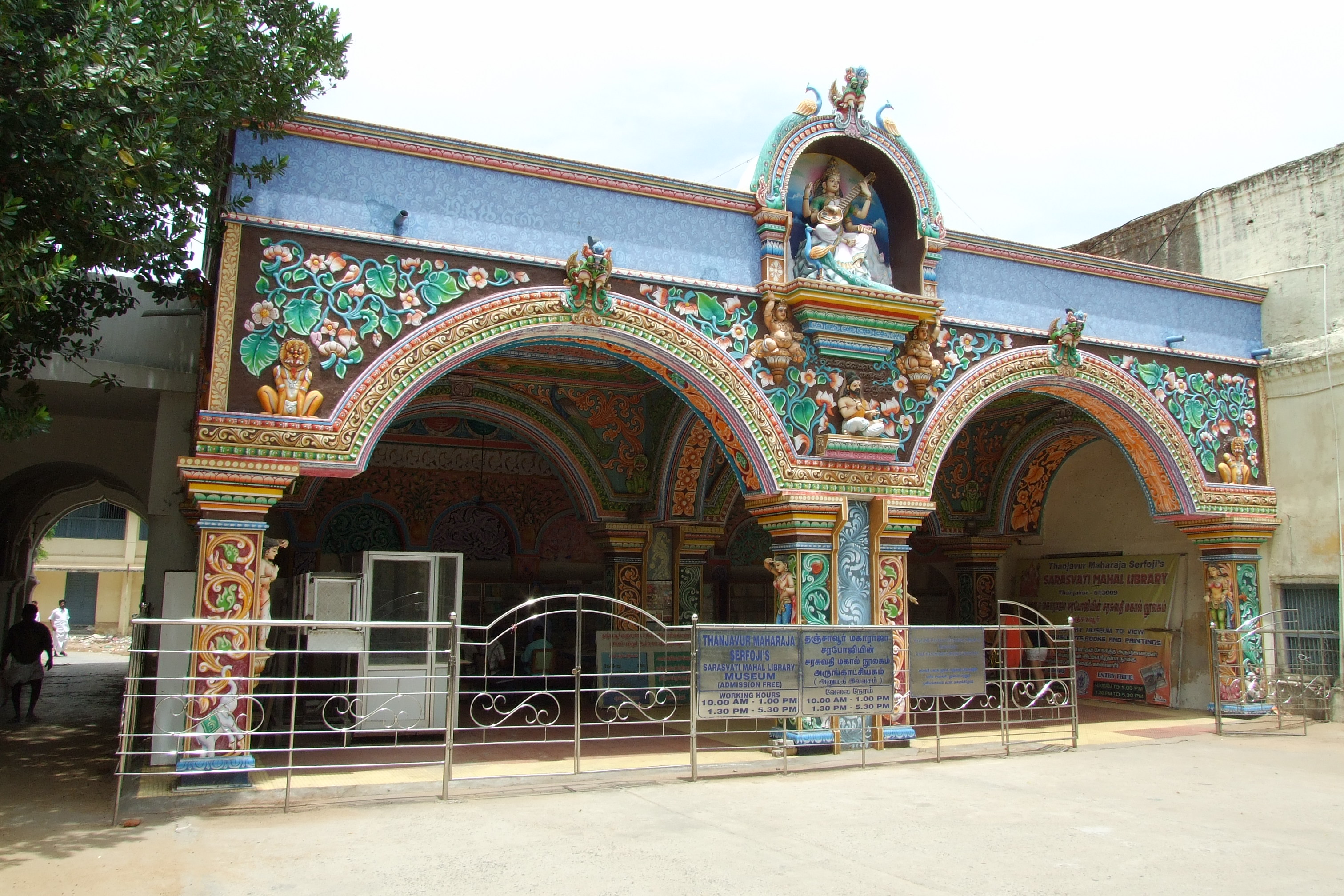
Saraswathi Mahal Library
Somewhere in the corridors of the Thanjavur Palace, behind climate-controlled glass, a palm-leaf manuscript inscribed in Tamil more than four centuries ago still carries its ink as clearly as the day a scribe pressed stylus to leaf. The Saraswathi Mahal Library holds over 49,000 such volumes -- manuscripts in Tamil, Sanskrit, Marathi, Telugu, Persian, and Urdu -- and the Encyclopedia Britannica once called it the "most remarkable library of India." What began as a private royal collection for the Nayak kings has survived dynasty changes, colonial upheaval, and the simple ravages of tropical humidity to remain one of the oldest functioning libraries in Asia.
A King Who Collected the World
The library was founded in the 16th century by the Nayak kings of Thanjavur, who ruled from 1535 to 1676 CE and kept it as a private collection for royal intellectual enrichment. When the Maratha rulers captured Thanjavur in 1675, they did not plunder the library -- they expanded it. The most devoted patron was Serfoji II, who reigned from 1798 to 1832. Tutored by the German missionary Christian Friedrich Schwartz, Serfoji mastered English, French, Italian, and Latin in addition to his native languages. He dispatched scholars across northern India to collect, purchase, and copy manuscripts from renowned centers of Sanskrit learning. Under his stewardship, the library became something extraordinary: not merely a collection of local knowledge, but a repository that reached across linguistic and geographic boundaries to gather the written wisdom of an entire subcontinent.
What the Shelves Hold
The numbers alone stagger. Of the collection's manuscripts, 39,300 are in Sanskrit. Another 3,076 Marathi manuscripts document the saints of Maharashtra and the religious lineages of the Sri Ramadasi and Dattatreya traditions. There are 846 Telugu manuscripts, most inscribed on palm leaf, and 22 in Persian and Urdu from the 19th century. Beyond the manuscripts lie 1,342 bundles of Maratha Raj administrative records, written in Modi script -- a rapid shorthand for Devanagari -- covering the political, cultural, and social governance of Thanjavur's Maratha kings. The library also holds Ayurvedic medical records, complete with patient case studies, classified under the Dhanvantari section. Among the printed rarities: Dr. Samuel Johnson's dictionary from 1784, a pictorial Bible printed in Amsterdam in 1791, and Lavoisier's Traite Elementaire de Chimie, alongside ancient maps and town-planning documents that detail Thanjavur's underground drainage system.
Preservation Against the Odds
Palm-leaf manuscripts are fragile things. In the humid climate of Tamil Nadu, insects, mold, and moisture are constant threats. Efforts to preserve the collection began in 1965, when Indira Gandhi, then India's Information and Broadcasting Minister, sanctioned funding for microfilming and cataloging. The library was designated a Manuscript Conservation Centre under the National Mission for Manuscripts in 2003. Computers arrived in 1998 to begin digitizing the catalog, though the vast scope of the collection means the work continues. Only a tiny fraction of the 49,000 volumes are ever on display; the rest remain in controlled storage, accessible to scholars by prior arrangement. The library opened its doors to the public in 1918, but its true audience has always been the future -- each preservation effort a wager that someone, someday, will need what these leaves contain.
Living Knowledge in a Palace Setting
The library sits within the campus of the Thanjavur Palace, a setting that reflects its origins as a royal institution. Walking the corridors, visitors encounter painted murals and carved archways alongside glass cases displaying manuscripts that predate the European printing press. The collection is not a museum of dead texts. Tamil and Sanskrit scholars still visit to consult medical treatises, literary works, and historical records that exist nowhere else. The Maratha Raj records offer social historians a window into three centuries of governance in southern India. Town-planning documents reveal that Thanjavur's rulers built sophisticated drainage and water-supply systems centuries before such infrastructure became standard in European cities. What survives here is not just paper and palm leaf but the intellectual ambitions of rulers who believed knowledge was worth gathering, protecting, and passing forward.
From the Air
Located at 10.79N, 79.14E within the Thanjavur Palace complex in Tamil Nadu, India. The palace and surrounding old city are visible from lower altitudes. The nearest airport is Tiruchirappalli International Airport (VOTR/TRZ), approximately 55 km to the southwest. The Kaveri River delta spreads to the east, and the Brihadisvara Temple's massive vimana tower, one of the tallest ancient structures in India, serves as a visual landmark nearby. Best viewed at 3,000-5,000 feet in clear conditions.