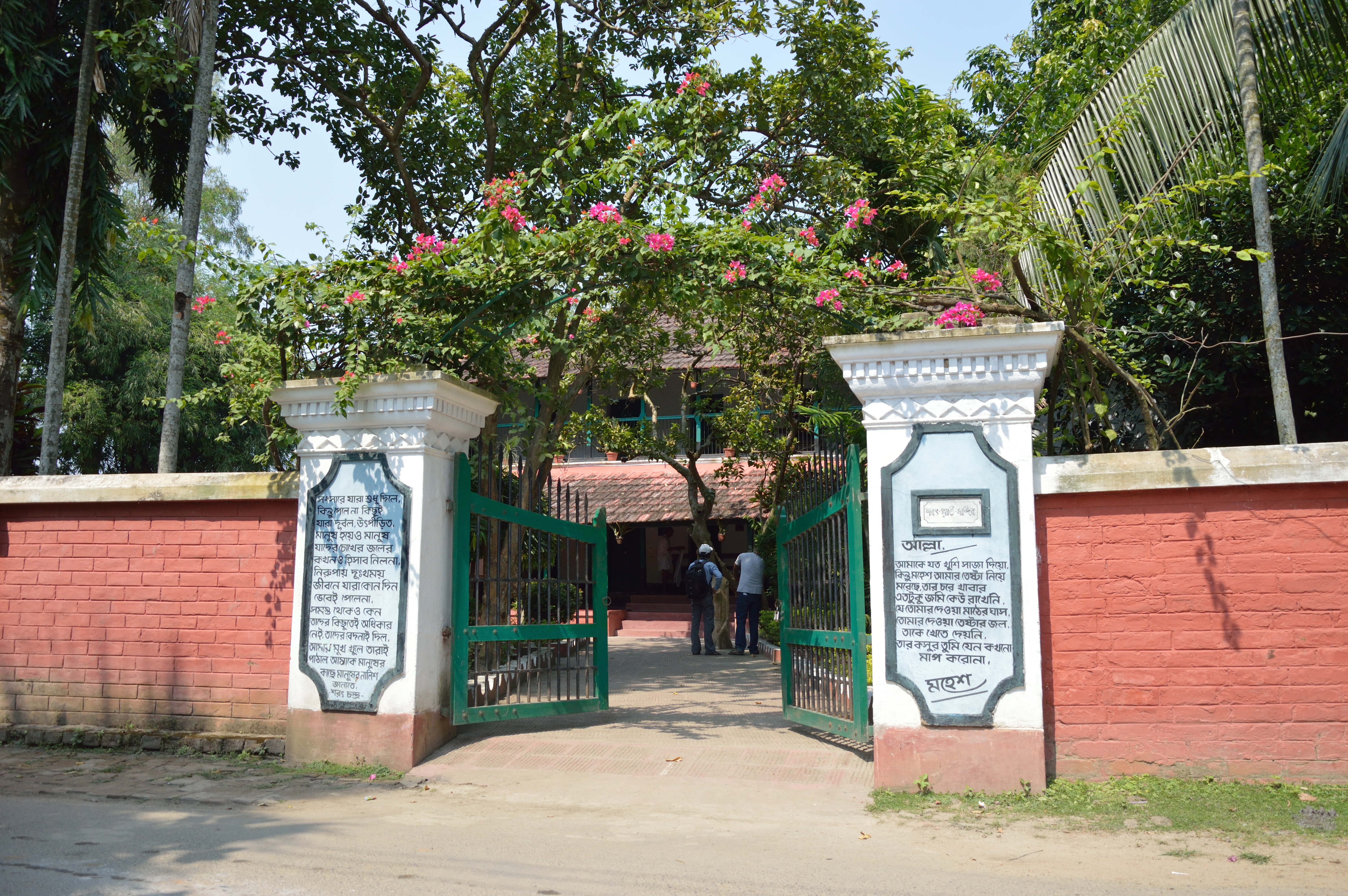
Sarat Chandra Kuthi
Devdas has been adapted into more than twenty films across eight languages and three countries. But the story of the doomed romantic was not born in a Calcutta publishing house or a filmmaker's studio. It was written here, in a two-story house overlooking rice paddies and a quiet stretch of the Rupnarayan River, in a village so small that Sarat Chandra Chattopadhyay gave it a new name when he arrived. He called it Samtaber. The house he built there in 1923, now known as Sarat Chandra Kuthi, survives as a museum -- one of the few places in India where you can stand in the room where a literary giant worked and look out at the landscape that shaped his imagination.
The Novelist Comes Home
Sarat Chandra Chattopadhyay, born in 1876, is the most popular, most translated, and most adapted Indian author of all time. His novels of Bengali family life -- their caste tensions, their quiet heartbreaks, their women fighting for dignity within rigid social structures -- spoke to readers across the subcontinent. By 1919, when he bought a plot of land in the village of Samta for 1,100 rupees, he was already a celebrated writer. Samta was near his sister's home in the village of Panitras, and its location on the Rupnarayan River, in Howrah district, offered the kind of rural quiet he craved. He hired a local worker named Gopal Das to build the house, which was ready by February 1923. The total cost was 17,000 rupees.
Twelve Years of Creation
Chattopadhyay lived at Sarat Chandra Kuthi for twelve years, and during that period he produced some of his most enduring work. Devdas, the tragic love story that would become perhaps the most filmed novel in Indian cinema history, was serialized in the literary journal Bharatbarsha while he lived in Samtaber. So were Baikunther Will, Dena Paona, Datta, and Nishkriti -- each exploring, in its own way, the moral contradictions of Bengali middle-class life. He also wrote Ramer Sumati and Mahesh during these years. The house itself reflected his temperament: he fenced the property, dug ponds, and planted paddy fields beside it, shaping the land as deliberately as he shaped a sentence. The Rupnarayan River once flowed much closer to the house than it does today, and its presence -- visible from the upper verandah -- threaded through his days.
What the Floods Left Behind
Chattopadhyay eventually left Samtaber for Calcutta, and his death followed in 1938. The house endured without him, but not without damage. Parts of the structure, including the mud-walled kitchen, collapsed over the decades. In 1978, severe floods swept through West Bengal and damaged the building further. The local Zilla Parishad undertook repairs, and in 2001 the house was declared a heritage-historical site under the West Bengal Heritage Commission Act. A more thorough renovation came in 2009, when workers also preserved the novelist's personal belongings -- furniture, manuscripts, the artifacts of a domestic life that had long since passed into legend.
Walking Through the Rooms
Today, Sarat Chandra Kuthi is a quiet museum. The entrance bears a plaque reading "Sarat Smriti Mandir" -- Sarat's Memorial Temple. Inside, the ground-floor corridors open onto a study where his writing furniture remains. Upstairs, a verandah runs along the southern side, offering the view that once ended at the river. In the garden, trees the novelist planted still stand, and a statue of Chattopadhyay presides over the grounds. Near the house are the samadhis -- memorial shrines -- of the novelist, his brother, and his second wife, Hironmoyee Debi. Across the path, a pond he mentioned in his novel Palli Samaj catches the light. It is a modest place, easily overlooked. But for readers of Bengali literature, stepping through its gate is something close to pilgrimage.
From the Air
Located at 22.475N, 87.907E in the village of Samta (Samtaber), Howrah district, West Bengal, on the banks of the Rupnarayan River. The house is a small structure surrounded by ponds and gardens, difficult to spot from high altitude. Nearest major airport is Netaji Subhash Chandra Bose International Airport (VECC), approximately 75 km northeast. Recommended viewing altitude: 1,500-2,500 feet. The Rupnarayan River provides a clear visual reference for navigation to this rural site.