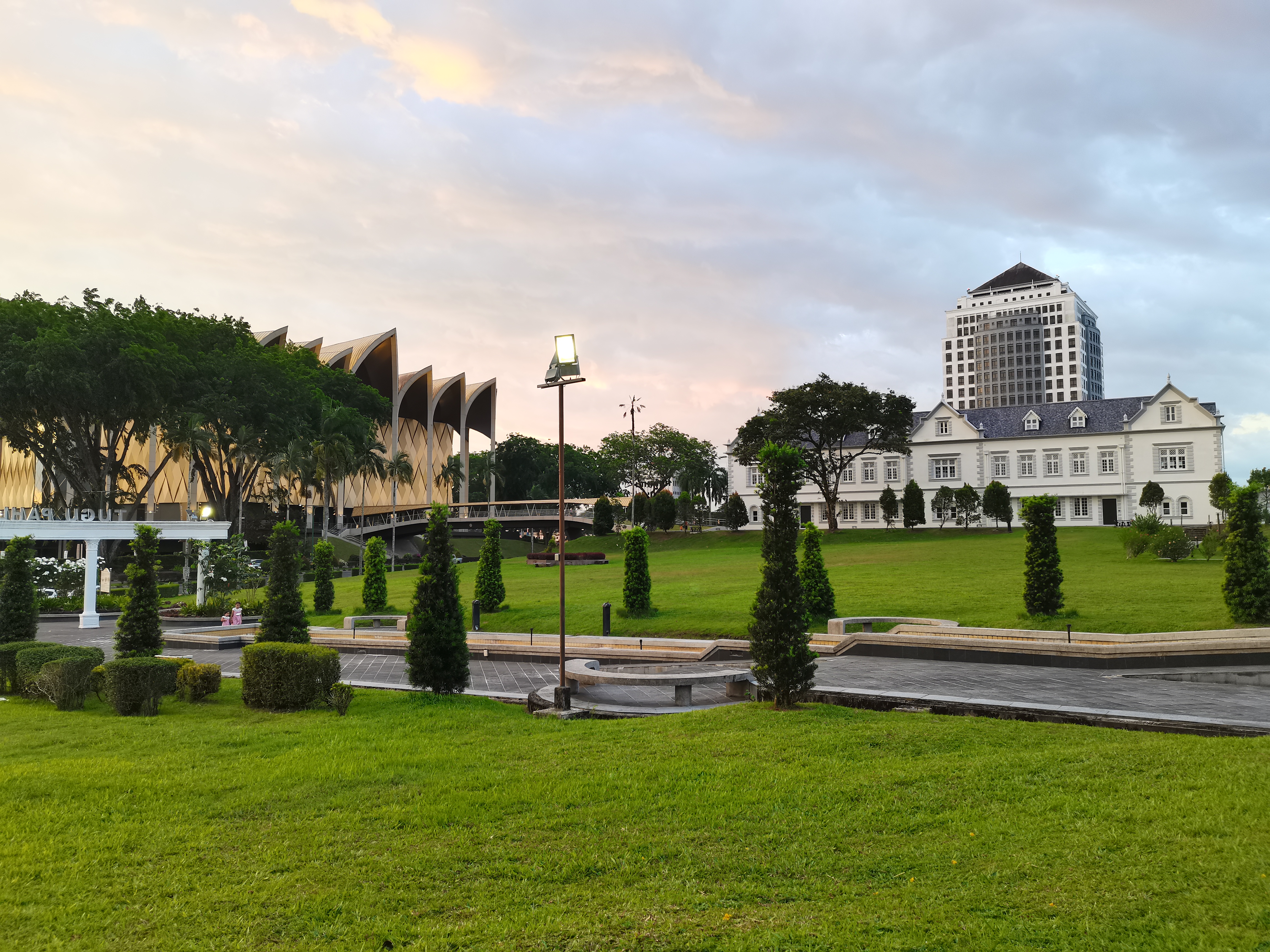
Sarawak State Museum
Before the Sarawak State Museum had a building, it had a room above a vegetable market. Specimens collected from Borneo's rivers and jungles -- birds, insects, indigenous crafts -- sat in an improvised gallery while the colonial government figured out where to put them. Hugh Brooke Low's collections from the Rajang River had outgrown a clock tower at a government office, and the overflow had nowhere else to go. That makeshift arrangement above the market stalls, open to anyone curious enough to climb the stairs, was Borneo's first public museum. The proper building that replaced it in 1891 still stands on the Kuching waterfront, its dormer windows and brick pillars a quietly incongruous piece of Queen Anne architecture transplanted to the equatorial tropics.
A Museum Born from Curiosity and Overflow
The museum's founding in 1888 reflected the peculiar enthusiasms of Sarawak's Brooke dynasty, the English family who ruled the territory as White Rajahs. Charles Brooke, the second Rajah, requested land from the Anglican Mission as early as 1880 to house the growing collections. The purpose-built structure was completed in 1889 and formally opened on 4 August 1891 -- a rectangular building measuring 44 by 160 feet, its walls and pillars of brick, its galleries lit by dormer windows that freed the walls for display cases. A new wing followed in 1911. The architectural style is Queen Anne, and the resemblance to the Samuel Way Building of the Adelaide Women's and Children's Hospital is striking enough that historians have noted the connection. In a territory of longhouses and tropical timber, this brick edifice must have looked like a dispatch from another world entirely.
Surviving the Occupation
When Japanese forces occupied British Borneo during World War II, the museum's fate hung on a single person's sympathies. A Japanese officer was assigned to direct the institution, and unlike what happened to many colonial buildings across Southeast Asia, he chose to protect it. The museum suffered very little damage or looting during the occupation years. Meanwhile, curator Edward Banks, who had run the museum since 1925, was interned from 1942 to 1945. When the war ended, Tom Harrisson -- a British polymath who had parachuted into Borneo's interior to organize indigenous resistance against the Japanese -- took over as curator in June 1947 and would lead the museum for nearly two decades.
Longhouses, Turtles, and Scientific Journals
The museum's ground floor holds Sarawak's natural history: expertly mounted specimens of the territory's reptiles, mammals, and birds, alongside a Shell exhibition on the petroleum industry that became central to Sarawak's modern economy. Upstairs, the ethnographic collections tell a different story -- models of the various longhouse types built by Sarawak's indigenous peoples, musical instruments, fish and animal traps, handicrafts, and boat models. The museum's responsibilities extend well beyond its walls. Its director is charged with protecting marine turtles and assisting the chief game warden in wildlife conservation. And since 1911, the museum staff has published the Sarawak Museum Journal, one of the oldest scientific journals in Southeast Asia, covering the history, natural history, and ethnology of Borneo.
The Borneo Cultures Museum and What Comes Next
In March 2022, the museum's ambitions materialized in a massive new building: the Borneo Cultures Museum, now the largest museum complex in Malaysia and the second largest in Southeast Asia after Singapore's National Museum. A bridge connects the new structure to the original 1891 building, linking the Victorian-era galleries to a modern exhibition space. The old museum itself has been undergoing its own renovation, though the reopening has been delayed by the complexity of fitting out galleries and exhibitions to contemporary standards. The institution that began above a vegetable market now sprawls across multiple buildings on the Kuching waterfront. Through it all, the original brick walls and dormer windows remain -- a 135-year-old reminder that curiosity, once it finds a home, tends to outgrow it.
From the Air
The Sarawak State Museum sits at 1.555N, 110.344E on the Kuching waterfront along the Sarawak River in Sarawak, Malaysian Borneo. The Queen Anne-style building and adjacent Borneo Cultures Museum are visible from low altitude along the riverfront. Kuching International Airport (WBGG) is approximately 11 km to the south. The terrain is flat, low-lying coastal plain with the city of Kuching spread along both banks of the Sarawak River.