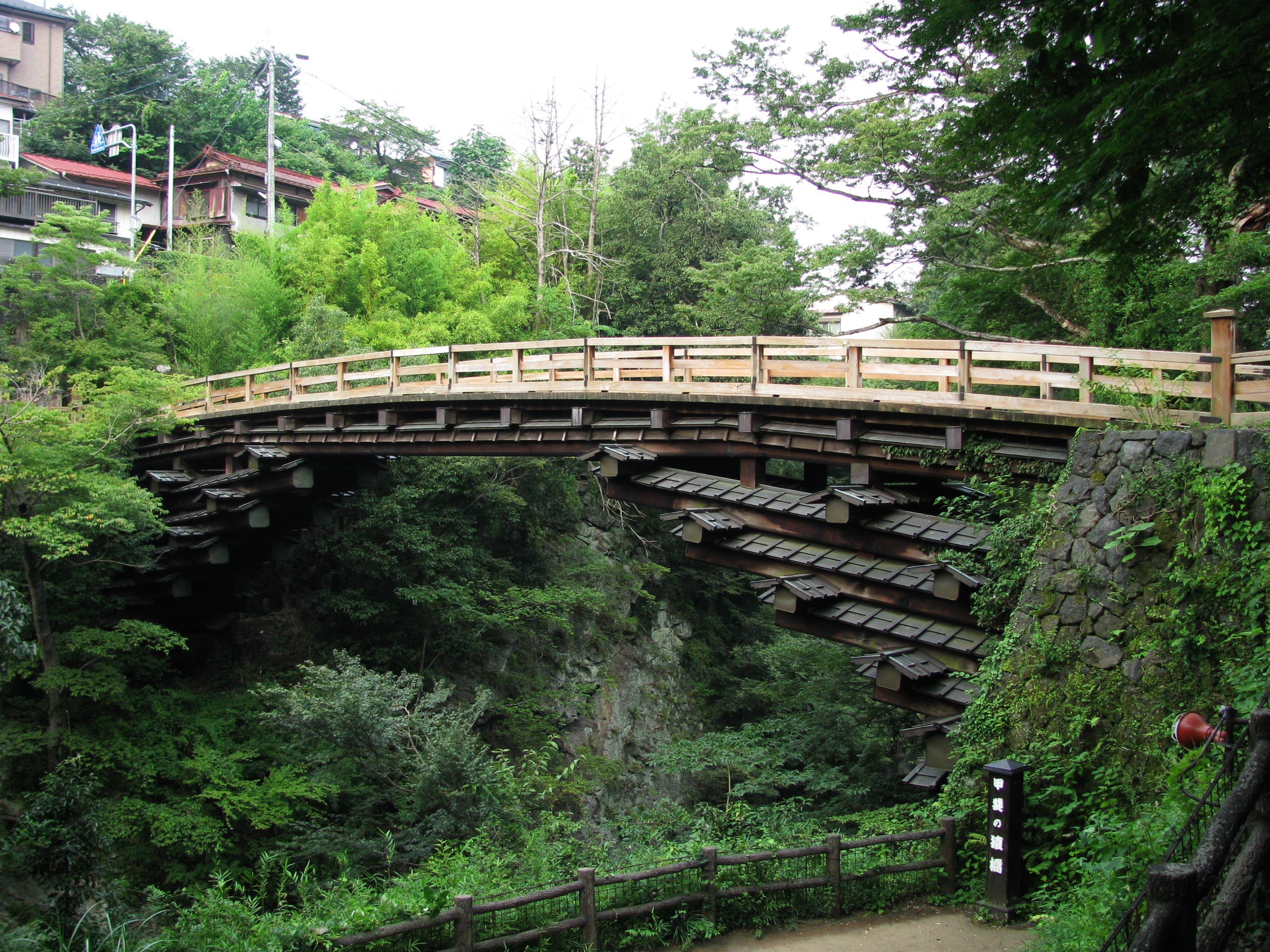
Saruhashi: The Monkey Bridge That Inspired Masters
According to legend, a troop of monkeys once linked their bodies together to bridge a chasm above the Katsura River, letting a stranded couple cross to safety. The story is almost certainly myth, but the bridge that bears its name -- Saruhashi, the Monkey Bridge -- has been defying gravity above this gorge in Yamanashi Prefecture for centuries, and it does so with a structural trick nearly as improbable as the legend itself. No piers support it from below. No cables suspend it from above. Instead, four pairs of wooden cantilever beams jut from holes carved directly into the cliff faces on either side, each pair longer than the one beneath it, stepping outward over the void until the gap between them is narrow enough for a simple arch to close. The bridge appears to float. Artists thought so too: Hokusai, Hiroshige, and Katsushika Taito II all traveled here to paint it.
Engineering Without Piers
The gorge of the Katsura River at Otsuki is deep and sheer-walled -- the kind of crossing where most builders would reach for suspension cables or masonry piers. Saruhashi's builders chose neither. They used a design called hanebashi, a cantilever technique employed during the Edo period (1603-1868). Workers bored holes into the vertical rock faces on both sides of the gorge and inserted inclined wooden beams called hanegi. Four pairs extend from each cliff, the lower pairs bracing the load of the longer pairs above them. Each beam wears a small peaked roof, a miniature shelter protecting the wood from rain and snow. At the top, where the opposing sets of beams nearly meet, a simple arch completes the crossing. The result is a bridge that seems to hover above the water with no visible means of support. It is the finest surviving example of hanebashi construction in Japan, and one of three bridges designated among the country's most unique, alongside the Kintai Bridge and the Shinkyo Bridge.
Fortress on the Highway
Saruhashi's origins are uncertain, but military records place a bridge at this site as early as the fifteenth century. The Kamakura Ozoshi, a chronicle of Kanto warfare during the Muromachi period, documents a battle near Saruhashi between Ashikaga Mochiuji and Takeda Nobunaga. In 1487, a traveling Buddhist recorded songs and Chinese poems inspired by the crossing. By 1520, the feudal lord Nobuyoshi Oyamada had relocated the bridge for strategic advantage, and from 1524 a strong garrison guarded it -- battles followed in 1530. The bridge's importance only grew when the Koshu Kaido, one of the principal highways of the Edo period, was routed across it. This was no decorative garden bridge. Saruhashi was a choke point, a toll gate, a piece of infrastructure as vital to feudal power as any castle wall.
Canvas Above the Gorge
The combination of dramatic engineering and wild scenery drew Japan's greatest artists to the gorge. In 1817, the ukiyo-e master Hokusai sketched Saruhashi for his celebrated Hokusai Manga series. In 1841, Utagawa Hiroshige walked the Koshu Kaido and kept a travel diary, the Koshu Nikki, recording the sights that would later appear in his Famous Places in the Sixty-odd Provinces. Between 1843 and 1847, Katsushika Taito II composed one of the most striking images of all: Full Moon Beneath the Monkey Bridge, now held by the Cleveland Museum of Art. In the woodblock print, the full moon hangs below the level of the bridge deck, casting silver light on boats drifting through the gorge while the cantilever beams grip the rugged cliffs overhead. The print captures what visitors still feel today -- that the bridge belongs as much to the air as to the rock.
A Bridge Preserved
On March 25, 1932, the Japanese government designated Saruhashi a Place of Scenic Beauty. At the time, the tiny village of Hirosato lacked funds to maintain it, and the bridge lingered as an orphaned landmark for three decades until Otsuki absorbed the village in 1963 and took over its care. By then, new bridges had arrived: in 1934, Shinsaruhashi Bridge was built upstream for vehicle traffic, and in 1973 another span went in downstream to carry National Route 20. Saruhashi no longer needed to bear anything heavier than footsteps. Today, boat tours glide through the gorge beneath it when river conditions allow, and the most popular time to visit is early to mid-November, when the maples lining the Katsura River ignite in autumn color and the ancient wooden beams hang above a canyon of red and gold.
From the Air
Located at 35.616°N, 138.980°E in the Katsura River gorge near Otsuki, Yamanashi Prefecture. The bridge is small but the narrow gorge it spans is visible from low altitude, cutting through forested hills west of Tokyo. Best viewed at 1,500-3,000 feet AGL. The Koshu Kaido highway (now Route 20) follows the river valley and serves as a navigation reference. Nearest airport is Chofu Airport (RJTF), approximately 40 nautical miles east. Mount Fuji (RJAF Fuji area) is visible to the south-southwest in clear conditions.