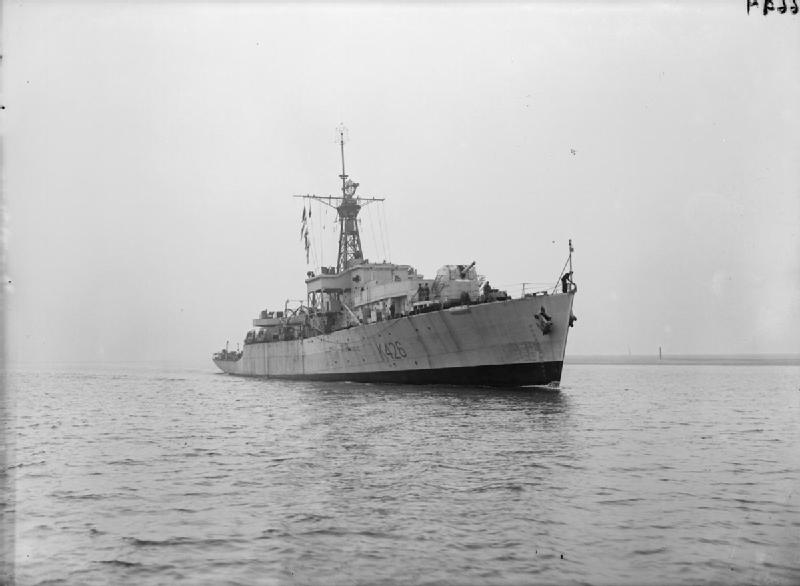
SAS Transvaal
She was commissioned one week after Germany surrendered. Built at Harland & Wolff's Belfast shipyard as HMS Loch Ard, the frigate was transferred to the South African Navy in 1944 while still under construction, renamed HMSAS Transvaal, and completed on May 14, 1945 -- too late for the war she had been designed to fight. What followed was not the anti-submarine career the ship's triple-barrelled Squid mortars were built for, but a thirty-year second act of diplomacy, rescue, and exploration across the southern oceans.
An Empire's Errands
Transvaal's postwar duties read like the itinerary of a seafaring bureaucrat. Between November 1945 and March 1946, she repatriated some 700 troops from Egypt alongside her sister ships. In 1947, she escorted the battleship serving as the royal yacht during King George VI's tour of South Africa. That same year, her captain, Lieutenant-Commander John Fairbairn, read the official proclamation annexing the Prince Edward Islands for South Africa -- a ceremony conducted in the sub-Antarctic wind, far from any audience. The following year, all three sister ships toured ports in Portuguese West Africa and the Belgian Congo, flying the flag in waters where South Africa sought to project influence.
Rescues and Remote Islands
Between the ceremonial duties, Transvaal earned her keep with unglamorous but vital work. Sailing from Durban to Simon's Town, she rescued survivors from a stricken tanker. In February 1949, she towed a disabled coastal steamer from the South Atlantic all the way back to Cape Town. Two years later, she represented South Africa during Australia's Golden Jubilee celebrations in Sydney and participated in exercises with other Commonwealth warships. In 1955, Transvaal surveyed Gough Island to assess its suitability as a weather station -- a lonely assignment in one of the most remote inhabited places on Earth. After the eruption of Queen Mary's Peak on Tristan da Cunha in October 1961, she ferried Royal Geographical Society scientists to investigate conditions on the devastated island.
Refits, Repairs, and Retirement
Transvaal entered Simon's Town Naval Dockyard on September 11, 1957, for a refit that would consume three years. Her main armament was replaced with more powerful four-inch Mk XVI guns in a twin turret. Anti-aircraft defenses were modernized with 40mm Bofors mounts, and her radar and communications equipment were upgraded for the Cold War era. She recommissioned on August 24, 1960, but mechanical problems soon caught up with her aging hull. In December 1963, her starboard propeller shaft broke, forcing her to limp home on a single engine. By August 14, 1964, Transvaal was taken out of service and laid up in Simon's Town, her active career over after less than twenty years.
A Second Life on the Seabed
Transvaal sat in reserve for thirteen years before being sold for scrap in 1977 alongside her sister ship Good Hope, fetching a modest R6,500. But the story did not end at the breaker's yard. After salvagers stripped her of valuable metals and fittings, the hulk was donated to the False Bay Conservation Society. On August 3, 1978, Transvaal was scuttled in False Bay, her 307-foot hull settling upright on the sandy bottom at roughly 34 meters depth. Today, the wreck serves as an artificial reef, its rusting structure colonized by marine life. The bow has broken away and the hull is slowly collapsing, but divers still visit the site with the required permit, descending into the cold Cape waters to swim through the remains of a ship that once annexed islands and rescued sailors across the breadth of the southern hemisphere.
From the Air
The wreck site is located at approximately 33.27S, 18.47E in False Bay, southeast of Cape Town. False Bay is a large, easily identifiable body of water bounded by the Cape Peninsula to the west and the Hottentots Holland mountains to the east. Simon's Town, where Transvaal spent much of her career, is visible along the western shore of False Bay. Cape Town International Airport (FACT) is about 40 km to the northwest. The wreck itself is not visible from altitude, but the broader False Bay coastline and its naval facilities are prominent landmarks.