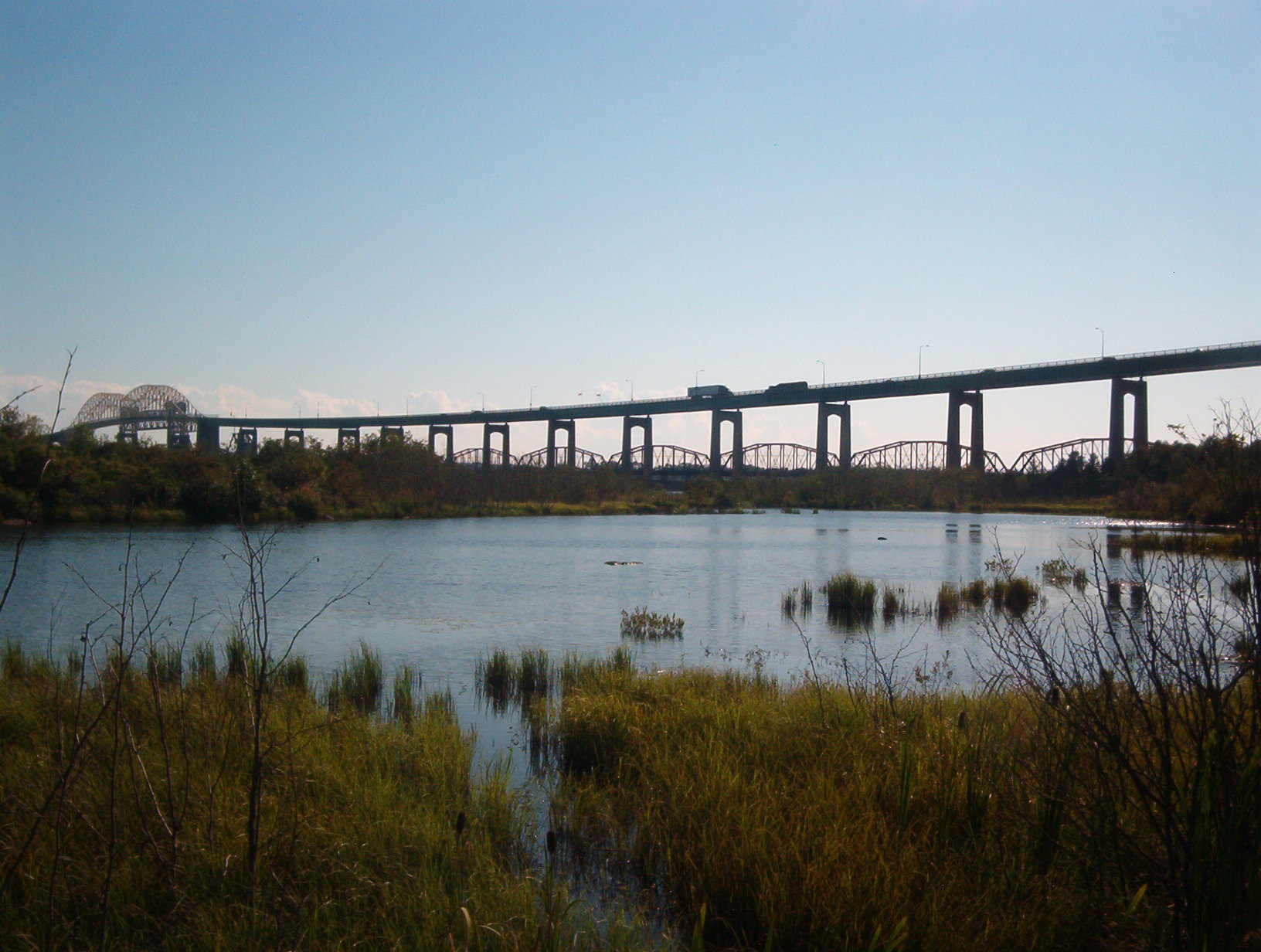
Sault Ste. Marie International Bridge
For over a century, the only way to cross between Sault Ste. Marie, Michigan, and Sault Ste. Marie, Ontario, was by ferry. The two cities shared a name, a river, and a history stretching back to the fur trade, but they sat on opposite sides of an international border with no fixed road link between them. That changed on October 31, 1962, when the Sault Ste. Marie International Bridge opened to traffic, stitching together two countries across the St. Marys River with steel arches that soar above the famous locks below. By March 1, 2018, the bridge had carried its 100 millionth crossing -- a staggering number for a structure that serves a combined population of roughly 100,000 people in its two anchor cities.
Twin Cities, Divided River
The twin Saults occupy one of the most strategically important pinch points on the continent. The St. Marys River connects Lake Superior to Lake Huron, and its rapids made the spot a gathering place for Indigenous peoples, then fur traders, then military garrisons long before anyone thought about building a bridge. The U.S. Port of Entry was established in 1843, and regular ferry service began in 1865. For nearly a century, ferries shuttled passengers and cargo between the two shores while border inspection services operated from terminals on each bank. A railroad bridge -- the Sault Ste. Marie International Railroad Bridge -- was built in 1887, giving trains a fixed crossing. But automobiles, trucks, and pedestrians remained dependent on the ferries until the International Bridge finally replaced them in 1962.
Arches Over the Locks
The bridge's design is dictated by what lies beneath it. The St. Marys River at this point is not just a waterway but an industrial corridor, and the bridge had to clear the lock systems on both banks without interfering with ship traffic. The solution is a steel truss arch bridge with a suspended deck, split into two distinct main spans: a double-arch span on the American side that clears the four U.S. Soo Locks, and a single-arch span on the Canadian side that crosses the Canadian Lock. A long causeway joins the two spans across the river's midpoint. On the Michigan end, the bridge connects to Interstate 75, making it the northernmost terminus of that highway's run from Miami, Florida. On the Ontario end, it lands on Huron Street in the downtown core. The bridge also marks the northern endpoint of U.S. Bicycle Route 35, making it one of the few international bridges in North America that welcomes cyclists.
Steel, Bethlehem, and Cold War Urgency
The push to build the bridge gained momentum in the 1950s, when both nations recognized the strategic and economic value of a permanent crossing. In 1954, Michigan created the International Bridge Authority; Canada followed in 1955 with the St. Mary's River Co. Construction began in 1960, with contracts awarded to Massman Construction Company of Kansas City, Missouri, and Bethlehem Steel of Bethlehem, Pennsylvania -- the same steelmaker that had supplied armor plate for two world wars. The bridge opened on October 31, 1962, ending ferry service for good. By 1975, the bridge recorded its 10 millionth crossing. The structure is now the tenth-busiest passenger crossing on the entire Canada-United States border, and it and its companion rail bridge are the only fixed crossings for several hundred miles in either direction, bounded by the Pigeon River Bridge beyond the far end of Lake Superior to the west and the Blue Water Bridge beyond the far end of Lake Huron to the south.
A Bridge Run by Two Countries
Governance of the International Bridge reflects its binational character. The Sault Ste. Marie Bridge Authority oversees daily operations through the International Bridge Administration, with four directors appointed by the Governor of Michigan and four appointed by the Canadian government through the Federal Bridge Corporation. This arrangement has evolved over the decades -- the original International Bridge Authority, created in 1935, was replaced by the Joint International Bridge Authority in 2000, which was in turn succeeded by the current structure in 2009. The toll plaza on the Michigan side was completely rebuilt between 2014 and 2015 to better handle truck traffic and modern security requirements. On the Ontario side, the bridge sits near Station Mall, making it an unusually urban crossing where international transit deposits travelers directly into a downtown shopping district.
The Lonely Crossing
What makes the Sault Ste. Marie International Bridge remarkable is not its engineering superlatives but its isolation. Stand on the bridge's deck and look in either direction along the border, and the next fixed crossing is hundreds of miles away. To the west, Lake Superior stretches for nearly 400 miles before the Pigeon River Bridge appears at the Minnesota-Ontario border. To the south and east, Lake Huron runs the full length of Michigan's mitten before the Blue Water Bridge connects Port Huron to Sarnia. Between those distant bookends, this single bridge and its railroad companion handle everything: commuters, tourists, long-haul truckers, and the occasional cyclist pedaling the length of U.S. Bicycle Route 35. From the air, the bridge appears as a thin line scratched across the blue-green ribbon of the St. Marys River, its arches framing the lock chambers like parentheses around the continent's most critical inland shipping corridor.
From the Air
The Sault Ste. Marie International Bridge is located at 46.507N, 84.361W, spanning the St. Marys River between Sault Ste. Marie, Michigan, and Sault Ste. Marie, Ontario. The bridge's double-arch and single-arch spans are clearly visible from the air, crossing directly over the Soo Locks (U.S.) and the Canadian Lock. Recommended viewing altitude: 2,000-4,000 feet AGL to see the bridge in context with the locks and both cities. The companion railroad bridge is visible just upstream. Nearest airports: Sault Ste. Marie Airport (CYAM) 8nm west on the Ontario side, Sanderson Field (KANJ) 3nm south on the Michigan side, Chippewa County International (KCIU) 12nm south.