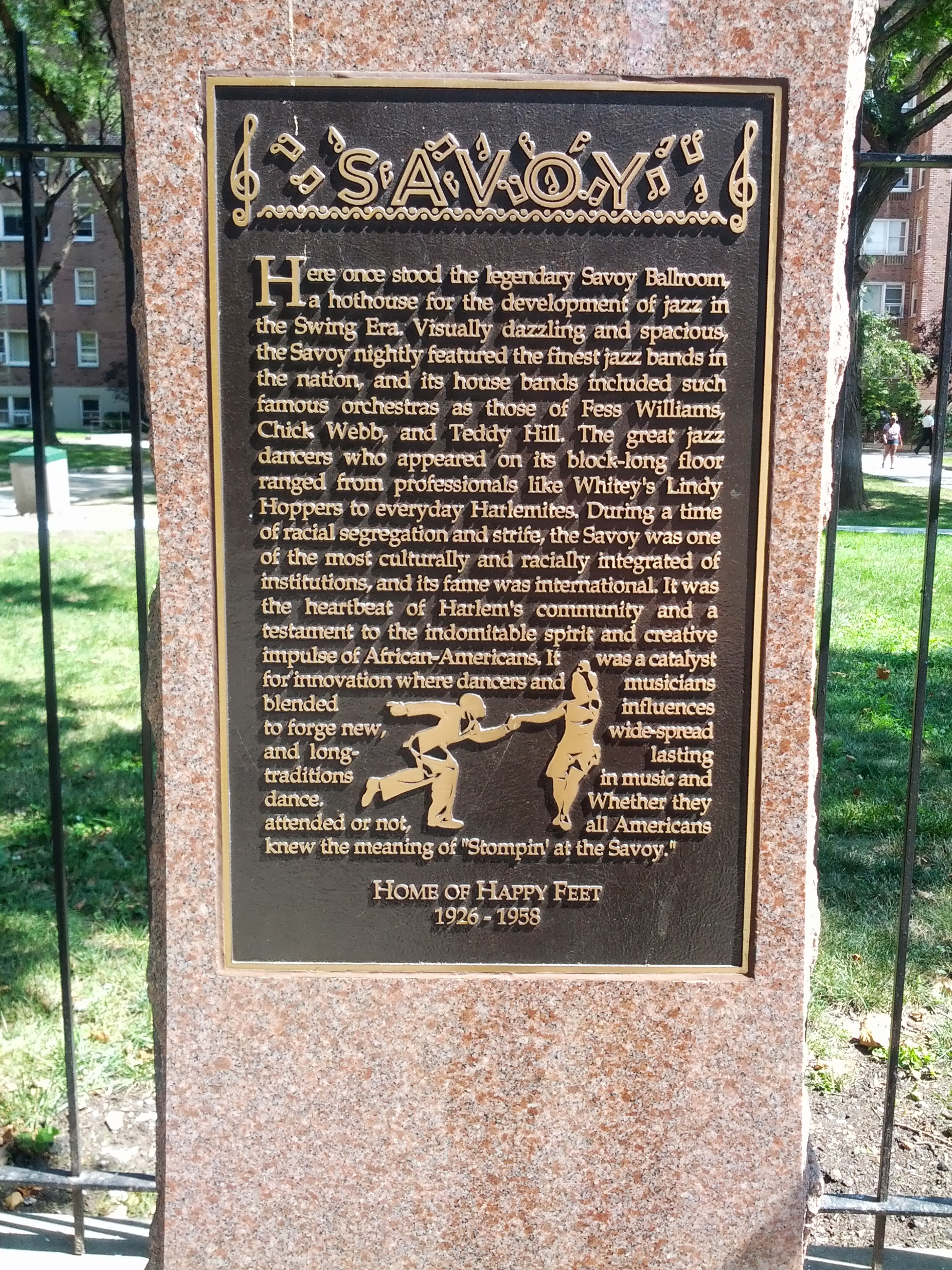
Savoy Ballroom
"One night somebody came over and said, 'Hey man, Clark Gable just walked in the house.' Somebody else said, 'Oh, yeah, can he dance?'" Frankie Manning's memory captures the Savoy Ballroom in a sentence. At 596 Lenox Avenue, between 140th and 141st Streets, the only question that mattered was whether you could move. From its opening night on March 12, 1926, when two thousand people were turned away at the door, until its final season in 1958, the Savoy was Harlem's living room, its proving ground, and its gift to American culture. The dances invented on its block-long sprung wooden floor, especially the Lindy Hop, reshaped how the world moves to music.
A Palace on Lenox Avenue
The Savoy was the brainchild of white entrepreneur Jay Faggen and businessman Moe Gale, who modeled it on Faggen's downtown venue, the Roseland Ballroom. But the Savoy was not a copy. It was an answer. Roseland catered primarily to white audiences; the Savoy was built for Harlem's Black community, and its scale reflected ambition. The second-floor ballroom measured ten thousand square feet, occupied an entire city block, and could hold four thousand people. The interior was painted pink with mirrored walls. Colored lights played across a sprung layered wood floor engineered for dancing. A spacious lobby featured a cut-glass chandelier and marble staircase. Charles Buchanan, a Black civic leader born in the British West Indies, managed the operation with a vision of providing a luxury venue where people could dance in what he called "an atmosphere of tasteful refinement" rather than in the cramped, smoke-laden cellar clubs that were the alternative. Dancer Leon James, quoted in Jazz Dance, recalled his first visit: "My first impression was that I had stepped into another world."
Where Feet Wrote the Rules
The Lindy Hop was born at the Savoy in 1927, named for Charles Lindbergh's transatlantic flight, and the ballroom nurtured it from novelty into art form. Known downtown as the Home of Happy Feet and uptown as the Track, for the long, narrow floor that encouraged laps of exuberant motion, the Savoy generated a culture of competitive dancing that rewarded invention. Herbert White, a bouncer promoted to floor manager, scouted the best dancers and organized them into Whitey's Lindy Hoppers, a troupe that appeared in the Marx Brothers' 1937 film A Day at the Races. White looked for dancers who were "young, stylized, and, most of all, they had to have a beat, they had to swing." The Jitterbug, as the Lindy Hop was also known, emerged from what scholars describe as the mounting exhilaration and hot interaction of music and dance. It spread from the Savoy to ballrooms across the country and eventually around the world. The Savoy also presented "The Evolution of Negro Dance" at the 1939 New York World's Fair, carrying Harlem's creative energy to a global audience.
Battle of the Bands
Two bandstands faced each other across the dance floor, and the Savoy used them for what became the most anticipated events in American popular music: the Battle of the Bands. In 1937, the Benny Goodman Orchestra, riding a wave of mainstream popularity, challenged house bandleader Chick Webb. Webb and his band were declared the winners. The following year, Count Basie brought his orchestra to challenge Webb again. The verdict was less unanimous this time. Earle Warren, Basie's alto saxophonist, remembered preparing their weapon, the song "Swingin' the Blues," and said, "When we unloaded our cannons, that was the end." Webb's supporters disagreed. The argument never fully resolved, which was precisely the point. The battles drew enormous crowds and generated the kind of passionate debate that made the Savoy essential. Chick Webb recorded the 1934 jazz standard "Stompin' at the Savoy," named for the ballroom, which remains one of the most performed compositions in jazz history. Other house bandleaders included Erskine Hawkins, Lucky Millinder, Buddy Johnson, and Cootie Williams.
The Floor Where Color Did Not Matter
Unlike the Cotton Club, which admitted Black performers but excluded Black patrons, the Savoy maintained a no-discrimination policy from day one. The clientele was typically eighty-five percent Black and fifteen percent white, though some nights approached an even split. What made the Savoy radical was not the mixing itself but the terms on which it occurred. On the dance floor, skill was the only currency. Celebrity meant nothing unless you could dance. Frankie Manning's anecdote about Clark Gable illustrates the point with precision: fame got you noticed, but only your feet earned respect. This egalitarianism was not without consequences. The ballroom was shut down in April 1943 on "charges of vice filed by the police department and Army," widely understood as retaliation for the interracial mingling that made authorities uncomfortable. The closure lasted six months before the Savoy's license was renewed. At its peak, the ballroom drew nearly 700,000 visitors a year, generating an estimated $250,000 in annual profit, with entrance fees ranging from thirty cents in the afternoon to eighty-five cents after eight in the evening.
Demolished but Not Forgotten
The Savoy closed in July 1958 after thirty-two years of continuous operation. Despite protests from Borough President Hulan Jack, manager Charles Buchanan, and numerous civic organizations, the building was demolished in early 1959 to make way for the Delano Village housing complex. Its fixtures were auctioned off for a slum clearance project, a final indignity for a venue that Langston Hughes had placed at the heartbeat of Harlem. The ballroom that poet Hughes called the soul of a neighborhood was reduced to rubble. But the dances it created survived. On May 26, 2002, Frankie Manning and Norma Miller, both members of Whitey's Lindy Hoppers, unveiled a commemorative plaque on Lenox Avenue between 140th and 141st Streets. The Lindy Hop revival of the 1990s and 2000s brought new generations of dancers to a style born on the Savoy's sprung floor. Google honored the ballroom with an interactive Doodle game in 2021. The building is gone. What happened inside it still moves.
From the Air
Located at 40.8175N, 73.9380W on Lenox Avenue between 140th and 141st Streets in Harlem, Manhattan. The original building was demolished in 1959; the Delano Village housing complex now occupies the site. Best viewed from 2,000-3,000 feet AGL. The site is in the dense urban grid of central Harlem, along the Lenox Avenue corridor. The Harlem River is to the east, and the 145th Street Bridge is nearby. Nearby airports: KLGA (LaGuardia) 5nm east, KTEB (Teterboro) 8nm northwest.